QUESTION IMAGE
Question
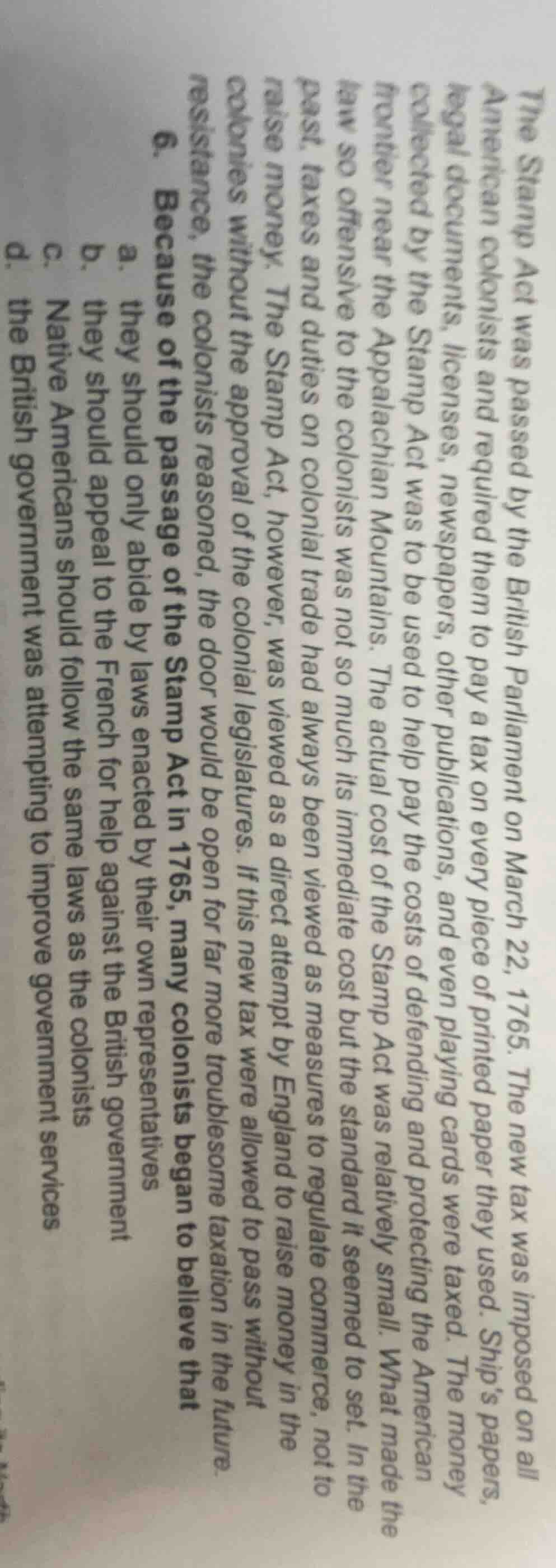
the stamp act was passed by the british parliament on march 22, 1765. the new tax was imposed on all american colonists and required them to pay a tax on every piece of printed paper they used. ships papers, legal documents, licenses, newspapers, other publications, and even playing cards were taxed. the money collected by the stamp act was to be used to help pay the costs of defending and protecting the american frontier near the appalachian mountains. the actual cost of the stamp act was relatively small. what made the law so offensive to the colonists was not so much its immediate cost but the standard it seemed to set. in the past, taxes and duties on colonial trade had always been viewed as measures to regulate commerce, not to raise money. the stamp act, however, was viewed as a direct attempt by england to raise money in the colonies without the approval of the colonial legislatures. if this new tax were allowed to pass without resistance, the colonists reasoned, the door would be open for far more troublesome taxation in the future.
- because of the passage of the stamp act in 1765, many colonists began to believe that
a. they should only abide by laws enacted by their own representatives
b. they should appeal to the french for help against the british government
c. native americans should follow the same laws as the colonists
d. the british government was attempting to improve government services
The text states colonists opposed the Stamp Act because it was a direct tax passed without colonial legislative approval, leading them to believe only their own representatives should enact laws for them. The other options are not supported by the passage: there is no mention of appealing to the French, Native American laws, or British government improvement efforts.

Snap & solve any problem in the app
Get step-by-step solutions on Sovi AI
Photo-based solutions with guided steps
Explore more problems and detailed explanations
a. they should only abide by laws enacted by their own representatives