QUESTION IMAGE
Question
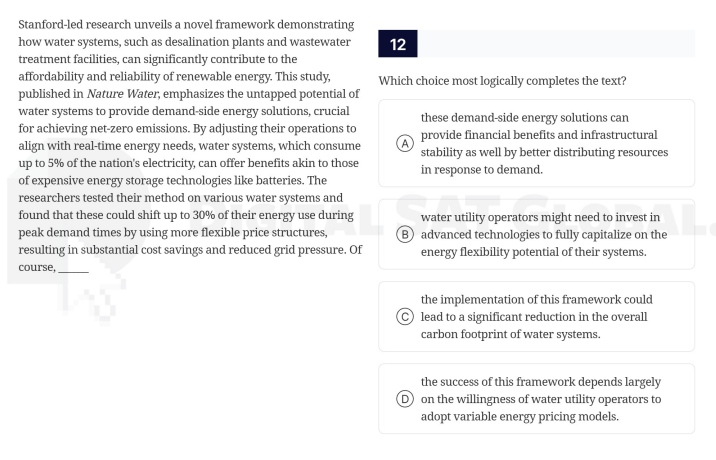
stanford - led research unveils a novel framework demonstrating how water systems, such as desalination plants and wastewater treatment facilities, can significantly contribute to the affordability and reliability of renewable energy. this study, published in nature water, emphasizes the untapped potential of water systems to provide demand - side energy solutions, crucial for achieving net - zero emissions. by adjusting their operations to align with real - time energy needs, water systems, which consume up to 5% of the nation’s electricity, can offer benefits akin to those of expensive energy storage technologies like batteries. the researchers tested their method on various water systems and found that these could shift up to 30% of their energy use during peak demand times by using more flexible price structures, resulting in substantial cost savings and reduced grid pressure. of course, ______
12 which choice most logically completes the text?
a these demand - side energy solutions can provide financial benefits and infrastructural stability as well by better distributing resources in response to demand.
b water utility operators might need to invest in advanced technologies to fully capitalize on the energy flexibility potential of their systems.
c the implementation of this framework could lead to a significant reduction in the overall carbon footprint of water systems.
d the success of this framework depends largely on the willingness of water utility operators to adopt variable energy pricing models.
To solve this, we analyze the context. The passage talks about a framework for water systems to provide demand - side energy solutions, testing the method, and resulting in cost savings and reduced grid pressure. We need to find a sentence that logically continues this.
- Option A: The passage already established that water systems can offer benefits like demand - side energy solutions. This option just re - emphasizes the benefits, but the previous part already covered the benefits and the testing. So, it's not a logical continuation.
- Option B: The passage focuses on the framework's success in providing solutions and the results of testing (cost savings, reduced grid pressure). There's no indication in the passage that utility operators need to invest in advanced technologies. The framework is about adjusting operations, not investing in new tech. So, this is not a logical continuation.
- Option C: The passage mentions that the framework is crucial for net - zero emissions (implied by "crucial for achieving net - zero emissions") and the testing led to cost savings and reduced grid pressure. A reduction in the carbon footprint of water systems is a logical next step as it ties to the net - zero emissions goal and the positive results of the framework. So, this option logically continues the text.
- Option D: The passage says that the researchers tested the method on various water systems and found that they could shift energy use by using more flexible price structures. The success of the framework is not dependent on the willingness of operators as the testing already showed positive results. So, this is not a logical continuation.

Snap & solve any problem in the app
Get step-by-step solutions on Sovi AI
Photo-based solutions with guided steps
Explore more problems and detailed explanations
C. the implementation of this framework could lead to a significant reduction in the overall carbon footprint of water systems.