QUESTION IMAGE
Question
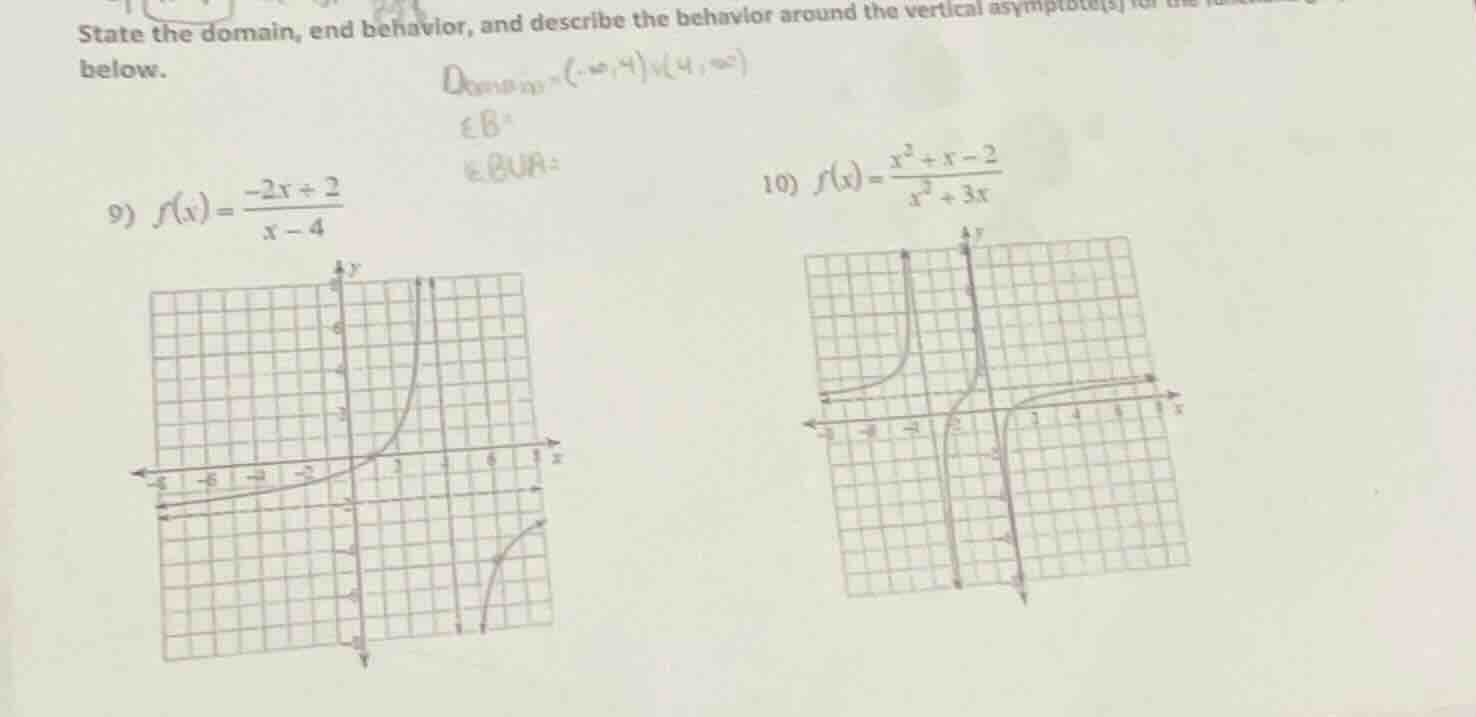
state the domain, end behavior, and describe the behavior around the vertical asymptote(s) for the below.
- $f(x)=\frac{-2x + 2}{x - 4}$
- $f(x)=\frac{x^2 + x - 2}{x^2 + 3x}$
Problem 9: \( f(x) = \frac{-2x + 2}{x - 4} \)
Domain:
The domain of a rational function is all real numbers except where the denominator is zero.
Set \( x - 4 = 0 \), so \( x = 4 \).
Thus, the domain is \( (-\infty, 4) \cup (4, \infty) \).
End Behavior:
To find the end behavior, we analyze the degrees of the numerator and denominator.
- Degree of numerator: \( 1 \) (from \( -2x \))
- Degree of denominator: \( 1 \) (from \( x \))
Since the degrees are equal, the end behavior is determined by the ratio of the leading coefficients.
Leading coefficient of numerator: \( -2 \)
Leading coefficient of denominator: \( 1 \)
Thus, as \( x \to \pm\infty \), \( f(x) \to \frac{-2}{1} = -2 \).
So, the horizontal asymptote is \( y = -2 \).
Behavior around Vertical Asymptote (\( x = 4 \)):
- As \( x \to 4^- \) (approaching 4 from the left), the denominator \( x - 4 \to 0^- \) (negative small number), and the numerator \( -2x + 2 \) at \( x = 4 \) is \( -8 + 2 = -6 \) (negative). So, \( f(x) = \frac{\text{negative}}{\text{negative small}} \to +\infty \).
- As \( x \to 4^+ \) (approaching 4 from the right), the denominator \( x - 4 \to 0^+ \) (positive small number), and the numerator is still negative. So, \( f(x) = \frac{\text{negative}}{\text{positive small}} \to -\infty \).
Problem 10: \( f(x) = \frac{x^2 + x - 2}{x^2 + 3x} \)
Domain:
Set the denominator \( x^2 + 3x = 0 \). Factor: \( x(x + 3) = 0 \). Thus, \( x = 0 \) or \( x = -3 \).
Domain: \( (-\infty, -3) \cup (-3, 0) \cup (0, \infty) \).
End Behavior:
Degrees of numerator and denominator are both \( 2 \) (leading terms \( x^2 \)).
Ratio of leading coefficients: \( \frac{1}{1} = 1 \).
Thus, as \( x \to \pm\infty \), \( f(x) \to 1 \). Horizontal asymptote: \( y = 1 \).
Behavior around Vertical Asymptotes (\( x = -3 \) and \( x = 0 \)):
- At \( x = -3 \):
- As \( x \to -3^- \), denominator \( x(x + 3) \to (-3^-)(-0^-) = -0^+ \) (negative small), numerator \( x^2 + x - 2 \) at \( x = -3 \) is \( 9 - 3 - 2 = 4 \) (positive). So, \( f(x) \to \frac{4}{-0^+} \to -\infty \).
- As \( x \to -3^+ \), denominator \( x(x + 3) \to (-3^+)(+0^+) = -0^- \) (negative small), numerator is positive. So, \( f(x) \to \frac{4}{-0^-} \to +\infty \).
- At \( x = 0 \):
- As \( x \to 0^- \), denominator \( x(x + 3) \to (-0^-)(3) = -0^- \) (negative small), numerator \( x^2 + x - 2 \) at \( x = 0 \) is \( -2 \) (negative). So, \( f(x) \to \frac{-2}{-0^-} \to -\infty \).
- As \( x \to 0^+ \), denominator \( x(x + 3) \to (+0^+)(3) = +0^+ \) (positive small), numerator is negative. So, \( f(x) \to \frac{-2}{+0^+} \to -\infty \).
Final Answers (Summarized):
Problem 9:
- Domain: \( \boldsymbol{(-\infty, 4) \cup (4, \infty)} \)
- End Behavior: As \( x \to \pm\infty \), \( f(x) \to -2 \) (horizontal asymptote \( y = -2 \))
- Vertical Asymptote (\( x = 4 \)): \( x \to 4^- \), \( f(x) \to +\infty \); \( x \to 4^+ \), \( f(x) \to -\infty \)
Problem 10:
- Domain: \( \boldsymbol{(-\infty, -3) \cup (-3, 0) \cup (0, \infty)} \)
- End Behavior: As \( x \to \pm\infty \), \( f(x) \to 1 \) (horizontal asymptote \( y = 1 \))
- Vertical Asymptotes (\( x = -3 \), \( x = 0 \)):
- At \( x = -3 \): \( x \to -3^- \), \( f(x) \to -\infty \); \( x \to -3^+ \), \( f(x) \to +\infty \)
- At \( x = 0 \): \( x \to 0^- \), \( f(x) \to -\infty \); \( x \to 0^+ \), \( f(x) \to -\infty \)

Snap & solve any problem in the app
Get step-by-step solutions on Sovi AI
Photo-based solutions with guided steps
Explore more problems and detailed explanations
Problem 9: \( f(x) = \frac{-2x + 2}{x - 4} \)
Domain:
The domain of a rational function is all real numbers except where the denominator is zero.
Set \( x - 4 = 0 \), so \( x = 4 \).
Thus, the domain is \( (-\infty, 4) \cup (4, \infty) \).
End Behavior:
To find the end behavior, we analyze the degrees of the numerator and denominator.
- Degree of numerator: \( 1 \) (from \( -2x \))
- Degree of denominator: \( 1 \) (from \( x \))
Since the degrees are equal, the end behavior is determined by the ratio of the leading coefficients.
Leading coefficient of numerator: \( -2 \)
Leading coefficient of denominator: \( 1 \)
Thus, as \( x \to \pm\infty \), \( f(x) \to \frac{-2}{1} = -2 \).
So, the horizontal asymptote is \( y = -2 \).
Behavior around Vertical Asymptote (\( x = 4 \)):
- As \( x \to 4^- \) (approaching 4 from the left), the denominator \( x - 4 \to 0^- \) (negative small number), and the numerator \( -2x + 2 \) at \( x = 4 \) is \( -8 + 2 = -6 \) (negative). So, \( f(x) = \frac{\text{negative}}{\text{negative small}} \to +\infty \).
- As \( x \to 4^+ \) (approaching 4 from the right), the denominator \( x - 4 \to 0^+ \) (positive small number), and the numerator is still negative. So, \( f(x) = \frac{\text{negative}}{\text{positive small}} \to -\infty \).
Problem 10: \( f(x) = \frac{x^2 + x - 2}{x^2 + 3x} \)
Domain:
Set the denominator \( x^2 + 3x = 0 \). Factor: \( x(x + 3) = 0 \). Thus, \( x = 0 \) or \( x = -3 \).
Domain: \( (-\infty, -3) \cup (-3, 0) \cup (0, \infty) \).
End Behavior:
Degrees of numerator and denominator are both \( 2 \) (leading terms \( x^2 \)).
Ratio of leading coefficients: \( \frac{1}{1} = 1 \).
Thus, as \( x \to \pm\infty \), \( f(x) \to 1 \). Horizontal asymptote: \( y = 1 \).
Behavior around Vertical Asymptotes (\( x = -3 \) and \( x = 0 \)):
- At \( x = -3 \):
- As \( x \to -3^- \), denominator \( x(x + 3) \to (-3^-)(-0^-) = -0^+ \) (negative small), numerator \( x^2 + x - 2 \) at \( x = -3 \) is \( 9 - 3 - 2 = 4 \) (positive). So, \( f(x) \to \frac{4}{-0^+} \to -\infty \).
- As \( x \to -3^+ \), denominator \( x(x + 3) \to (-3^+)(+0^+) = -0^- \) (negative small), numerator is positive. So, \( f(x) \to \frac{4}{-0^-} \to +\infty \).
- At \( x = 0 \):
- As \( x \to 0^- \), denominator \( x(x + 3) \to (-0^-)(3) = -0^- \) (negative small), numerator \( x^2 + x - 2 \) at \( x = 0 \) is \( -2 \) (negative). So, \( f(x) \to \frac{-2}{-0^-} \to -\infty \).
- As \( x \to 0^+ \), denominator \( x(x + 3) \to (+0^+)(3) = +0^+ \) (positive small), numerator is negative. So, \( f(x) \to \frac{-2}{+0^+} \to -\infty \).
Final Answers (Summarized):
Problem 9:
- Domain: \( \boldsymbol{(-\infty, 4) \cup (4, \infty)} \)
- End Behavior: As \( x \to \pm\infty \), \( f(x) \to -2 \) (horizontal asymptote \( y = -2 \))
- Vertical Asymptote (\( x = 4 \)): \( x \to 4^- \), \( f(x) \to +\infty \); \( x \to 4^+ \), \( f(x) \to -\infty \)
Problem 10:
- Domain: \( \boldsymbol{(-\infty, -3) \cup (-3, 0) \cup (0, \infty)} \)
- End Behavior: As \( x \to \pm\infty \), \( f(x) \to 1 \) (horizontal asymptote \( y = 1 \))
- Vertical Asymptotes (\( x = -3 \), \( x = 0 \)):
- At \( x = -3 \): \( x \to -3^- \), \( f(x) \to -\infty \); \( x \to -3^+ \), \( f(x) \to +\infty \)
- At \( x = 0 \): \( x \to 0^- \), \( f(x) \to -\infty \); \( x \to 0^+ \), \( f(x) \to -\infty \)