QUESTION IMAGE
Question
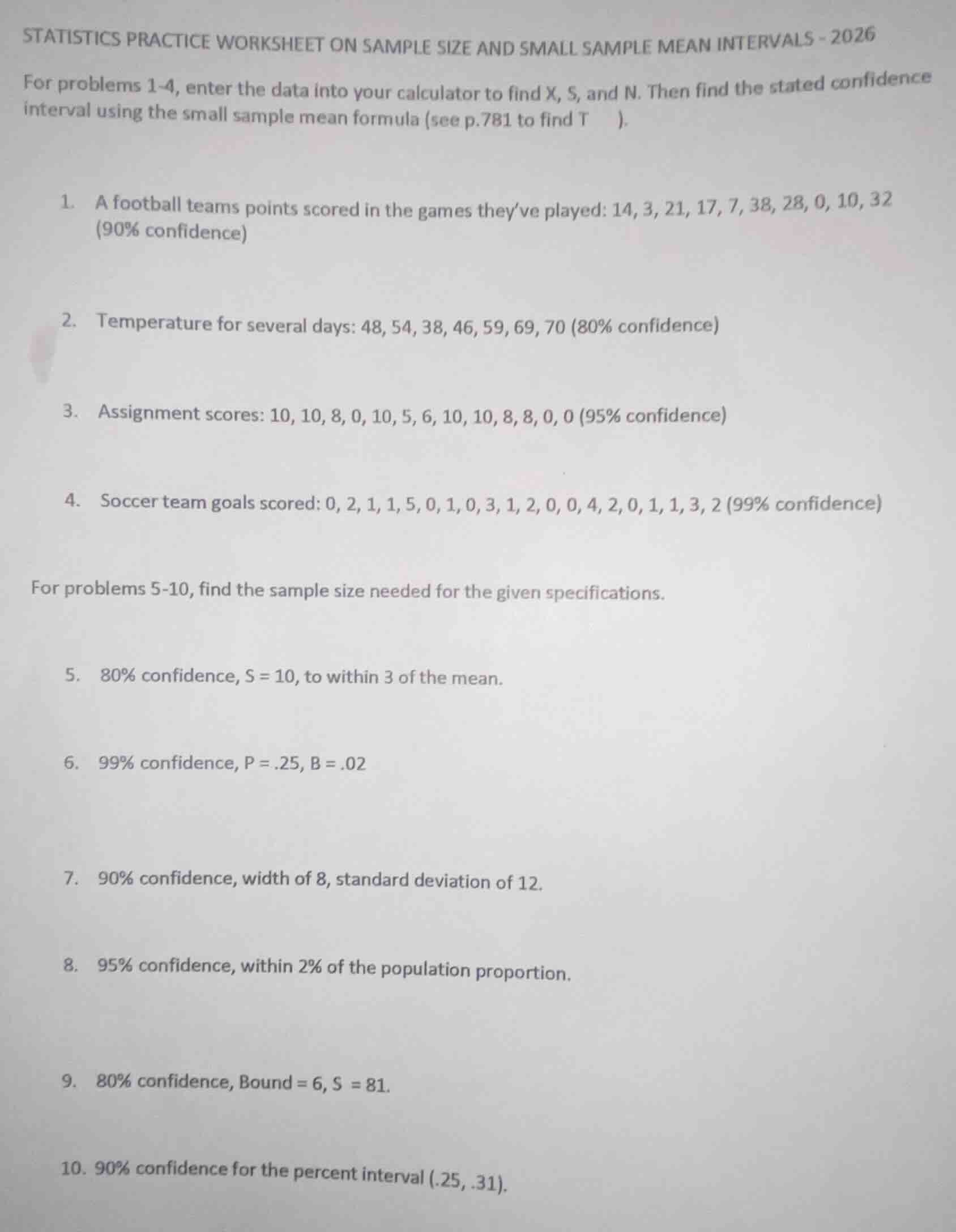
statistics practice worksheet on sample size and small sample mean intervals - 2026
for problems 1-4, enter the data into your calculator to find x, s, and n. then find the stated confidence interval using the small sample mean formula (see p.781 to find t ).
- a football teams points scored in the games theyve played: 14, 3, 21, 17, 7, 38, 28, 0, 10, 32 (90% confidence)
- temperature for several days: 48, 54, 38, 46, 59, 69, 70 (80% confidence)
- assignment scores: 10, 10, 8, 0, 10, 5, 6, 10, 10, 8, 8, 0, 0 (95% confidence)
- soccer team goals scored: 0, 2, 1, 1, 5, 0, 1, 0, 3, 1, 2, 0, 0, 4, 2, 0, 1, 1, 3, 2 (99% confidence)
for problems 5-10, find the sample size needed for the given specifications.
- 80% confidence, s = 10, to within 3 of the mean.
- 99% confidence, p =.25, b =.02
- 90% confidence, width of 8, standard deviation of 12.
- 95% confidence, within 2% of the population proportion.
- 80% confidence, bound = 6, s = 81.
- 90% confidence for the percent interval (.25,.31).
Let's solve problem 1 as an example (the process is similar for other problems involving confidence intervals for small samples):
Problem 1: Football team points scored (90% confidence)
Data: \( 14, 3, 21, 17, 7, 38, 28, 0, 10, 32 \)
Step 1: Calculate the sample mean (\( \bar{X} \))
The formula for the sample mean is \( \bar{X} = \frac{\sum_{i = 1}^{n} X_i}{n} \)
First, sum the data:
\( 14 + 3 + 21 + 17 + 7 + 38 + 28 + 0 + 10 + 32 = 170 \)
The sample size \( n = 10 \)
So, \( \bar{X} = \frac{170}{10} = 17 \)
Step 2: Calculate the sample standard deviation (\( S \))
The formula for the sample standard deviation is \( S = \sqrt{\frac{\sum_{i = 1}^{n}(X_i - \bar{X})^2}{n - 1}} \)
First, calculate \( (X_i - \bar{X})^2 \) for each data point:
- \( (14 - 17)^2 = 9 \)
- \( (3 - 17)^2 = 196 \)
- \( (21 - 17)^2 = 16 \)
- \( (17 - 17)^2 = 0 \)
- \( (7 - 17)^2 = 100 \)
- \( (38 - 17)^2 = 441 \)
- \( (28 - 17)^2 = 121 \)
- \( (0 - 17)^2 = 289 \)
- \( (10 - 17)^2 = 49 \)
- \( (32 - 17)^2 = 225 \)
Sum these squared deviations:
\( 9 + 196 + 16 + 0 + 100 + 441 + 121 + 289 + 49 + 225 = 1446 \)
Now, divide by \( n - 1 = 9 \):
\( \frac{1446}{9} \approx 160.67 \)
Take the square root:
\( S = \sqrt{160.67} \approx 12.68 \)
Step 3: Determine the degrees of freedom and the critical \( t \)-value
Degrees of freedom \( df = n - 1 = 10 - 1 = 9 \)
For a 90% confidence interval, the significance level \( \alpha = 1 - 0.90 = 0.10 \), so \( \alpha/2 = 0.05 \)
Looking up the \( t \)-value in the \( t \)-distribution table (or using a calculator) for \( df = 9 \) and \( \alpha/2 = 0.05 \), we get \( t_{\alpha/2} \approx 1.833 \)
Step 4: Calculate the margin of error (\( E \))
The formula for the margin of error for a small sample confidence interval for the mean is \( E = t_{\alpha/2} \times \frac{S}{\sqrt{n}} \)
Substitute the values:
\( E = 1.833 \times \frac{12.68}{\sqrt{10}} \)
\( \sqrt{10} \approx 3.162 \)
\( \frac{12.68}{3.162} \approx 4.01 \)
\( E \approx 1.833 \times 4.01 \approx 7.35 \)
Step 5: Calculate the confidence interval
The confidence interval is \( \bar{X} \pm E \)
\( 17 - 7.35 = 9.65 \)
\( 17 + 7.35 = 24.35 \)
Final Answer for Problem 1:
The 90% confidence interval for the mean number of points scored is approximately \( (9.65, 24.35) \)
(For other problems, follow the same steps: calculate \( \bar{X} \), \( S \), \( n \), find the appropriate \( t \)-value, calculate the margin of error, and then the confidence interval. For sample size problems (5 - 10), use the relevant sample size formulas for means or proportions depending on the problem.)

Snap & solve any problem in the app
Get step-by-step solutions on Sovi AI
Photo-based solutions with guided steps
Explore more problems and detailed explanations
Let's solve problem 1 as an example (the process is similar for other problems involving confidence intervals for small samples):
Problem 1: Football team points scored (90% confidence)
Data: \( 14, 3, 21, 17, 7, 38, 28, 0, 10, 32 \)
Step 1: Calculate the sample mean (\( \bar{X} \))
The formula for the sample mean is \( \bar{X} = \frac{\sum_{i = 1}^{n} X_i}{n} \)
First, sum the data:
\( 14 + 3 + 21 + 17 + 7 + 38 + 28 + 0 + 10 + 32 = 170 \)
The sample size \( n = 10 \)
So, \( \bar{X} = \frac{170}{10} = 17 \)
Step 2: Calculate the sample standard deviation (\( S \))
The formula for the sample standard deviation is \( S = \sqrt{\frac{\sum_{i = 1}^{n}(X_i - \bar{X})^2}{n - 1}} \)
First, calculate \( (X_i - \bar{X})^2 \) for each data point:
- \( (14 - 17)^2 = 9 \)
- \( (3 - 17)^2 = 196 \)
- \( (21 - 17)^2 = 16 \)
- \( (17 - 17)^2 = 0 \)
- \( (7 - 17)^2 = 100 \)
- \( (38 - 17)^2 = 441 \)
- \( (28 - 17)^2 = 121 \)
- \( (0 - 17)^2 = 289 \)
- \( (10 - 17)^2 = 49 \)
- \( (32 - 17)^2 = 225 \)
Sum these squared deviations:
\( 9 + 196 + 16 + 0 + 100 + 441 + 121 + 289 + 49 + 225 = 1446 \)
Now, divide by \( n - 1 = 9 \):
\( \frac{1446}{9} \approx 160.67 \)
Take the square root:
\( S = \sqrt{160.67} \approx 12.68 \)
Step 3: Determine the degrees of freedom and the critical \( t \)-value
Degrees of freedom \( df = n - 1 = 10 - 1 = 9 \)
For a 90% confidence interval, the significance level \( \alpha = 1 - 0.90 = 0.10 \), so \( \alpha/2 = 0.05 \)
Looking up the \( t \)-value in the \( t \)-distribution table (or using a calculator) for \( df = 9 \) and \( \alpha/2 = 0.05 \), we get \( t_{\alpha/2} \approx 1.833 \)
Step 4: Calculate the margin of error (\( E \))
The formula for the margin of error for a small sample confidence interval for the mean is \( E = t_{\alpha/2} \times \frac{S}{\sqrt{n}} \)
Substitute the values:
\( E = 1.833 \times \frac{12.68}{\sqrt{10}} \)
\( \sqrt{10} \approx 3.162 \)
\( \frac{12.68}{3.162} \approx 4.01 \)
\( E \approx 1.833 \times 4.01 \approx 7.35 \)
Step 5: Calculate the confidence interval
The confidence interval is \( \bar{X} \pm E \)
\( 17 - 7.35 = 9.65 \)
\( 17 + 7.35 = 24.35 \)
Final Answer for Problem 1:
The 90% confidence interval for the mean number of points scored is approximately \( (9.65, 24.35) \)
(For other problems, follow the same steps: calculate \( \bar{X} \), \( S \), \( n \), find the appropriate \( t \)-value, calculate the margin of error, and then the confidence interval. For sample size problems (5 - 10), use the relevant sample size formulas for means or proportions depending on the problem.)