QUESTION IMAGE
Question
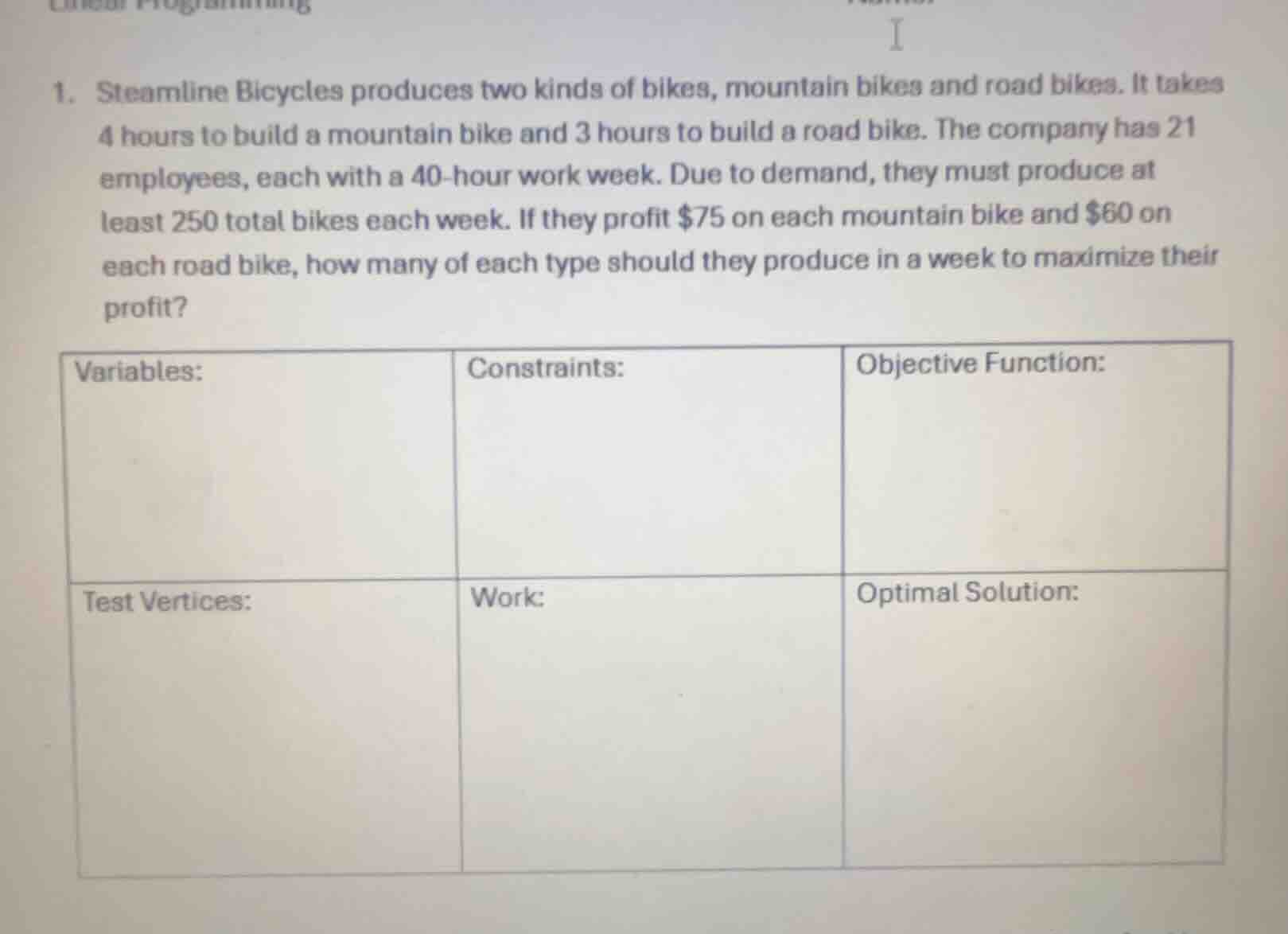
- steamline bicycles produces two kinds of bikes, mountain bikes and road bikes. it takes 4 hours to build a mountain bike and 3 hours to build a road bike. the company has 21 employees, each with a 40 - hour work week. due to demand, they must produce at least 250 total bikes each week. if they profit $75 on each mountain bike and $60 on each road bike, how many of each type should they produce in a week to maximize their profit?
| variables: | constraints: | objective function: |
|---|
Variables:
Let \( x \) be the number of mountain bikes, and \( y \) be the number of road bikes.
Constraints:
- Time Constraint: Each mountain bike takes 4 hours, each road bike takes 3 hours. Total work hours: \( 21 \times 40 = 840 \) hours. So, \( 4x + 3y \leq 840 \).
- Total Bikes Constraint: \( x + y \geq 250 \).
- Non - negativity: \( x \geq 0 \), \( y \geq 0 \) (since the number of bikes can't be negative).
Objective Function:
The profit from mountain bikes is \( \$75 \) per bike and from road bikes is \( \$60 \) per bike. To maximize profit \( P \), the objective function is \( P = 75x + 60y \).
Step 1: Find the feasible region boundaries
- From \( 4x + 3y = 840 \), when \( x = 0 \), \( y=\frac{840}{3}=280 \); when \( y = 0 \), \( x=\frac{840}{4}=210 \).
- From \( x + y=250 \), when \( x = 0 \), \( y = 250 \); when \( y = 0 \), \( x = 250 \).
Step 2: Find the intersection of \( 4x + 3y = 840 \) and \( x + y=250 \)
From \( x + y=250 \), we have \( y = 250 - x \). Substitute into \( 4x + 3y = 840 \):
\( 4x+3(250 - x)=840 \)
\( 4x + 750-3x=840 \)
\( x=840 - 750=90 \)
Then \( y=250 - 90 = 160 \).
Test Vertices:
The vertices of the feasible region are:
- Intersection of \( x + y = 250 \) and \( y = 0 \): \( (250,0) \)
- Intersection of \( 4x + 3y = 840 \) and \( x = 0 \): \( (0,280) \)
- Intersection of \( 4x + 3y = 840 \) and \( x + y=250 \): \( (90,160) \)
Step 3: Evaluate the objective function at each vertex
- At \( (250,0) \): \( P=75(250)+60(0)=18750 \)
- At \( (0,280) \): \( P=75(0)+60(280)=16800 \)
- At \( (90,160) \): \( P=75(90)+60(160)=6750 + 9600=16350 \)
Optimal Solution:
We compare the profit values: \( 18750>16800>16350 \).

Snap & solve any problem in the app
Get step-by-step solutions on Sovi AI
Photo-based solutions with guided steps
Explore more problems and detailed explanations
To maximize profit, the company should produce 250 mountain bikes and 0 road bikes. The maximum profit is \$18750.