QUESTION IMAGE
Question
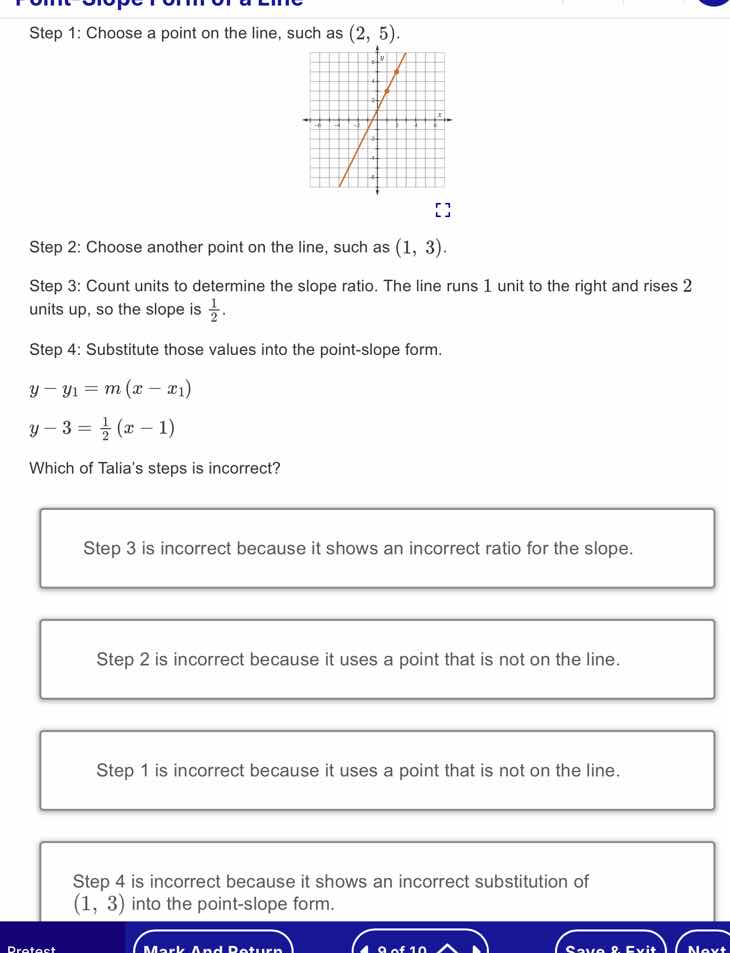
step 1: choose a point on the line, such as (2, 5).
step 2: choose another point on the line, such as (1, 3).
step 3: count units to determine the slope ratio. the line runs 1 unit to the right and rises 2 units up, so the slope is \\(\frac{1}{2}\\).
step 4: substitute those values into the point - slope form.
\\(y - y_1 = m(x - x_1)\\)
\\(y - 3 = \frac{1}{2}(x - 1)\\)
which of talia’s steps is incorrect?
step 3 is incorrect because it shows an incorrect ratio for the slope.
step 2 is incorrect because it uses a point that is not on the line.
step 1 is incorrect because it uses a point that is not on the line.
step 4 is incorrect because it shows an incorrect substitution of (1, 3) into the point - slope form.
- First, check the points \((2,5)\) and \((1,3)\). The slope formula is \(m=\frac{y_2 - y_1}{x_2 - x_1}\). Using \((2,5)\) as \((x_2,y_2)\) and \((1,3)\) as \((x_1,y_1)\), we get \(m=\frac{5 - 3}{2 - 1}=\frac{2}{1} = 2\), not \(\frac{1}{2}\). So Step 3 has an incorrect slope ratio.
- Check Step 2: The point \((1,3)\) - let's see the line. From \((2,5)\), if we go left 1 (x - 1) and down 2 (y - 2), we get \((1,3)\), so \((1,3)\) is on the line. So Step 2 is correct.
- Check Step 1: The point \((2,5)\) - looking at the graph (the line passes through it), so Step 1 is correct.
- Check Step 4: The point - slope form is \(y - y_1=m(x - x_1)\). Using \((1,3)\) as \((x_1,y_1)\) and \(m = \frac{1}{2}\) (even though slope is wrong, substitution is correct for the given \(m\)). But the error is in Step 3's slope calculation. Wait, no - wait, the slope between \((2,5)\) and \((1,3)\) is \(\frac{5 - 3}{2 - 1}=2\), so Step 3 says slope is \(\frac{1}{2}\), which is wrong. But also, let's check the options again. Wait, the option "Step 2 is incorrect..." - no, \((1,3)\) is on the line. Wait, maybe I made a mistake. Wait, the line in the graph: let's see the y - intercept. The line passes through (0,1) maybe? Wait, from (2,5), slope 2: \(y - 5 = 2(x - 2)\) → \(y=2x + 1\). So when x = 1, y = 3. So (1,3) is on the line. When x = 2, y = 5, so (2,5) is on the line. Then the slope between (2,5) and (1,3) is \(\frac{5 - 3}{2 - 1}=2\), so Step 3 says slope is \(\frac{1}{2}\), which is incorrect. But wait, the option "Step 2 is incorrect because it uses a point that is not on the line" - no, (1,3) is on the line. Wait, maybe the graph is different. Wait, the user's graph: the line has a positive slope, passes through (0,1) maybe? Let's recalculate. If the line passes through (2,5) and (0,1), then slope is \(\frac{5 - 1}{2 - 0}=\frac{4}{2}=2\). So from (2,5) to (1,3): x decreases by 1, y decreases by 2? Wait no, 5 - 3 = 2, 2 - 1 = 1. So it's a rise of - 2 (or fall of 2) for a run of - 1 (or left 1). So slope is \(\frac{2}{1}=2\) (since slope is rise over run, and both change in y and change in x: \(\Delta y=3 - 5=-2\), \(\Delta x=1 - 2=-1\), so \(\frac{-2}{-1}=2\)). So Step 3 says slope is \(\frac{1}{2}\), which is wrong. But the option "Step 2 is incorrect..." - no, (1,3) is on the line. Wait, maybe I misread the points. Wait, the first point is (2,5), second is (1,3). Let's plot them: (2,5) is 2 right, 5 up. (1,3) is 1 right, 3 up. The difference in x: 2 - 1 = 1 (run is 1, right), difference in y: 5 - 3 = 2 (rise is 2, up). So slope is rise over run = 2/1 = 2. So Step 3 says slope is 1/2, which is incorrect. But the option "Step 2 is incorrect..." - no, (1,3) is on the line. Wait, maybe the graph is such that (1,3) is not on the line? Wait, the problem says "such as (1,3)" - maybe the line in the graph doesn't pass through (1,3). Wait, the user's graph: the line has a y - intercept at (0,1) maybe? Let's check with (2,5): slope from (0,1) to (2,5) is (5 - 1)/(2 - 0)=4/2 = 2. So (1,3) is on the line (since 12 + 1 = 3). So (1,3) is on the line. So Step 2 is correct. Step 1: (2,5) is on the line (22 + 1 = 5), so correct. Step 4: substitution is correct for the given m. So the incorrect step is Step 3, but wait, the option "Step 2 is incorrect..." - no, maybe I made a mistake. Wait, the options:
Option 1: Step 3 is incorrect because it shows an incorrect ratio for the slope.
Option 2: Step 2 is incorrect because it uses a point that is not on the line.
Option 3: Step 1 is incorrect because it uses a point that is not on the line.
Option 4: Step 4 is i…

Snap & solve any problem in the app
Get step-by-step solutions on Sovi AI
Photo-based solutions with guided steps
Explore more problems and detailed explanations
Step 3 is incorrect because it shows an incorrect ratio for the slope.