QUESTION IMAGE
Question
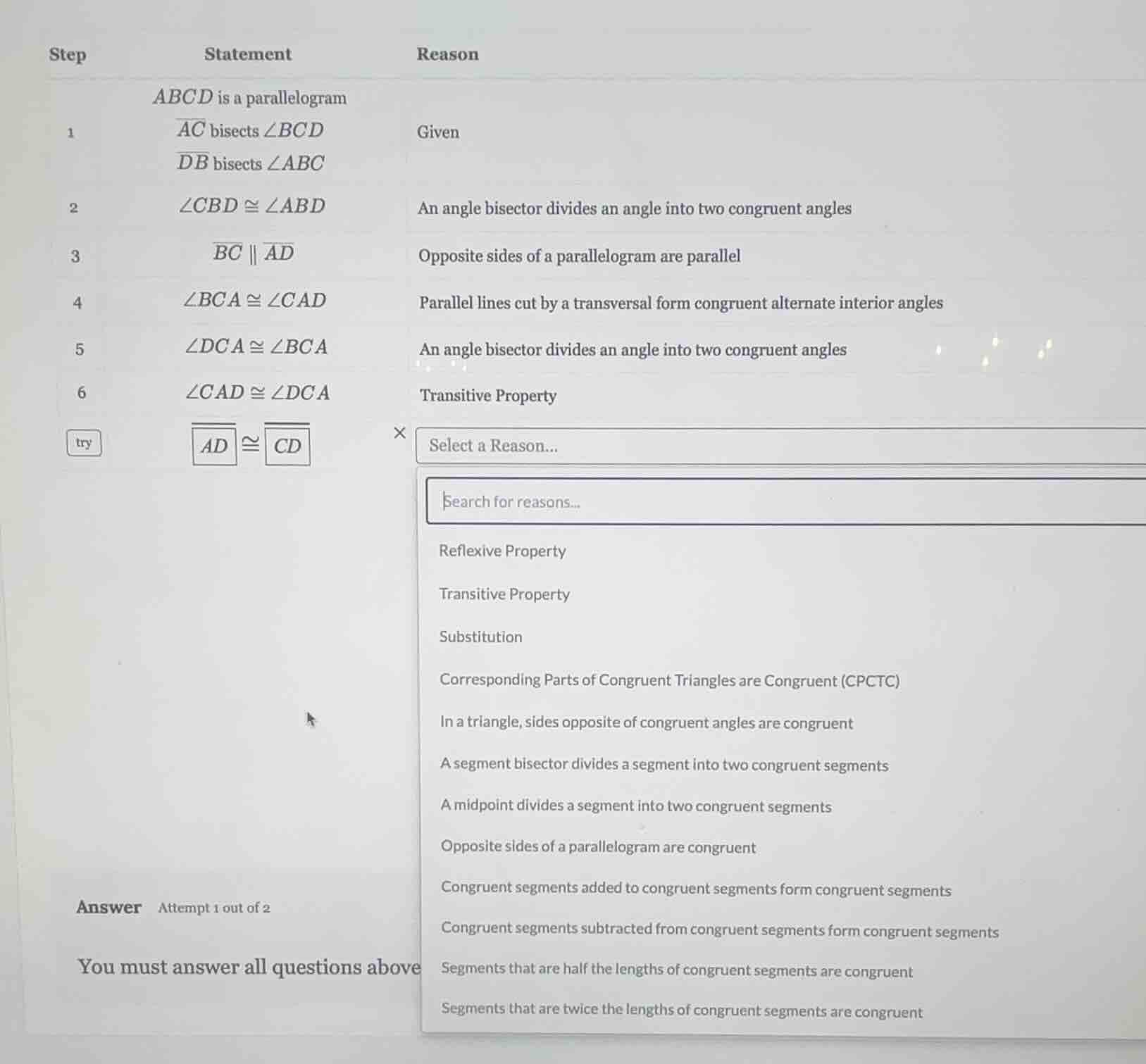
step statement reason 1 abcd is a parallelogram \\(\overline{ac}\\) bisects \\(\angle bcd\\) \\(\overline{db}\\) bisects \\(\angle abc\\) given 2 \\(\angle cbd \cong \angle abd\\) an angle bisector divides an angle into two congruent angles 3 \\(\overline{bc} \parallel \overline{ad}\\) opposite sides of a parallelogram are parallel 4 \\(\angle bca \cong \angle cad\\) parallel lines cut by a transversal form congruent alternate interior angles 5 \\(\angle dca \cong \angle bca\\) an angle bisector divides an angle into two congruent angles 6 \\(\angle cad \cong \angle dca\\) transitive property \\(\overline{ad} \cong \overline{cd}\\) select a reason... search for reasons... reflexive property transitive property substitution corresponding parts of congruent triangles are congruent (cpctc) in a triangle, sides opposite of congruent angles are congruent a segment bisector divides a segment into two congruent segments a midpoint divides a segment into two congruent segments opposite sides of a parallelogram are congruent congruent segments added to congruent segments form congruent segments congruent segments subtracted from congruent segments form congruent segments segments that are half the lengths of congruent segments are congruent segments that are twice the lengths of congruent segments are congruent answer attempt 1 out of 2 you must answer all questions above
Step1: Identify relevant prior step
From step 6, we have $\angle CAD \cong \angle DCA$.
Step2: Match to triangle side rule
$\overline{AD}$ and $\overline{CD}$ are the sides opposite $\angle DCA$ and $\angle CAD$ respectively in $\triangle ADC$. The rule for this relationship is that sides opposite congruent angles in a triangle are congruent.

Snap & solve any problem in the app
Get step-by-step solutions on Sovi AI
Photo-based solutions with guided steps
Explore more problems and detailed explanations
In a triangle, sides opposite of congruent angles are congruent