QUESTION IMAGE
Question
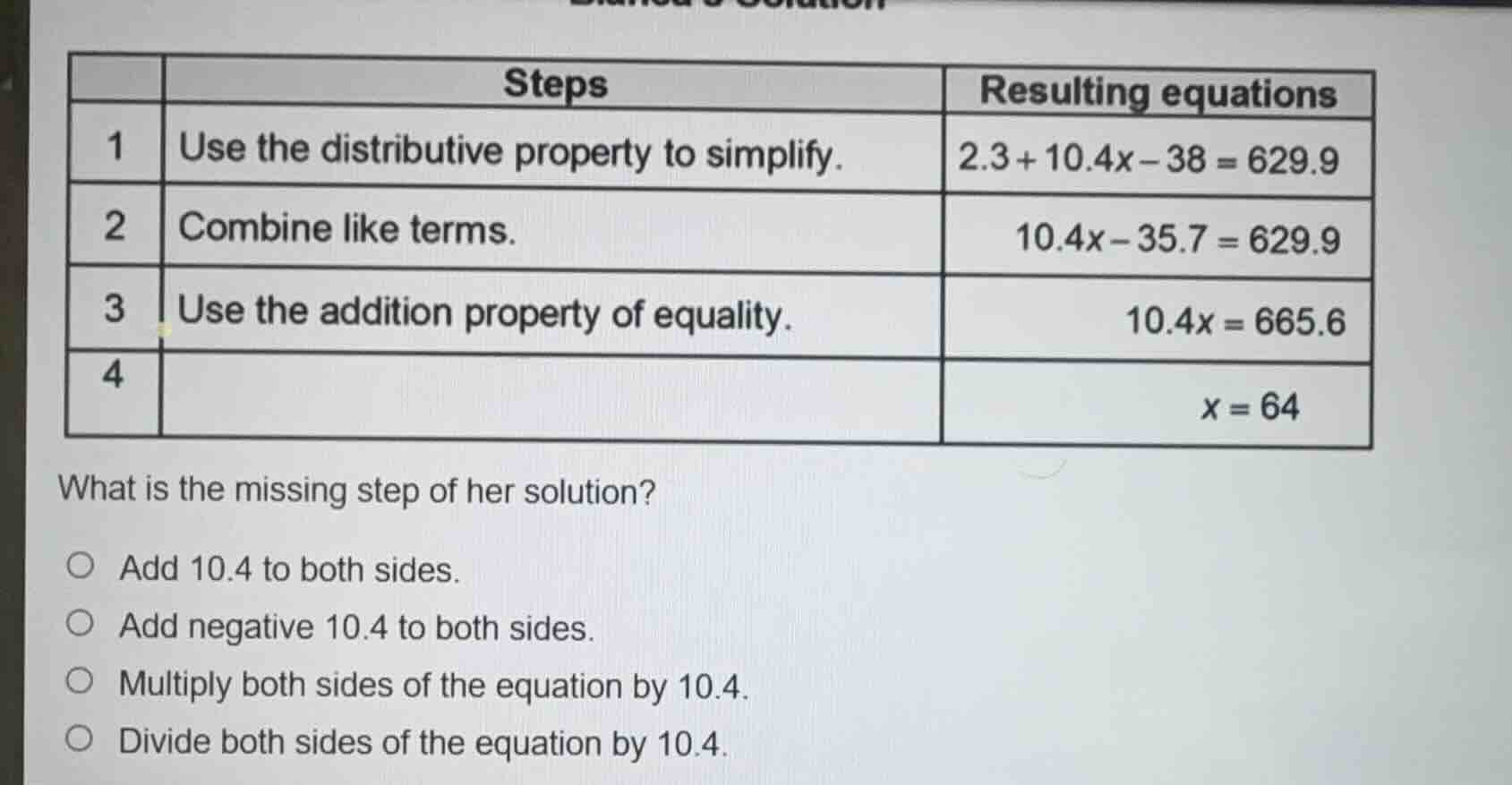
| steps | resulting equations | |
| 1 | use the distributive property to simplify. | $2.3 + 10.4x - 38 = 629.9$ |
| 2 | combine like terms. | $10.4x - 35.7 = 629.9$ |
| 3 | use the addition property of equality. | $10.4x = 665.6$ |
| 4 | $x = 64$ |
what is the missing step of her solution?
\\(\circ\\) add 10.4 to both sides.
\\(\circ\\) add negative 10.4 to both sides.
\\(\circ\\) multiply both sides of the equation by 10.4.
\\(\circ\\) divide both sides of the equation by 10.4.
Brief Explanations
To solve for \( x \) in the equation \( 10.4x = 665.6 \), we need to isolate \( x \). Since \( x \) is multiplied by \( 10.4 \), we use the division property of equality, which means we divide both sides of the equation by \( 10.4 \). Let's check:
- If we divide both sides of \( 10.4x = 665.6 \) by \( 10.4 \), we get \( \frac{10.4x}{10.4}=\frac{665.6}{10.4} \), which simplifies to \( x = 64 \), matching the final result.
- Adding or subtracting \( 10.4 \) (or -10.4) would not isolate \( x \) when it's multiplied by \( 10.4 \). Multiplying by \( 10.4 \) would make \( x \) have a larger coefficient, not isolate it. So the missing step is to divide both sides by \( 10.4 \).

Snap & solve any problem in the app
Get step-by-step solutions on Sovi AI
Photo-based solutions with guided steps
Explore more problems and detailed explanations
D. Divide both sides of the equation by 10.4.