QUESTION IMAGE
Question
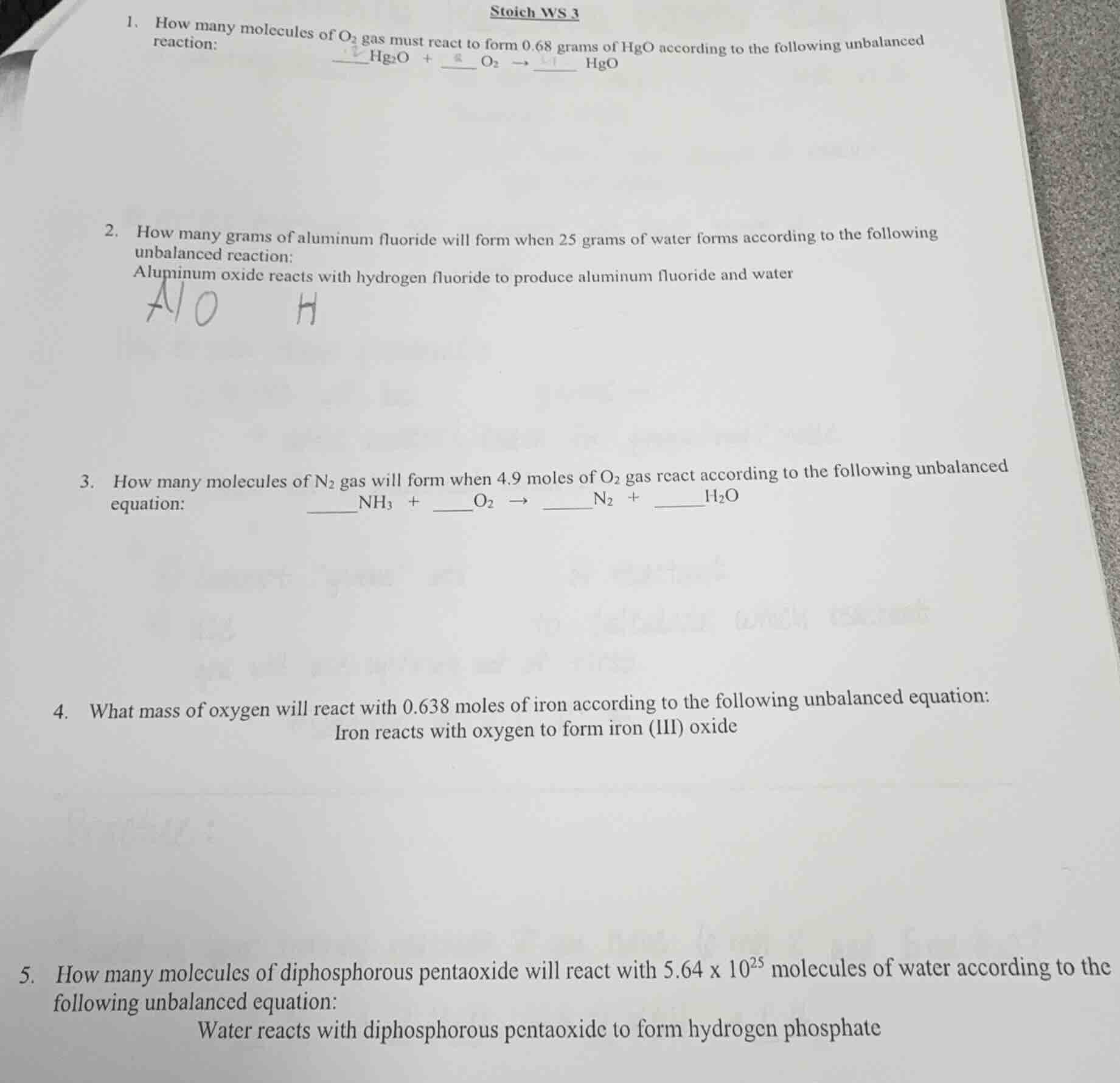
stoich ws 3
- how many molecules of o₂ gas must react to form 0.68 grams of hgo according to the following unbalanced reaction:
__hg₂o + o₂ → __ hgo
- how many grams of aluminum fluoride will form when 25 grams of water forms according to the following unbalanced reaction:
aluminum oxide reacts with hydrogen fluoride to produce aluminum fluoride and water
- how many molecules of n₂ gas will form when 4.9 moles of o₂ gas react according to the following unbalanced equation:
__nh₃ + o₂ → n₂ + __h₂o
- what mass of oxygen will react with 0.638 moles of iron according to the following unbalanced equation:
iron reacts with oxygen to form iron (iii) oxide
- how many molecules of diphosphorous pentaoxide will react with 5.64 x 10²⁵ molecules of water according to the following unbalanced equation:
water reacts with diphosphorous pentaoxide to form hydrogen phosphate
Problem 1
Step 1: Balance the chemical equation
The unbalanced equation is $\ce{Hg2O + O2 -> HgO}$. To balance it, we need to adjust the coefficients. For Hg: on the left, we have 2 Hg in $\ce{Hg2O}$, so on the right, we need 2 $\ce{HgO}$. For O: on the left, $\ce{Hg2O}$ has 1 O and $\ce{O2}$ has 2 O, total 3 O. On the right, 2 $\ce{HgO}$ has 2 O. Wait, no, let's do it properly. Let's start with Hg. The left has $\ce{Hg2O}$ (2 Hg), so right $\ce{HgO}$ needs a coefficient of 2. Now the equation is $\ce{Hg2O + O2 -> 2HgO}$. Now check O: left has 1 (from $\ce{Hg2O}$) + 2 (from $\ce{O2}$) = 3 O. Right has 2 O (from 2 $\ce{HgO}$). So we need to balance O. Let's adjust the coefficients. Let's put a coefficient of 1/2 in front of $\ce{O2}$, but we usually use whole numbers. Multiply the entire equation by 2: $2\ce{Hg2O + O2 -> 4HgO}$. Now check Hg: left 22 = 4, right 41 = 4. O: left 21 (from $2\ce{Hg2O}$) + 2 (from $\ce{O2}$) = 4, right 41 (from $4\ce{HgO}$) = 4. So balanced equation is $2\ce{Hg2O + O2 -> 4HgO}$.
Step 2: Calculate moles of $\ce{HgO}$
Molar mass of $\ce{HgO}$: Hg is 200.59 g/mol, O is 16.00 g/mol, so molar mass = 200.59 + 16.00 = 216.59 g/mol. Given mass of $\ce{HgO}$ is 0.68 g. Moles of $\ce{HgO}$ = mass / molar mass = $0.68\ \text{g} / 216.59\ \text{g/mol} \approx 0.00314\ \text{mol}$.
Step 3: Use stoichiometry to find moles of $\ce{O2}$
From the balanced equation, 4 moles of $\ce{HgO}$ are produced from 1 mole of $\ce{O2}$. So the mole ratio of $\ce{O2}$ to $\ce{HgO}$ is 1:4. Moles of $\ce{O2}$ = (moles of $\ce{HgO}$) * (1/4) = $0.00314\ \text{mol} * (1/4) \approx 0.000785\ \text{mol}$.
Step 4: Calculate number of molecules of $\ce{O2}$
Using Avogadro's number, $N = n * N_A$, where $N_A = 6.022 \times 10^{23}\ \text{molecules/mol}$. So number of $\ce{O2}$ molecules = $0.000785\ \text{mol} * 6.022 \times 10^{23}\ \text{molecules/mol} \approx 4.73 \times 10^{20}\ \text{molecules}$.
Step 1: Write the balanced chemical equation
The reaction is: Aluminum oxide ($\ce{Al2O3}$) reacts with hydrogen fluoride ($\ce{HF}$) to produce aluminum fluoride ($\ce{AlF3}$) and water ($\ce{H2O}$). The unbalanced equation is $\ce{Al2O3 + HF -> AlF3 + H2O}$.
Balance Al: Left has 2 Al in $\ce{Al2O3}$, so right $\ce{AlF3}$ needs a coefficient of 2. Now equation: $\ce{Al2O3 + HF -> 2AlF3 + H2O}$.
Balance F: Right has 2*3 = 6 F, so left $\ce{HF}$ needs a coefficient of 6. Equation: $\ce{Al2O3 + 6HF -> 2AlF3 + H2O}$.
Balance O: Left has 3 O in $\ce{Al2O3}$, so right $\ce{H2O}$ needs a coefficient of 3. Equation: $\ce{Al2O3 + 6HF -> 2AlF3 + 3H2O}$.
Now check H: Left has 6 H in 6 $\ce{HF}$, right has 3*2 = 6 H in 3 $\ce{H2O}$. Balanced equation: $\ce{Al2O3 + 6HF -> 2AlF3 + 3H2O}$.
Step 2: Calculate moles of $\ce{H2O}$
Molar mass of $\ce{H2O}$: 2*1.008 + 16.00 = 18.016 g/mol. Given mass of $\ce{H2O}$ is 25 g. Moles of $\ce{H2O}$ = $25\ \text{g} / 18.016\ \text{g/mol} \approx 1.387\ \text{mol}$.
Step 3: Use stoichiometry to find moles of $\ce{AlF3}$
From the balanced equation, 3 moles of $\ce{H2O}$ are produced with 2 moles of $\ce{AlF3}$. So mole ratio of $\ce{AlF3}$ to $\ce{H2O}$ is 2/3. Moles of $\ce{AlF3}$ = (moles of $\ce{H2O}$) * (2/3) = $1.387\ \text{mol} * (2/3) \approx 0.9247\ \text{mol}$.
Step 4: Calculate mass of $\ce{AlF3}$
Molar mass of $\ce{AlF3}$: 26.98 + 319.00 = 26.98 + 57.00 = 83.98 g/mol. Mass of $\ce{AlF3}$ = moles molar mass = $0.9247\ \text{mol} * 83.98\ \text{g/mol} \approx 77.7\ \text{g}$.
Step 1: Balance the chemical equation
The unbalanced equation is $\ce{NH3 + O2 -> N2 + H2O}$.
Balance N: Left has 1 N in $\ce{NH3}$, so right $\ce{N2}$ needs a coefficient of 1/2, but we use whole numbers. Multiply $\ce{NH3}$ by 2: $2\ce{NH3 + O2 -> N2 + H2O}$. Now N is balanced (2 N on left and right).
Balance H: Left has 23 = 6 H in $2\ce{NH3}$, so right $\ce{H2O}$ needs a coefficient of 3 (32 = 6 H). Equation: $2\ce{NH3 + O2 -> N2 + 3H2O}$.
Balance O: Right has 3 O in $3\ce{H2O}$, so left $\ce{O2}$ needs a coefficient of 3/2 (3/2 2 = 3 O). Multiply the entire equation by 2 to eliminate fractions: $4\ce{NH3 + 3O2 -> 2N2 + 6H2O}$. Now check: N: 41 = 4, right 22 = 4. H: 43 = 12, right 62 = 12. O: 32 = 6, right 6*1 = 6. Balanced equation: $4\ce{NH3 + 3O2 -> 2N2 + 6H2O}$.
Step 2: Use stoichiometry to find moles of $\ce{N2}$
Given moles of $\ce{O2}$ = 4.9 mol. From the balanced equation, the mole ratio of $\ce{N2}$ to $\ce{O2}$ is 2/3. So moles of $\ce{N2}$ = (moles of $\ce{O2}$) * (2/3) = $4.9\ \text{mol} * (2/3) \approx 3.2667\ \text{mol}$.
Step 3: Calculate number of molecules of $\ce{N2}$
Using Avogadro's number, $N = n * N_A = 3.2667\ \text{mol} * 6.022 \times 10^{23}\ \text{molecules/mol} \approx 1.967 \times 10^{24}\ \text{molecules}$.

Snap & solve any problem in the app
Get step-by-step solutions on Sovi AI
Photo-based solutions with guided steps
Explore more problems and detailed explanations
Approximately $4.73 \times 10^{20}$ molecules of $\ce{O2}$