QUESTION IMAGE
Question
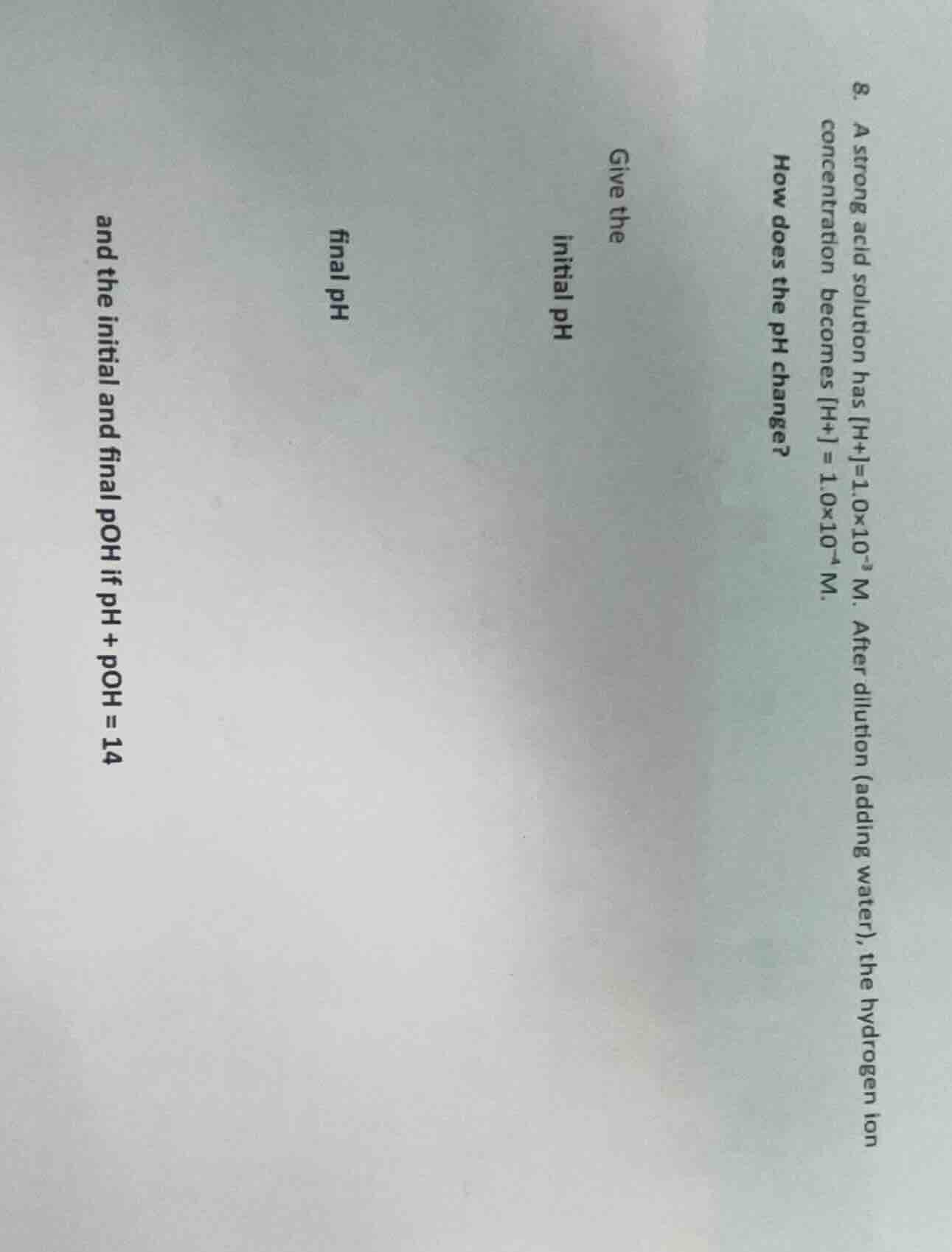
- a strong acid solution has h+=1.0×10⁻³ m. after dilution (adding water), the hydrogen ion concentration becomes h+ = 1.0×10⁻⁴ m.
how does the ph change?
give the
initial ph
final ph
and the initial and final poh if ph + poh = 14
Step1: Recall the pH formula
The formula for pH is \( \text{pH} = -\log_{10}[\text{H}^+] \), where \( [\text{H}^+] \) is the hydrogen ion concentration in moles per liter (M).
Step2: Calculate initial pH
Given the initial \( [\text{H}^+] = 1.0 \times 10^{-3} \, \text{M} \).
Using the pH formula:
\( \text{initial pH} = -\log_{10}(1.0 \times 10^{-3}) \)
Since \( \log_{10}(1.0 \times 10^{-3}) = -3 \) (because \( 10^{-3} = 1.0 \times 10^{-3} \) and \( \log_{10}(10^x) = x \)), then:
\( \text{initial pH} = -(-3) = 3 \)
Step3: Calculate final pH
Given the final \( [\text{H}^+] = 1.0 \times 10^{-4} \, \text{M} \).
Using the pH formula:
\( \text{final pH} = -\log_{10}(1.0 \times 10^{-4}) \)
Since \( \log_{10}(1.0 \times 10^{-4}) = -4 \), then:
\( \text{final pH} = -(-4) = 4 \)
Step4: Determine pH change
Compare the initial and final pH values. The initial pH is 3, and the final pH is 4. Since 4 > 3, the pH increases (becomes less acidic, more basic) when the acid solution is diluted (hydrogen ion concentration decreases).
Step5: Calculate initial pOH
We know that \( \text{pH} + \text{pOH} = 14 \). For the initial solution, with \( \text{initial pH} = 3 \):
\( \text{initial pOH} = 14 - \text{initial pH} = 14 - 3 = 11 \)
Step6: Calculate final pOH
For the final solution, with \( \text{final pH} = 4 \):
\( \text{final pOH} = 14 - \text{final pH} = 14 - 4 = 10 \)

Snap & solve any problem in the app
Get step-by-step solutions on Sovi AI
Photo-based solutions with guided steps
Explore more problems and detailed explanations
- How does the pH change? The pH increases (from 3 to 4).
- Initial pH: \( 3 \)
- Final pH: \( 4 \)
- Initial pOH: \( 11 \)
- Final pOH: \( 10 \)