QUESTION IMAGE
Question
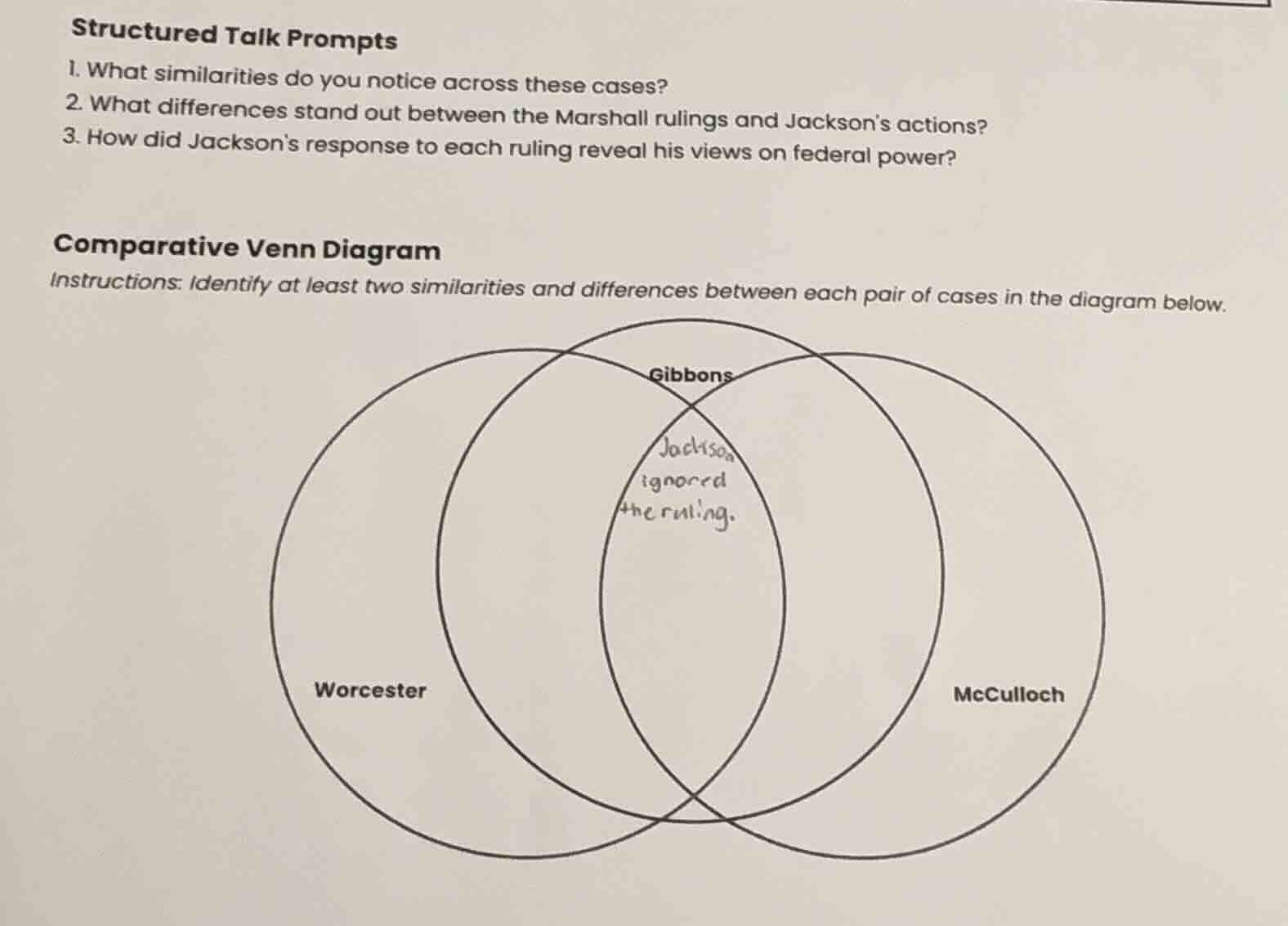
structured talk prompts
- what similarities do you notice across these cases?
- what differences stand out between the marshall rulings and jackson’s actions?
- how did jackson’s response to each ruling reveal his views on federal power?
comparative venn diagram
instructions: identify at least two similarities and differences between each pair of cases in the diagram below.
worcester gibbons mcculloch
(handwritten text in the middle overlap: jackson ignored the ruling.)
1. What similarities do you notice across these cases?
All three cases (Worcester, Gibbons, McCulloch) were Supreme Court rulings during John Marshall's tenure as Chief Justice, and they all dealt with issues related to federal power and the balance between federal and state authorities. They also aimed to clarify the scope of federal authority under the U.S. Constitution.
Marshall's rulings (in Worcester, Gibbons, McCulloch cases) generally expanded federal power, upholding the supremacy of federal law over state law. Jackson, however, sometimes acted contrary to these rulings (e.g., ignoring the Worcester ruling), showing a more states' rights - leaning or independent approach, especially when he felt the rulings went against his or states' interests.
- Worcester v. Georgia: Jackson ignored the ruling that protected Cherokee rights, showing he prioritized state (Georgia) interests over federal judicial authority, indicating a view that states could have significant power over federal rulings in some cases.
- Gibbons v. Ogden: If we assume Jackson's actions (or lack of strong opposition) here, but more clearly in other cases, his resistance in Worcester and potential deference in some economic - federal power cases (though less clear from the diagram) suggest he viewed federal power as limited in areas he deemed state - centered (like state - Native American relations) and more acceptable in others (like interstate commerce if it aligned with his vision). Overall, his responses showed a pragmatic view, supporting federal power when it suited his agenda and resisting when it didn't, with a leaning towards states' rights in some spheres.
- McCulloch v. Maryland: While Jackson generally had a complex view, his actions in other cases (and the fact that McCulloch upheld federal power to create a national bank) - if we consider his later opposition to the bank, it shows he was willing to challenge federal power when he believed it overstepped, revealing a view that federal power should be balanced with state and executive (his) discretion.

Snap & solve any problem in the app
Get step-by-step solutions on Sovi AI
Photo-based solutions with guided steps
Explore more problems and detailed explanations
- All were Supreme Court rulings under John Marshall.
- All related to federal - state power balance.
- All aimed to clarify federal authority scope.