QUESTION IMAGE
Question
student exploration: chemical changes
vocabulary: acid, base, catalyst, chemical change, coefficient, conservation of matter, decomposition, dissolve, double replacement, endothermic, exothermic, indicator, ion, physical change, product, reactant, single replacement, subscript, synthesis
prior knowledge questions (do these before using the gizmo.)
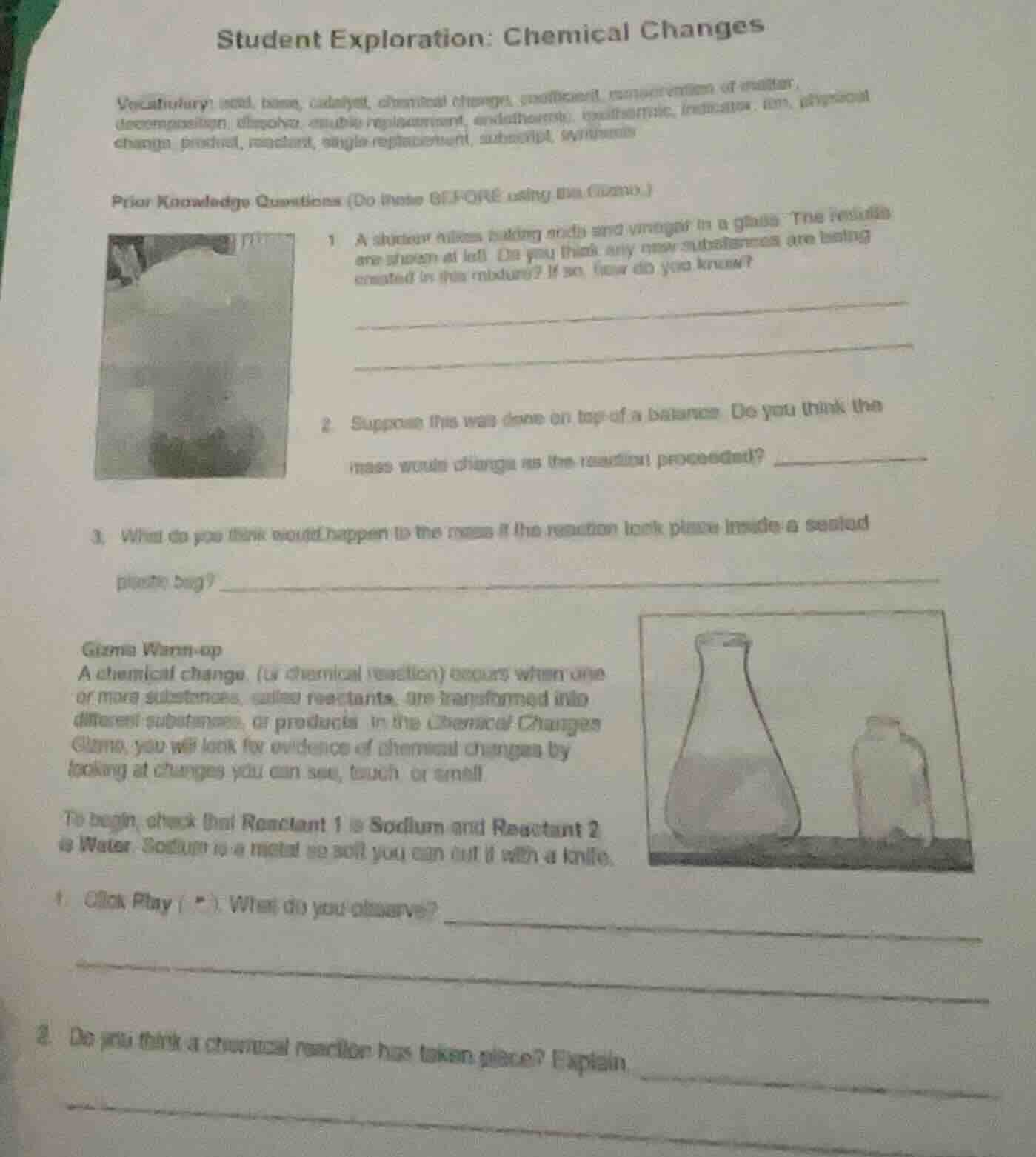
1 a student mixes baking soda and vinegar in a glass. the results are shown at left. do you think any new substances are being created in this mixture? if so, how do you know?
_____________________________________
_____________________________________
2 suppose this was done on top of a balance. do you think the mass would change as the reaction proceeded? ____________
3 what do you think would happen to the mass if the reaction took place inside a sealed plastic bag? _____________________________________
gizmo warm - up
a chemical change (or chemical reaction) occurs when one or more substances, called reactants, are transformed into different substances, or products. in the chemical changes gizmo, you will look for evidence of chemical changes by looking at changes you can see, touch, or smell.
to begin, check that reactant 1 is sodium and reactant 2 is water. sodium is a metal so soft you can cut it with a knife.
1 click play (▶). what do you observe? _____________________________________
_____________________________________
2 do you think a chemical reaction has taken place? explain _____________________________________
Since the problem is about "Student Exploration: Chemical Changes" and involves questions about chemical reactions and observations, the subfield under Natural Science is Chemistry. Here are the answers to the questions:
Prior Knowledge Questions
- Brief Explanations: When baking soda and vinegar mix, a chemical reaction occurs (acid - base reaction between sodium bicarbonate and acetic acid). New substances (like carbon dioxide gas, water, and sodium acetate) are created. We know this because we can observe bubbles (gas production), which is a sign of a chemical change (formation of a new substance).

Snap & solve any problem in the app
Get step-by-step solutions on Sovi AI
Photo-based solutions with guided steps
Explore more problems and detailed explanations
**: Yes, new substances are being created. We know this because bubbles (gas) are produced, indicating a chemical reaction where reactants are transformed into new products.
- Brief Explanations: In an open system (like on a balance without a cover), if a gas is produced (as in the baking soda - vinegar reaction), the gas can escape. According to the law of conservation of mass, mass should be conserved in a chemical reaction, but if gas escapes, the mass measured by the balance will decrease as the reaction proceeds.