QUESTION IMAGE
Question
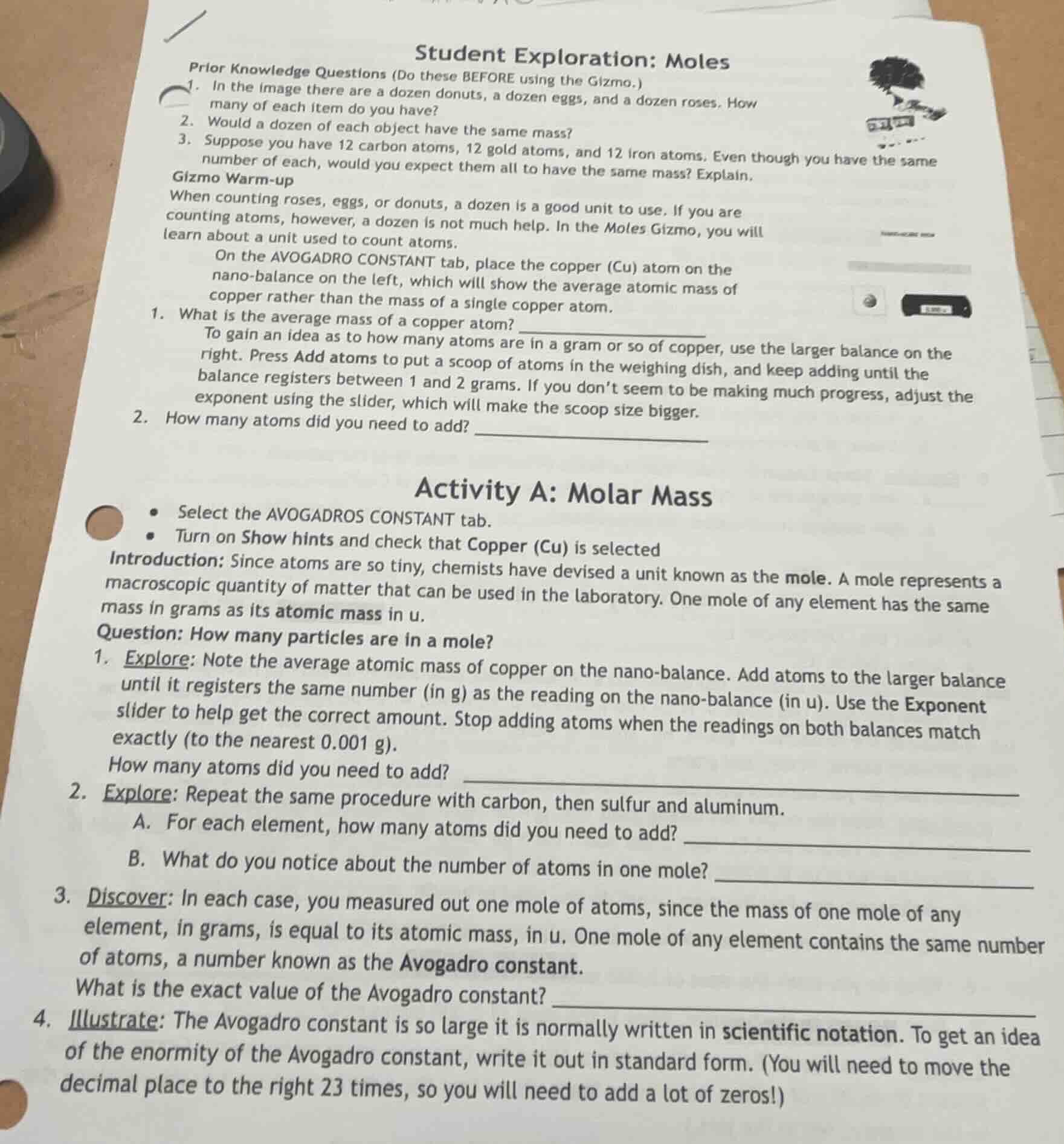
student exploration: moles
prior knowledge questions (do these before using the gizmo.)
- in the image there are a dozen donuts, a dozen eggs, and a dozen roses. how many of each item do you have?
- would a dozen of each object have the same mass?
- suppose you have 12 carbon atoms, 12 gold atoms, and 12 iron atoms. even though you have the same number of each, would you expect them all to have the same mass? explain.
gizmo warm - up
when counting roses, eggs, or donuts, a dozen is a good unit to use. if you are counting atoms, however, a dozen is not much help. in the moles gizmo, you will learn about a unit used to count atoms.
on the avogadro constant tab, place the copper (cu) atom on the nano - balance on the left, which will show the average atomic mass of copper rather than the mass of a single copper atom.
- what is the average mass of a copper atom?
to gain an idea as to how many atoms are in a gram or so of copper, use the larger balance on the right. press add atoms to put a scoop of atoms in the weighing dish, and keep adding until the balance registers between 1 and 2 grams. if you don’t seem to be making much progress, adjust the exponent using the slider, which will make the scoop size bigger.
- how many atoms did you need to add?
activity a: molar mass
- select the avogadros constant tab.
- turn on show hints and check that copper (cu) is selected
introduction: since atoms are so tiny, chemists have devised a unit known as the mole. a mole represents a macroscopic quantity of matter that can be used in the laboratory. one mole of any element has the same mass in grams as its atomic mass in u.
question: how many particles are in a mole?
- explore: note the average atomic mass of copper on the nano - balance. add atoms to the larger balance until it registers the same number (in g) as the reading on the nano - balance (in u). use the exponent slider to help get the correct amount. stop adding atoms when the readings on both balances match exactly (to the nearest 0.001 g).
how many atoms did you need to add?
- explore: repeat the same procedure with carbon, then sulfur and aluminum.
a. for each element, how many atoms did you need to add?
b. what do you notice about the number of atoms in one mole?
- discover: in each case, you measured out one mole of atoms, since the mass of one mole of any element, in grams, is equal to its atomic mass, in u. one mole of any element contains the same number of atoms, a number known as the avogadro constant.
what is the exact value of the avogadro constant?
- illustrate: the avogadro constant is so large it is normally written in scientific notation. to get an idea of the enormity of the avogadro constant, write it out in standard form. (you will need to move the decimal place to the right 23 times, so you will need to add a lot of zeros!)
Prior Knowledge Questions
- Answer: For a dozen donuts, a dozen eggs, and a dozen roses, you have 12 of each item. (Because a dozen is defined as 12 of something.)
- Answer: No, a dozen of each object would not have the same mass. Different objects (donuts, eggs, roses) have different individual masses, so 12 of each would have different total masses. For example, a donut likely has a different mass than an egg or a rose, so 12 donuts, 12 eggs, and 12 roses will have different masses.
- Answer: No, I would not expect 12 carbon atoms, 12 gold atoms, and 12 iron atoms to have the same mass. Atoms of different elements have different atomic masses (carbon, gold, and iron have different masses per atom). So even with the same number of atoms (12), the total mass (number of atoms × atomic mass per atom) will be different for each element.
Gizmo Warm - up
- Answer: The average atomic mass of a copper atom is approximately 63.55 u (unified atomic mass units). This value is the average mass of a copper atom, taking into account the different isotopes of copper and their relative abundances.
- Answer: To determine the number of copper atoms needed to get a mass between 1 and 2 grams, we use the concept of molar mass. The molar mass of copper is approximately 63.55 g/mol. One mole of copper contains \(6.022\times10^{23}\) atoms (Avogadro's number).
- If we want a mass of around 1 gram, the number of moles of copper is \(n=\frac{m}{M}=\frac{1\ g}{63.55\ g/mol}\approx0.0157\ mol\).
- The number of atoms is \(N = n\times N_A=0.0157\ mol\times6.022\times10^{23}\ atoms/mol\approx9.46\times10^{21}\) atoms.
- If we want a mass of around 2 grams, \(n = \frac{2\ g}{63.55\ g/mol}\approx0.0315\ mol\), and \(N=0.0315\ mol\times6.022\times10^{23}\ atoms/mol\approx1.897\times10^{22}\) atoms. So the number of atoms added will be in the range of approximately \(10^{21}\) to \(10^{22}\) atoms (the exact number depends on the mass achieved on the balance, but it will be related to a fraction of a mole, and thus a fraction of Avogadro's number of atoms).
Activity A: Molar Mass
- Answer: When you add copper atoms to the larger balance until the mass (in grams) matches the atomic mass (in u) of copper (approximately 63.55 g), the number of atoms you need to add is approximately \(6.022\times10^{23}\) atoms. This is because the molar mass of copper (63.55 g/mol) means that one mole of copper (which has a mass of 63.55 g) contains \(6.022\times10^{23}\) atoms (Avogadro's number of atoms).
- A. Answer: For each element (carbon, sulfur, aluminum), when you repeat the procedure, you will find that you need to add approximately \(6.022\times10^{23}\) atoms. This is because one mole of any element contains Avogadro's number of atoms, and the molar mass of an element (in grams) is equal to its atomic mass (in u). So when you match the mass in grams to the atomic mass in u, you are measuring out one mole of atoms, which contains \(6.022\times10^{23}\) atoms for any element.
B. Answer: I notice that the number of atoms in one mole is the same for all elements. This number is known as Avogadro's constant, and it is approximately \(6.022\times10^{23}\) atoms per mole. So regardless of the element, one mole of that element contains \(6.022\times10^{23}\) atoms.
- Answer: The exact value of the Avogadro constant is \(6.02214076\times10^{23}\) particles per mole. This number represents the number of atoms, molecules, ions, or other particles in one mole of a substance.
- Answer: The Avogadro constant…

Snap & solve any problem in the app
Get step-by-step solutions on Sovi AI
Photo-based solutions with guided steps
Explore more problems and detailed explanations
Prior Knowledge Questions
- Answer: For a dozen donuts, a dozen eggs, and a dozen roses, you have 12 of each item. (Because a dozen is defined as 12 of something.)
- Answer: No, a dozen of each object would not have the same mass. Different objects (donuts, eggs, roses) have different individual masses, so 12 of each would have different total masses. For example, a donut likely has a different mass than an egg or a rose, so 12 donuts, 12 eggs, and 12 roses will have different masses.
- Answer: No, I would not expect 12 carbon atoms, 12 gold atoms, and 12 iron atoms to have the same mass. Atoms of different elements have different atomic masses (carbon, gold, and iron have different masses per atom). So even with the same number of atoms (12), the total mass (number of atoms × atomic mass per atom) will be different for each element.
Gizmo Warm - up
- Answer: The average atomic mass of a copper atom is approximately 63.55 u (unified atomic mass units). This value is the average mass of a copper atom, taking into account the different isotopes of copper and their relative abundances.
- Answer: To determine the number of copper atoms needed to get a mass between 1 and 2 grams, we use the concept of molar mass. The molar mass of copper is approximately 63.55 g/mol. One mole of copper contains \(6.022\times10^{23}\) atoms (Avogadro's number).
- If we want a mass of around 1 gram, the number of moles of copper is \(n=\frac{m}{M}=\frac{1\ g}{63.55\ g/mol}\approx0.0157\ mol\).
- The number of atoms is \(N = n\times N_A=0.0157\ mol\times6.022\times10^{23}\ atoms/mol\approx9.46\times10^{21}\) atoms.
- If we want a mass of around 2 grams, \(n = \frac{2\ g}{63.55\ g/mol}\approx0.0315\ mol\), and \(N=0.0315\ mol\times6.022\times10^{23}\ atoms/mol\approx1.897\times10^{22}\) atoms. So the number of atoms added will be in the range of approximately \(10^{21}\) to \(10^{22}\) atoms (the exact number depends on the mass achieved on the balance, but it will be related to a fraction of a mole, and thus a fraction of Avogadro's number of atoms).
Activity A: Molar Mass
- Answer: When you add copper atoms to the larger balance until the mass (in grams) matches the atomic mass (in u) of copper (approximately 63.55 g), the number of atoms you need to add is approximately \(6.022\times10^{23}\) atoms. This is because the molar mass of copper (63.55 g/mol) means that one mole of copper (which has a mass of 63.55 g) contains \(6.022\times10^{23}\) atoms (Avogadro's number of atoms).
- A. Answer: For each element (carbon, sulfur, aluminum), when you repeat the procedure, you will find that you need to add approximately \(6.022\times10^{23}\) atoms. This is because one mole of any element contains Avogadro's number of atoms, and the molar mass of an element (in grams) is equal to its atomic mass (in u). So when you match the mass in grams to the atomic mass in u, you are measuring out one mole of atoms, which contains \(6.022\times10^{23}\) atoms for any element.
B. Answer: I notice that the number of atoms in one mole is the same for all elements. This number is known as Avogadro's constant, and it is approximately \(6.022\times10^{23}\) atoms per mole. So regardless of the element, one mole of that element contains \(6.022\times10^{23}\) atoms.
- Answer: The exact value of the Avogadro constant is \(6.02214076\times10^{23}\) particles per mole. This number represents the number of atoms, molecules, ions, or other particles in one mole of a substance.
- Answer: The Avogadro constant in scientific notation is \(6.02214076\times10^{23}\). In standard form, we move the decimal point 23 places to the right: 602214076000000000000000 (or more precisely, 602214076000000000000000 when considering the exact value, but usually written as \(6.022\times10^{23}\) in scientific notation and expanded as a very large number with 23 - 1 = 22 zeros after the non - zero digits in the coefficient when considering the approximate value \(6.022\times10^{23}\)).