QUESTION IMAGE
Question
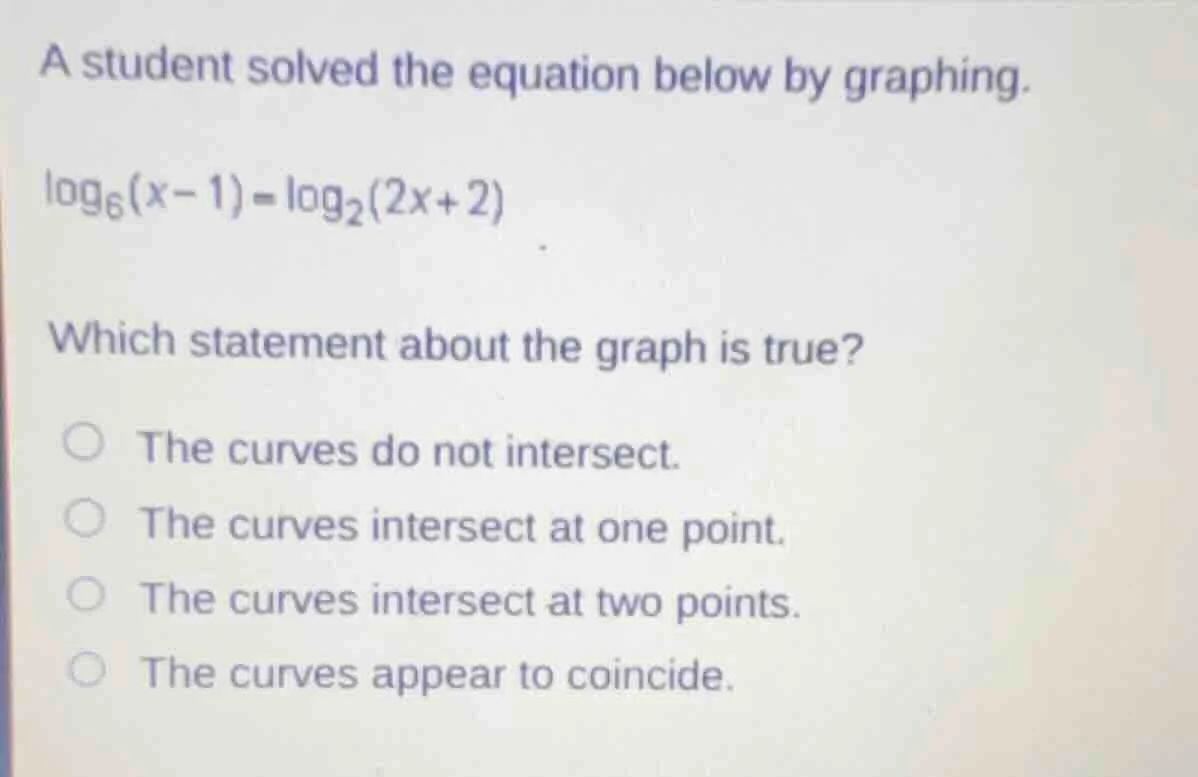
a student solved the equation below by graphing. $log_{6}(x-1)=log_{2}(2x+2)$ which statement about the graph is true? the curves do not intersect. the curves intersect at one point. the curves intersect at two points. the curves appear to coincide.
Step1: Define domain of functions
For $\log_6(x-1)$: $x-1>0 \implies x>1$
For $\log_2(2x+2)$: $2x+2>0 \implies x>-1$
Combined domain: $x>1$
Step2: Analyze function behavior
Let $f(x)=\log_6(x-1)$: increasing, $f(x)\in(-\infty,+\infty)$ as $x\to1^+$ to $x\to+\infty$
Let $g(x)=\log_2(2x+2)=\log_2(2(x+1))=1+\log_2(x+1)$: increasing, $g(x)\in(1+\log_2(2),+\infty)=(2,+\infty)$ at $x>1$
Step3: Check intersection possibility
At $x=2$: $f(2)=\log_6(1)=0$, $g(2)=1+\log_2(3)\approx2.58$; $f(x)
Since $\frac{1}{\ln6}<\frac{1}{\ln2}$, $g(x)$ grows faster than $f(x)$, so $f(x)$ remains less than $g(x)$ for all $x>1$. No intersection.

Snap & solve any problem in the app
Get step-by-step solutions on Sovi AI
Photo-based solutions with guided steps
Explore more problems and detailed explanations
The curves do not intersect.