QUESTION IMAGE
Question
student test
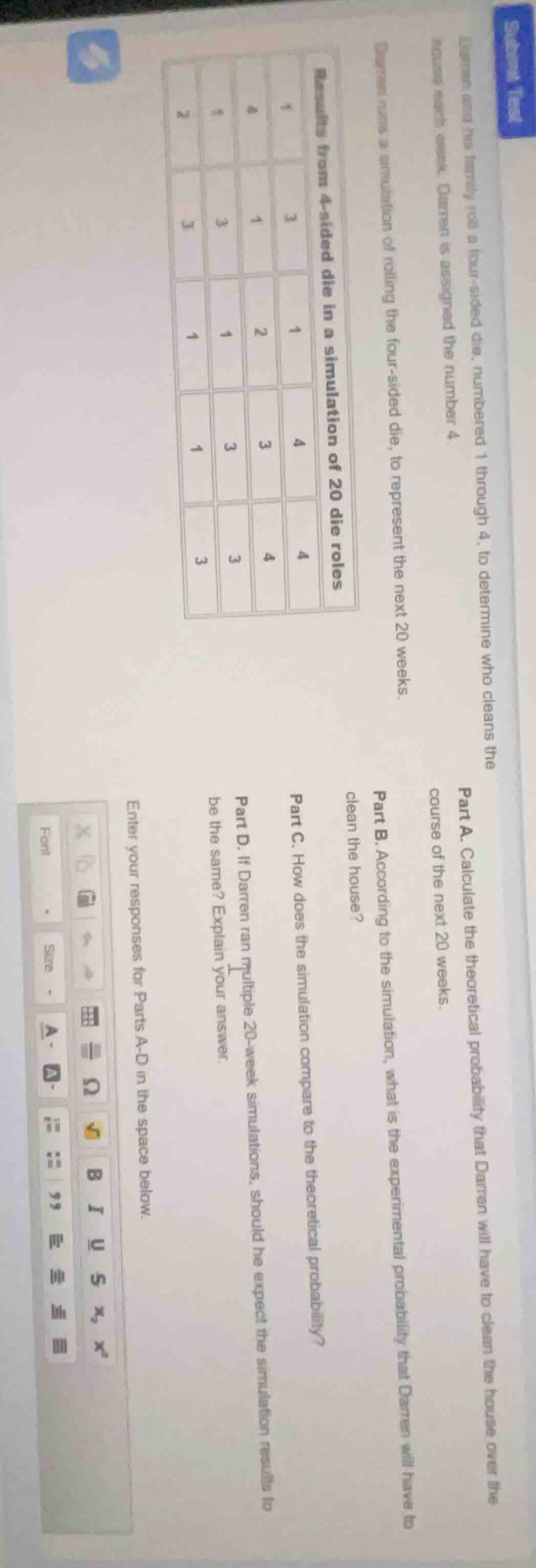
darren and his family roll a four-sided die, numbered 1 through 4, to determine who cleans the house each week. darren is assigned the number 4.
darren runs a simulation of rolling the four-sided die, to represent the next 20 weeks.
results from 4-sided die in a simulation of 20 die roles
1 3 1 4 4
4 1 2 3 4
1 3 1 3 3
2 3 1 1 3
part a. calculate the theoretical probability that darren will have to clean the house over the course of the next 20 weeks.
part b. according to the simulation, what is the experimental probability that darren will have to clean the house?
part c. how does the simulation compare to the theoretical probability?
part d. if darren ran multiple 20-week simulations, should he expect the simulation results to be the same? explain your answer.
enter your responses for parts a-d in the space below.
Step1: Calculate theoretical probability
The die has 4 equal outcomes, Darren is assigned 1 outcome (4).
$\text{Theoretical Probability} = \frac{1}{4} = 0.25$
Step2: Count simulation successes
Count number of 4s in the 20 rolls: looking at the table, the 4s are in positions (row1, col4), (row1, col5), (row4, col4), (row4, col5) → total 4.
Step3: Calculate experimental probability
$\text{Experimental Probability} = \frac{\text{Number of 4s}}{\text{Total Rolls}} = \frac{4}{20} = 0.20$
Step4: Compare simulation to theoretical
Subtract experimental from theoretical: $0.25 - 0.20 = 0.05$. The experimental probability is 0.05 lower than the theoretical.
Step5: Explain multiple simulation results
Each simulation uses random rolls, so results vary.

Snap & solve any problem in the app
Get step-by-step solutions on Sovi AI
Photo-based solutions with guided steps
Explore more problems and detailed explanations
Part A: $\frac{1}{4}$ or 0.25
Part B: $\frac{4}{20} = \frac{1}{5}$ or 0.20
Part C: The experimental probability from the simulation (0.20) is slightly lower than the theoretical probability (0.25).
Part D: No, he should not expect the results to be the same. Each simulation involves random die rolls, so there will be natural variation between different sets of 20 rolls.