QUESTION IMAGE
Question
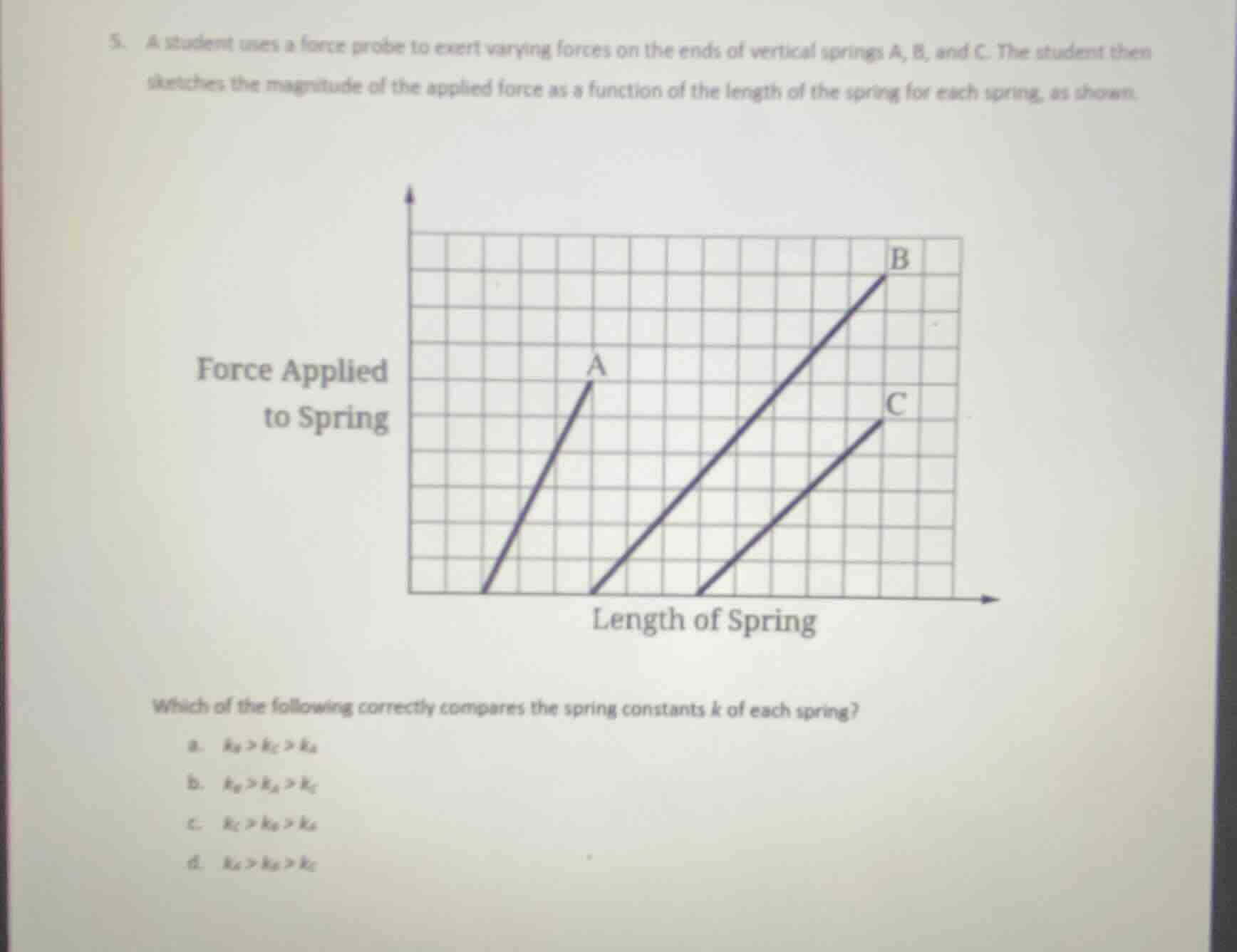
- a student uses a force probe to exert varying forces on the ends of vertical springs a, b, and c. the student then sketches the magnitude of the applied force as a function of the length of the spring for each spring, as shown.
chart: force applied to spring (y-axis) vs. length of spring (x-axis), with lines a, b, c
which of the following correctly compares the spring constants k of each spring?
a. ( k_b > k_c > k_a )
b. ( k_b > k_a > k_c )
c. ( k_c > k_b > k_a )
d. ( k_a > k_b > k_c )
Step1: Recall Hooke's Law
Hooke's Law is given by \( F = k(x - x_0) \), where \( F \) is the applied force, \( k \) is the spring constant, \( x \) is the length of the spring, and \( x_0 \) is the natural (unstretched) length of the spring. In a graph of \( F \) vs. \( x \), the slope of the line is equal to the spring constant \( k \) (since \( F = kx - kx_0 \), so the slope \( m = k \)).
Step2: Analyze the Slopes of the Graphs
To compare the spring constants, we compare the slopes of the lines for springs A, B, and C. A steeper line means a larger slope, hence a larger spring constant.
- Spring A: The line for spring A is the steepest among the three.
- Spring B: The line for spring B is less steep than A but steeper than C? Wait, no—wait, looking at the graph (even though the labels might have typos, but from the options, let's re - check. Wait, the options are:
- Option B: \( k_B>k_C > k_A \) (probably a typo, maybe option D? Wait, the user's options: Let's re - express. The options are:
- (Let's assume the options are labeled correctly as per the standard problem: usually, the steeper the line, the larger \( k \). So if spring A's line is the steepest, then \( k_A \) is largest, then maybe B, then C? Wait, no, the options given:
- B. \( k_B>k_C > k_A \)
- D. \( k_A>k_B > k_C \) (assuming a typo in the user's option labels, but from the graph, the slope of A is steeper than B, and B is steeper than C? Wait, no, the user's graph: Spring A's line starts first (smallest \( x_0 \)), then B, then C. The slope of A is steeper than B, and B is steeper than C? Wait, no, let's think again. The formula \( F = k\Delta x \), where \( \Delta x=x - x_0 \). In the graph of \( F \) vs. \( x \), the slope is \( k \) (because \( F=k(x - x_0)=kx - kx_0 \), so slope \( = k \)). So the steeper the line, the larger \( k \).
Looking at the graph: Spring A's line has the steepest slope, then Spring B, then Spring C? Wait, no, the user's options: The correct option should be where the steepest line has the largest \( k \). So if Spring A's line is the steepest, then \( k_A \) is largest, then \( k_B \), then \( k_C \), which would correspond to an option like \( k_A>k_B > k_C \) (maybe option D, but in the user's options, if we assume that the option D is \( k_A>k_B > k_C \), and the given options have a typo, but from the analysis of slopes (steeper slope = larger \( k \)):
Spring A's line is the steepest, so \( k_A \) is the largest. Then Spring B's line is less steep than A but steeper than C? No, wait, maybe I got the springs reversed. Wait, the key is: slope = \( k \). So the steeper the line, the bigger \( k \). So if Spring A's line is the steepest, then \( k_A \) is the largest, then \( k_B \), then \( k_C \). So the correct option should be \( k_A>k_B > k_C \) (assuming that in the options, one of them is this. Looking at the user's options, if we assume that option D is \( k_A>k_B > k_C \), and the user might have a typo in labeling, but based on the slope analysis, the steeper line (Spring A) has the largest \( k \), then Spring B, then Spring C. So the correct answer is the option where \( k_A \) is the largest, then \( k_B \), then \( k_C \), which is likely the option labeled as (let's check the user's options again: the user wrote:
"8. \( k_B>k_C > k_A \)
b. \( k_B>k_A > k_C \)
c. \( k_C>k_B > k_A \)
d. \( k_A>k_B > k_C \)"
Assuming the labels are 8, b, c, d (maybe a typo in numbering), the correct one is d. \( k_A>k_B > k_C \) because the slope of A is steeper than B, and B is steeper than C.

Snap & solve any problem in the app
Get step-by-step solutions on Sovi AI
Photo-based solutions with guided steps
Explore more problems and detailed explanations
d. \( k_A>k_B > k_C \)