QUESTION IMAGE
Question
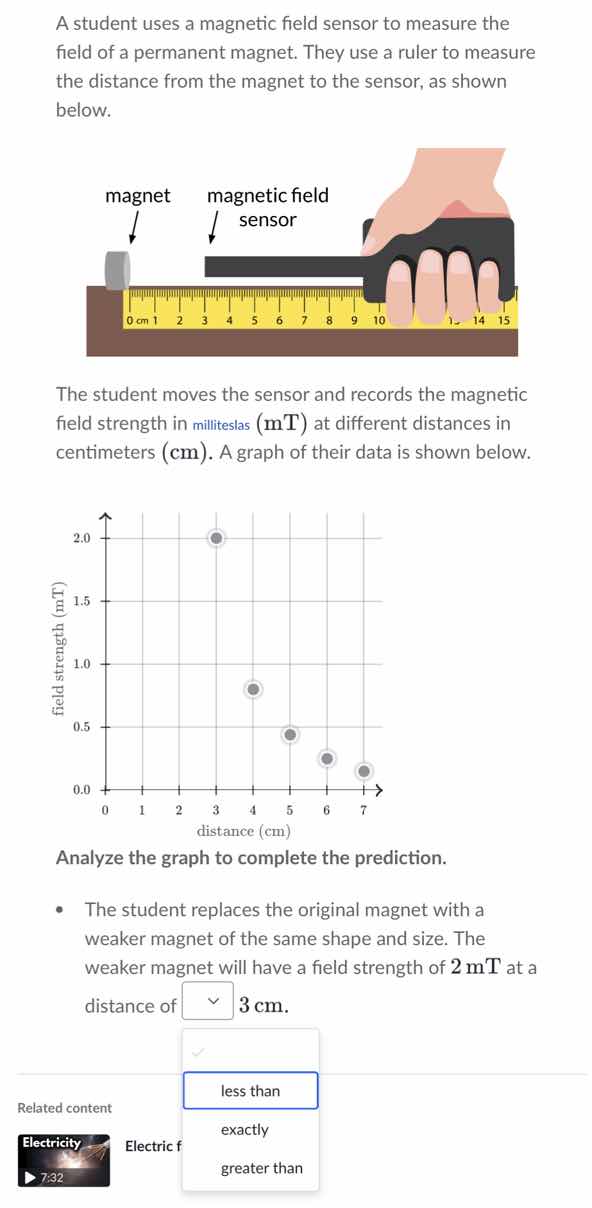
a student uses a magnetic field sensor to measure the field of a permanent magnet. they use a ruler to measure the distance from the magnet to the sensor, as shown below.
the student moves the sensor and records the magnetic field strength in milliteslas (mt) at different distances in centimeters (cm). a graph of their data is shown below.
analyze the graph to complete the prediction.
- the student replaces the original magnet with a weaker magnet of the same shape and size. the weaker magnet will have a field strength of 2 mt at a distance of ▼ 3 cm.
related content
electric f
The original magnet has a field strength of 2 mT at 3 cm. A weaker magnet (same shape/size) will produce a weaker field. So, to get 2 mT (same field strength as original at 3 cm), the weaker magnet needs to be closer? Wait, no—wait, the weaker magnet has less field strength. So, at the same distance (3 cm), the weaker magnet would have less than 2 mT. But the question is: the weaker magnet will have a field strength of 2 mT at a distance [ ] 3 cm. So, to achieve 2 mT (which is the original's strength at 3 cm), the weaker magnet must be closer? Wait, no—field strength decreases with distance. A weaker magnet has lower field strength at the same distance. So, to get the same field strength (2 mT) as the original at 3 cm, the weaker magnet must be closer (less than 3 cm)? Wait, no—wait, let's think again. Original magnet: at 3 cm, field is 2 mT. Weaker magnet: at 3 cm, field is less than 2 mT (since it's weaker). So, if we want the weaker magnet to have a field strength of 2 mT, we need to bring it closer (decrease distance) because field strength increases as distance decreases. Wait, no—field strength from a magnet decreases with increasing distance. So, for a weaker magnet, to get the same field strength (2 mT) as the original at 3 cm, the weaker magnet must be at a distance less than 3 cm? Wait, no—wait, original: distance 3 cm → field 2 mT. Weaker magnet: at distance 3 cm, field is less than 2 mT (because it's weaker). So, to get field strength 2 mT (which is higher than what the weaker magnet has at 3 cm), we need to move the sensor closer to the weaker magnet (decrease distance) so that the field strength increases. Wait, no—field strength increases as distance decreases. So, if the weaker magnet at 3 cm has field <2 mT, then to get field =2 mT, we need to be closer (distance less than 3 cm) because at closer distance, field strength is higher. Wait, but the question is phrased as: "The weaker magnet will have a field strength of 2 mT at a distance of [ ] 3 cm." So the options are less than, exactly, greater than. Let's re-express: Original magnet: distance 3 cm → 2 mT. Weaker magnet: same shape/size, so the field strength vs distance curve is similar but lower. So, for the weaker magnet, at distance 3 cm, field is less than 2 mT. Therefore, to get field strength 2 mT (which is higher than its field at 3 cm), the weaker magnet must be at a distance less than 3 cm (because closer distance means higher field strength). Wait, no—wait, field strength is inversely related to distance (approximately, for a magnet). So, if the weaker magnet is weaker, its field at the same distance is lower. So, to get the same field strength (2 mT) as the original at 3 cm, the weaker magnet must be closer (distance less than 3 cm) because at closer distance, the field strength is higher. So the distance is less than 3 cm.

Snap & solve any problem in the app
Get step-by-step solutions on Sovi AI
Photo-based solutions with guided steps
Explore more problems and detailed explanations
less than