QUESTION IMAGE
Question
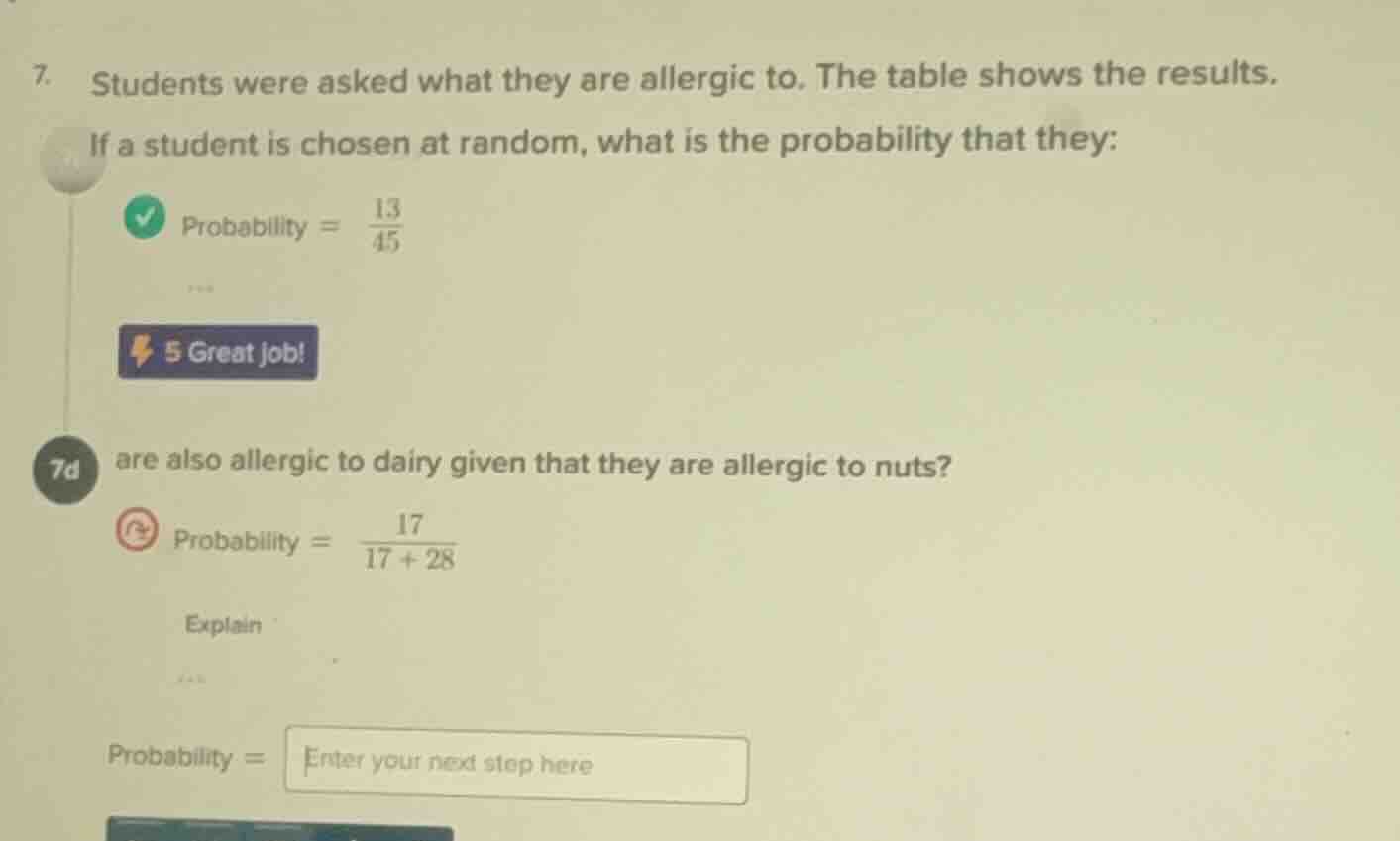
- students were asked what they are allergic to. the table shows the results. if a student is chosen at random, what is the probability that they: probability = \\(\frac{13}{45}\\) 7d are also allergic to dairy given that they are allergic to nuts? probability = \\(\frac{17}{17 + 28}\\) explain probability = enter your next step here
Step1: Recall Conditional Probability
For conditional probability \( P(A|B) \), it's the number of outcomes where both \( A \) and \( B \) occur divided by the number of outcomes where \( B \) occurs. Here, \( A \) is "allergic to dairy" and \( B \) is "allergic to nuts".
Step2: Calculate Denominator
The number of students allergic to nuts is the sum of those allergic to nuts and dairy (\( 17 \)) and those allergic to nuts but not dairy (\( 28 \)), so total for \( B \) is \( 17 + 28 \).
Step3: Calculate Probability
The number of students allergic to both nuts and dairy is \( 17 \). So \( P(\text{dairy}|\text{nuts})=\frac{17}{17 + 28}=\frac{17}{45} \).

Snap & solve any problem in the app
Get step-by-step solutions on Sovi AI
Photo-based solutions with guided steps
Explore more problems and detailed explanations
\(\frac{17}{45}\)