QUESTION IMAGE
Question
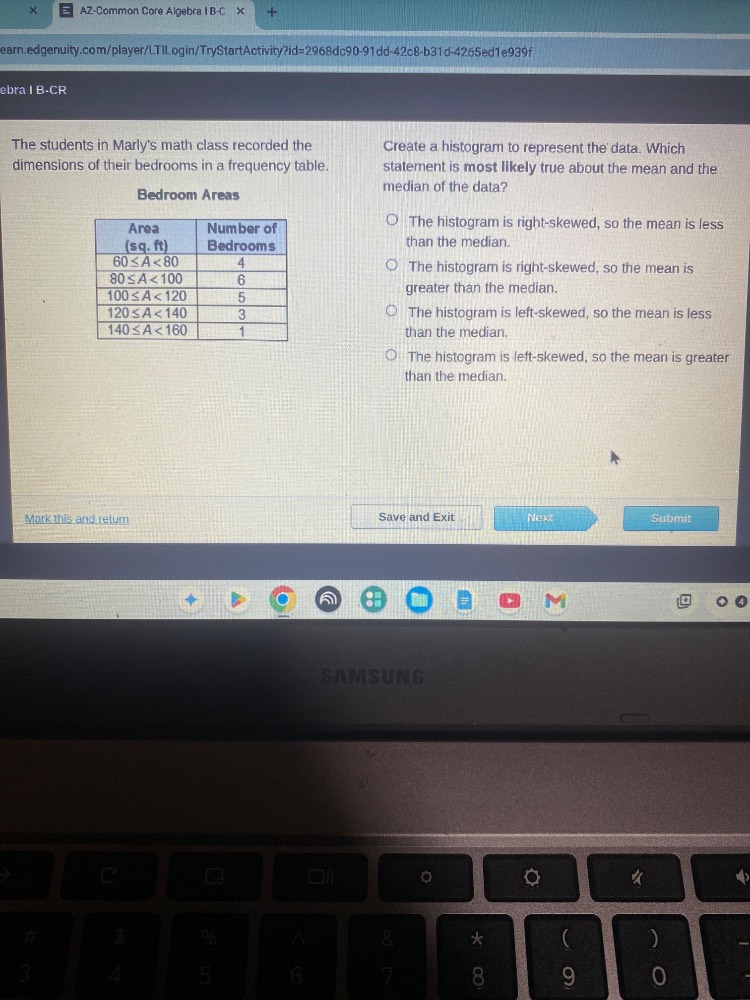
the students in marlys math class recorded the dimensions of their bedrooms in a frequency table.
bedroom areas
| area (sq. ft) | number of bedrooms |
|---|---|
| $80\leq a<100$ | 6 |
| $100\leq a<120$ | 5 |
| $120\leq a<140$ | 3 |
| $140\leq a<160$ | 1 |
create a histogram to represent the data. which statement is most likely true about the mean and the median of the data?
○ the histogram is right-skewed, so the mean is less than the median.
○ the histogram is right-skewed, so the mean is greater than the median.
○ the histogram is left-skewed, so the mean is less than the median.
○ the histogram is left-skewed, so the mean is greater than the median.
Step1: Identify data distribution
First, observe the frequency table: the highest frequencies are in the smaller area intervals (60-80, 80-100), and frequencies decrease as area increases. This means the histogram will have a tail extending to the right (higher values), so it is right-skewed.
Step2: Relate skew to mean/median
In a right-skewed distribution, the mean is pulled toward the long tail (higher values), making it greater than the median.

Snap & solve any problem in the app
Get step-by-step solutions on Sovi AI
Photo-based solutions with guided steps
Explore more problems and detailed explanations
The histogram is right-skewed, so the mean is greater than the median.