QUESTION IMAGE
Question
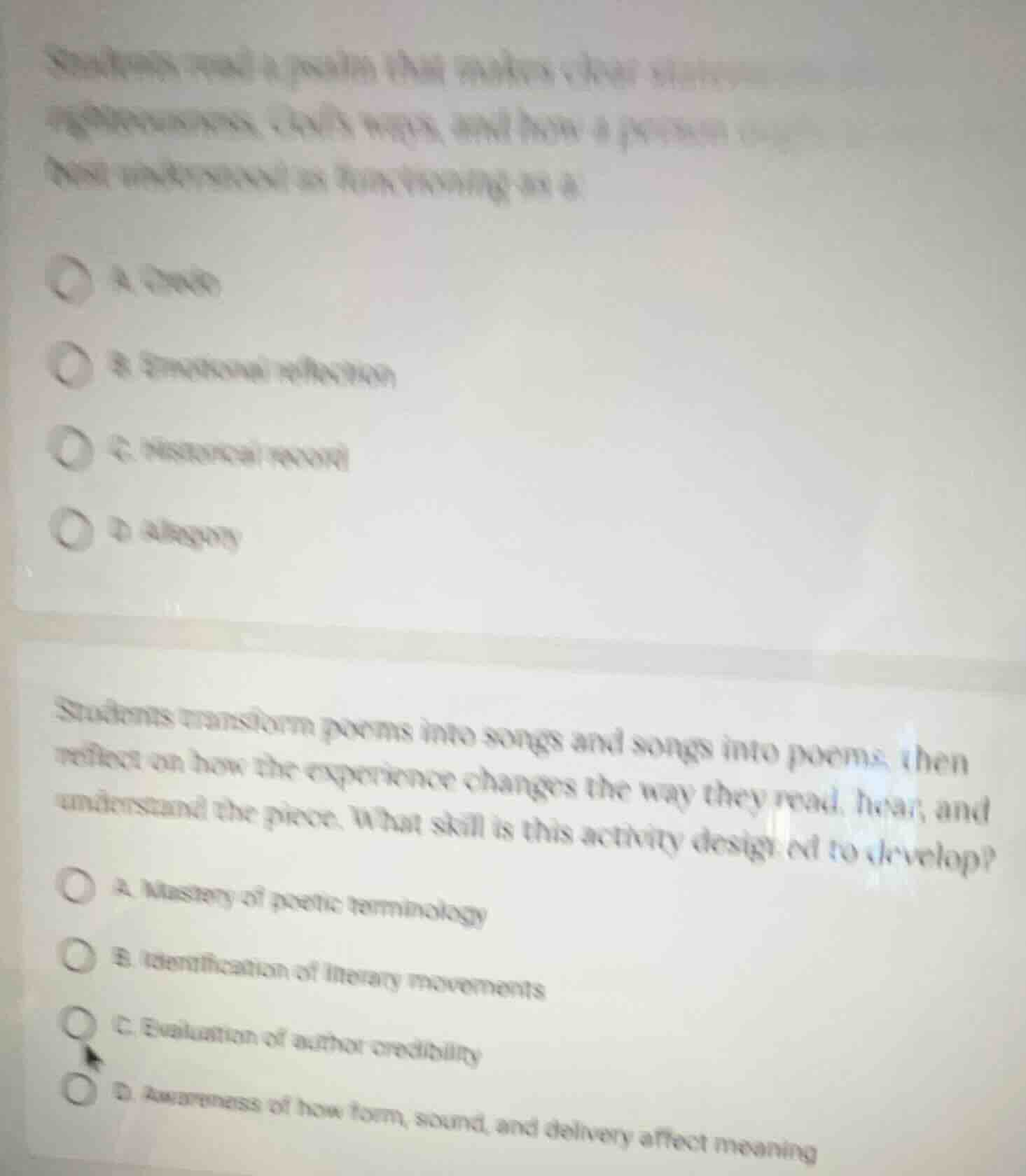
students read a psalm that makes their situation of homelessness, daily work, and loss a person could not understand as true (seeing - in it) a. (2009) b. emotional reflection c. historical record d. allegory students transform poems into songs and songs into poems, then reflect on how the experience changes the way they read, hear, and understand the piece. what skill is this activity designed to develop? a. mastery of poetic terminology b. identification of literary movements c. evaluation of author credibility d. awareness of how form, sound, and delivery affect meaning
First Question (Partially Visible, Assuming the First Question is About a Literary Device for Student Work Reflection)
Assuming the first question is about a method where students use a tool to reflect on their work (e.g., a journal, but the options include "Journal" (A, maybe typo), "Emotional reflection", "Historical record", "Allegory"). If it's about a tool for student reflection on work understanding, a journal (if A is "Journal") would be a common tool for students to record and reflect on their learning, making it a practical method for tracking understanding. But due to partial visibility, if we assume the correct option related to student reflection on work understanding, and if A is "Journal" (common for such reflection), but need to check. However, given the second question is clearer.
Second Question (Students Transform Poems and Songs)
- Option A: Mastery of poetic terminology focuses on terms like meter, rhyme scheme, etc. The activity is about transforming forms (poem to song, song to poem) and reflecting on understanding, not terminology. Eliminate A.
- Option B: Identification of literary movements (e.g., Romanticism, Modernism) is about classifying works by era/movement. The activity doesn’t involve identifying movements. Eliminate B.
- Option C: Evaluation of author credibility is about assessing an author’s trustworthiness (e.g., sources, expertise), which is unrelated to transforming poems/songs. Eliminate C.
- Option D: Transforming poems to songs and vice versa involves changing form (poem structure vs. song structure), sound (rhythm, melody), and delivery (reading vs. singing). Reflecting on how this changes understanding aligns with analyzing how form, sound, and delivery affect meaning. This matches the activity.

Snap & solve any problem in the app
Get step-by-step solutions on Sovi AI
Photo-based solutions with guided steps
Explore more problems and detailed explanations
s:
(First Question: Due to partial visibility, assuming the second question is the main clear one. For the second question:)
D. Awareness of how form, sound, and delivery affect meaning