QUESTION IMAGE
Question
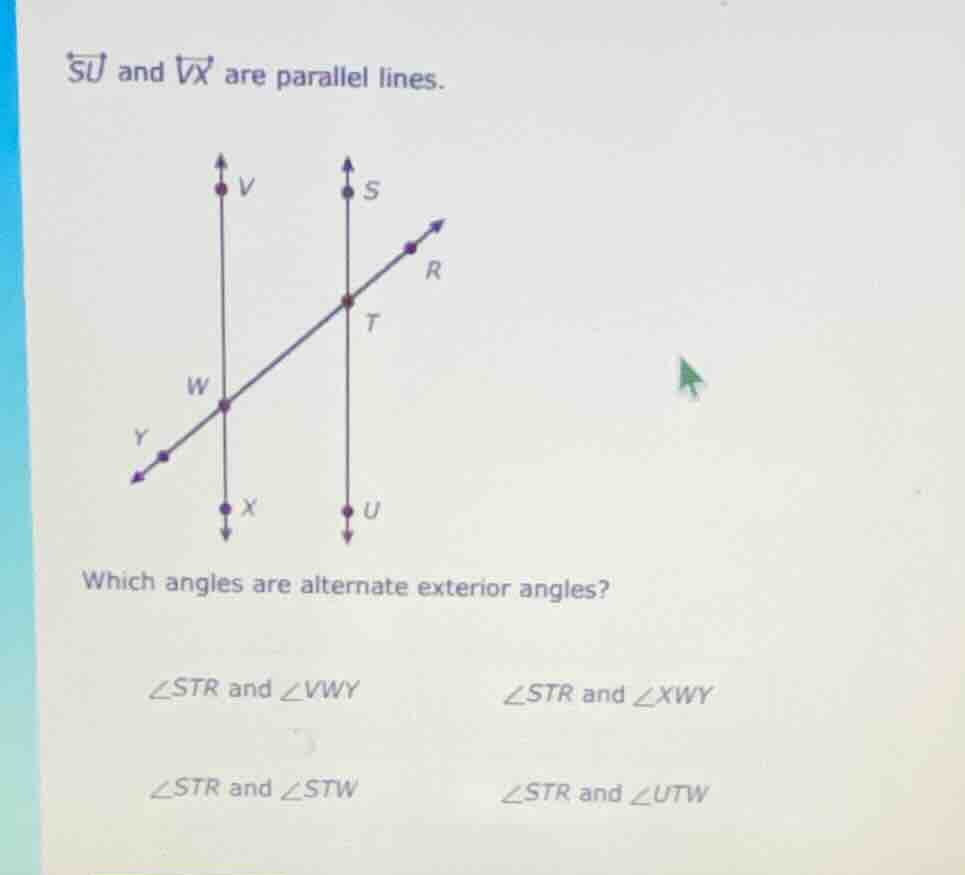
su and vx are parallel lines.
image of two vertical parallel lines (su and vx) and a transversal line (yr) intersecting them, with points labeled v, s, r, t, w, y, x, u
which angles are alternate exterior angles?
∠str and ∠vwy ∠str and ∠xwy
∠str and ∠stw ∠str and ∠utw
To determine alternate exterior angles, we recall the definition: alternate exterior angles are formed when a transversal crosses two parallel lines, lying outside the two parallel lines and on opposite sides of the transversal.
- For \(\angle STR\) and \(\angle VWY\): \(\angle STR\) is at the intersection of transversal \(YR\) and \(SU\), \(\angle VWY\) is at the intersection of \(YR\) and \(VX\). \(SU\) and \(VX\) are parallel. \(\angle STR\) is outside? No, \(\angle STR\) is between \(SU\) and \(YR\) (interior? Wait, no—wait, \(SU\) and \(VX\) are vertical parallel lines. The transversal is \(YR\). Exterior angles are outside the two parallel lines (the region not between \(SU\) and \(VX\)).
- \(\angle STR\): Let's visualize. \(SU\) and \(VX\) are parallel (vertical). Transversal \(YR\) crosses them. \(\angle STR\) is at \(T\) (on \(SU\)), \(\angle XWY\) is at \(W\) (on \(VX\)). Wait, no—let's check positions.
Wait, correct approach: Alternate exterior angles are outside the two parallel lines (so not between \(SU\) and \(VX\)) and on opposite sides of the transversal.
- \(\angle STR\) and \(\angle XWY\): Wait, no. Wait, \(\angle STR\) is above \(SU\) (since \(SU\) is vertical, \(T\) is on \(SU\), \(R\) is going up-right). \(\angle XWY\) is at \(W\) on \(VX\), \(Y\) is going down-left. Wait, maybe I got the lines wrong. \(SU\) and \(VX\) are parallel (both vertical, upward and downward arrows). Transversal is \(YR\) (from \(Y\) down-left to \(R\) up-right).
So the two parallel lines are \(SU\) (through \(S, T, U\)) and \(VX\) (through \(V, W, X\)). The transversal is \(YR\) (through \(Y, W, T, R\)).
Exterior regions: outside the area between \(SU\) and \(VX\). So for \(SU\), the exterior is above \(S\) or below \(U\); for \(VX\), above \(V\) or below \(X\).
\(\angle STR\): at \(T\), between \(SU\) and \(YR\)? No, \(SU\) is vertical, \(YR\) is slanting. Wait, \(\angle STR\) is formed by \(ST\) (vertical) and \(TR\) (slanting). So \(\angle STR\) is on the "outside" of \(VX\) (since \(VX\) is to the left of \(SU\))? Wait, maybe better to use the definition: alternate exterior angles are non - adjacent, outside the two parallel lines, and on opposite sides of the transversal.
Let's check each option:
- \(\angle STR\) and \(\angle VWY\): \(\angle VWY\) is at \(W\), between \(VX\) and \(YR\) (interior?), no.
- \(\angle STR\) and \(\angle XWY\): \(\angle XWY\) is at \(W\), below \(VX\) (exterior of \(VX\) - \(SU\) region), and \(\angle STR\) is above \(SU\) (exterior of \(VX\) - \(SU\) region), on opposite sides of transversal \(YR\). Wait, no—wait, \(\angle STR\) is at \(T\) (on \(SU\)), \(\angle XWY\) is at \(W\) (on \(VX\)). Are they outside the two parallel lines? The two parallel lines are \(SU\) and \(VX\). The area between them is between the two vertical lines. So \(\angle STR\) is to the right of \(SU\) (outside the region between \(SU\) and \(VX\)), and \(\angle XWY\) is to the left of \(VX\) (outside the region between \(SU\) and \(VX\))? No, that's not right. Wait, maybe I mixed up.
Wait, let's re - define: When two parallel lines are cut by a transversal, alternate exterior angles are:
- Outside the two parallel lines (i.e., not between the two lines)
- On opposite sides of the transversal.
So for lines \(SU\) (vertical, from \(S\) down to \(U\)) and \(VX\) (vertical, from \(V\) down to \(X\)), the region between them is the space between these two vertical lines. Exterior is outside this space. The transversal is \(YR\) (from \(Y\) (down - left) to \(R\) (up - right)).
\(\angle STR\): at point \(T\) (on \(SU\)), formed…

Snap & solve any problem in the app
Get step-by-step solutions on Sovi AI
Photo-based solutions with guided steps
Explore more problems and detailed explanations
\(\angle STR\) and \(\angle XWY\)