QUESTION IMAGE
Question
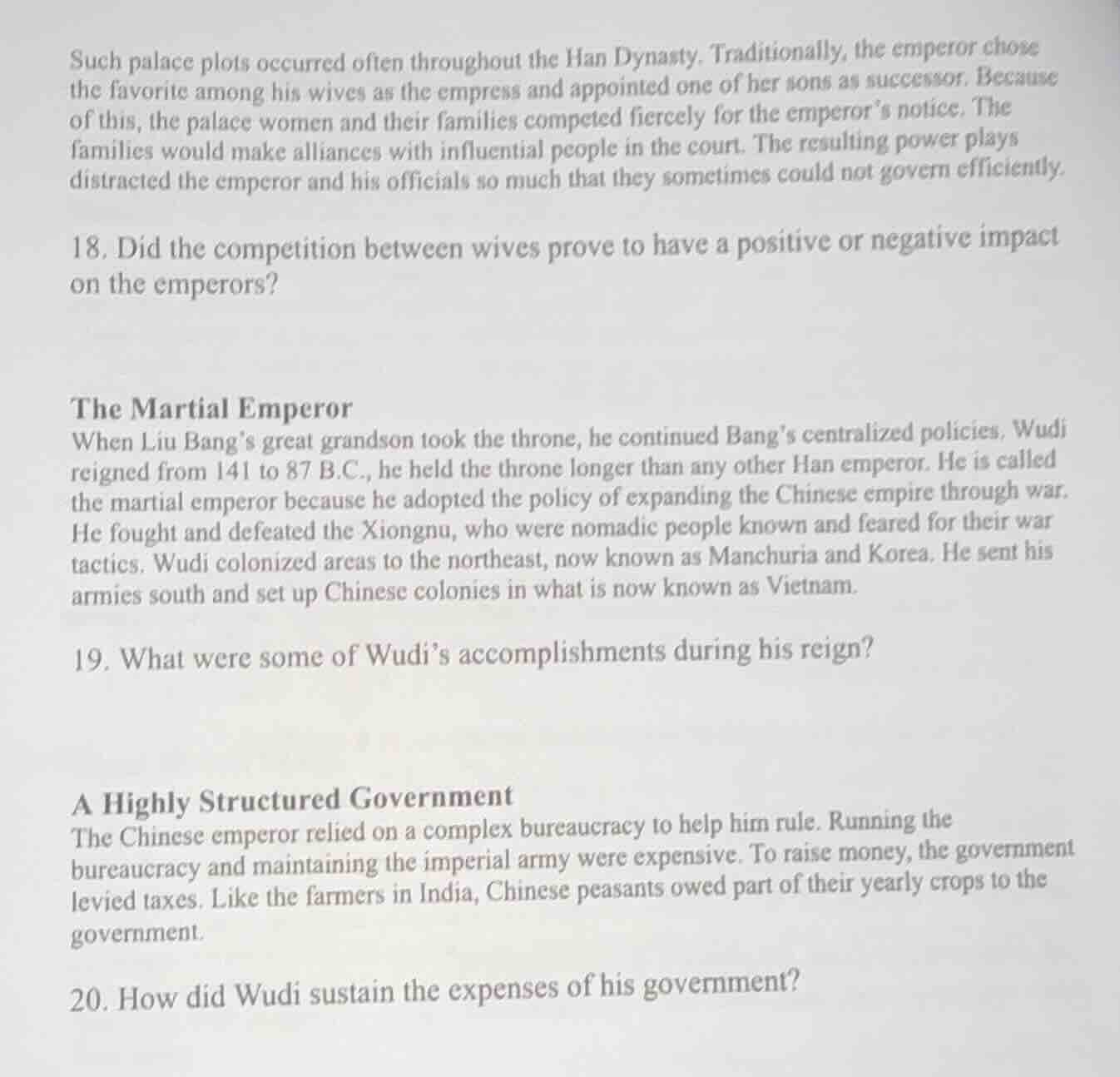
such palace plots occurred often throughout the han dynasty. traditionally, the emperor chose the favorite among his wives as the empress and appointed one of her sons as successor. because of this, the palace women and their families competed fiercely for the emperor’s notice. the families would make alliances with influential people in the court. the resulting power plays distracted the emperor and his officials so much that they sometimes could not govern efficiently.
- did the competition between wives prove to have a positive or negative impact on the emperors?
the martial emperor
when liu bang’s great grandson took the throne, he continued bang’s centralized policies. wudi reigned from 141 to 87 b.c., he held the throne longer than any other han emperor. he is called the martial emperor because he adopted the policy of expanding the chinese empire through war. he fought and defeated the xiongnu, who were nomadic people known and feared for their war tactics. wudi colonized areas to the northeast, now known as manchuria and korea. he sent his armies south and set up chinese colonies in what is now known as vietnam.
- what were some of wudi’s accomplishments during his reign?
a highly structured government
the chinese emperor relied on a complex bureaucracy to help him rule. running the bureaucracy and maintaining the imperial army were expensive. to raise money, the government levied taxes. like the farmers in india, chinese peasants owed part of their yearly crops to the government.
- how did wudi sustain the expenses of his government?
- For question 18: The text states the power plays from the competition distracted the emperor and officials, making efficient governance impossible, so the impact is negative.
- For question 19: The text lists Wudi's key actions: continuing centralized policies, reigning the longest of Han emperors, defeating the Xiongnu, colonizing areas in Manchuria, Korea, and Vietnam via military expansion.
- For question 20: The text notes that to cover government expenses, the government levied taxes, including taking part of peasants' yearly crops.

Snap & solve any problem in the app
Get step-by-step solutions on Sovi AI
Photo-based solutions with guided steps
Explore more problems and detailed explanations
- It had a negative impact. The resulting power plays distracted the emperor and his officials so much that they sometimes could not govern efficiently.
- - Continued Liu Bang's centralized policies
- Reigned longer than any other Han emperor (from 141 to 87 B.C.)
- Defeated the nomadic Xiongnu people
- Colonized areas in what is now Manchuria and Korea
- Set up Chinese colonies in what is now Vietnam through military expansion
- He sustained government expenses by having the government levy taxes, including taking part of Chinese peasants' yearly crops.