QUESTION IMAGE
Question
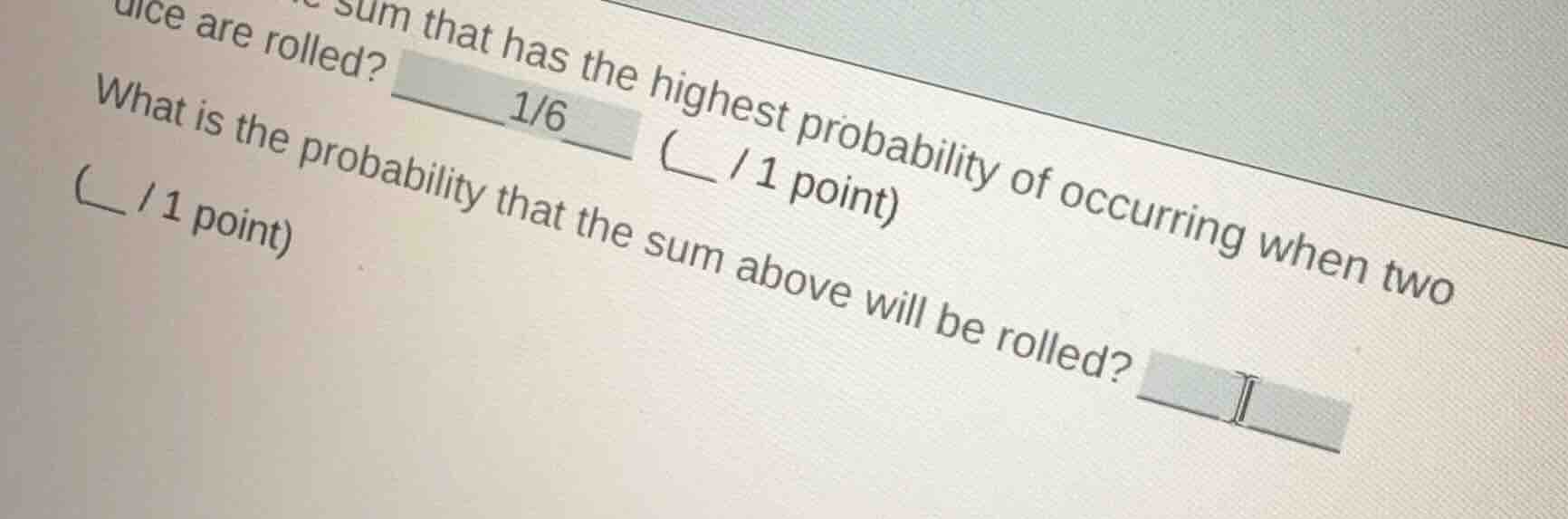
sum that has the highest probability of occurring when two dice are rolled? 1/6 ( /1 point) what is the probability that the sum above will be rolled? ( /1 point)
Step1: Determine total outcomes
When two dice are rolled, each die has 6 faces. So total outcomes = \(6\times6 = 36\).
Step2: Find sum with highest probability
The sum with the highest probability when two dice are rolled is 7. The combinations for sum 7 are (1,6), (2,5), (3,4), (4,3), (5,2), (6,1) → 6 combinations.
Step3: Calculate probability
Probability = \(\frac{\text{Number of favorable outcomes}}{\text{Total outcomes}}=\frac{6}{36}=\frac{1}{6}\). Wait, but the first blank had 1/6, maybe the sum is 7? Wait, the question is "What is the probability that the sum above will be rolled?" Assuming the sum with highest probability is 7, number of ways to get 7 is 6, total 36. So probability is \(\frac{6}{36}=\frac{1}{6}\)? Wait, no, wait: Wait, when two dice are rolled, the sum 7 has 6 outcomes, total 36. So probability is 6/36 = 1/6. But maybe the first part was about the sum with highest probability (which is 7, with probability 6/36 = 1/6), and then the second question is the same? Wait, maybe the sum is 7, so number of favorable is 6, total 36, so 6/36 = 1/6. But let's recheck.
Wait, the first blank was filled with 1/6, maybe the sum is 7. So for the second question, if the sum is 7, then number of ways is 6, total 36, so probability is 6/36 = 1/6. Wait, but maybe I misread. Wait, the first part: "sum that has the highest probability of occurring when two dice are rolled? 1/6 ( /1 point)". Wait, no, the first blank was for the sum's probability? Wait, no, the first sentence: "sum that has the highest probability of occurring when two dice are rolled? 1/6 ( /1 point)". Wait, no, the first blank is for the numerator? Wait, maybe the sum with highest probability is 7, which has 6 outcomes, so probability 6/36 = 1/6. So the first blank (numerator) is 6? Wait, no, the first filled blank is 1/6, maybe the sum is 7, and the probability is 6/36 = 1/6. So the second question: "What is the probability that the sum above will be rolled?" If the sum above is 7, then probability is 6/36 = 1/6, so numerator 6, denominator 36? Wait, no, simplify 6/36 to 1/6. Wait, maybe the answer is 6/36 or 1/6. But let's do it properly.
Total outcomes when two dice are rolled: \(6\times6 = 36\).
Sum 2: (1,1) → 1 way.
Sum 3: (1,2),(2,1) → 2 ways.
Sum 4: (1,3),(2,2),(3,1) → 3 ways.
Sum 5: (1,4),(2,3),(3,2),(4,1) → 4 ways.
Sum 6: (1,5),(2,4),(3,3),(4,2),(5,1) → 5 ways.
Sum 7: (1,6),(2,5),(3,4),(4,3),(5,2),(6,1) → 6 ways.
Sum 8: 5 ways, sum 9:4, sum10:3, sum11:2, sum12:1.
So the sum with highest probability is 7, with 6 outcomes. So probability is 6/36 = 1/6.
So if the "sum above" is 7, then the probability is 6/36 (or 1/6). But the first blank was filled with 1/6, maybe the numerator is 6? Wait, the first part: "sum that has the highest probability of occurring when two dice are rolled? 1/6 ( /1 point)". Wait, maybe the first blank is the numerator, so 6/36 reduces to 1/6, so numerator 6. Then the second question: probability is 6/36 = 1/6, so numerator 6, denominator 36? Or simplified 1/6.
Assuming the sum is 7, number of favorable is 6, total 36. So probability is 6/36 = 1/6. So the answer is 6/36 or 1/6. But likely 6/36 simplifies to 1/6, but maybe the question expects 6/36 or 1/6. Wait, the first blank was filled with 1/6, maybe the sum is 7, and the probability is 6/36 = 1/6. So the second question's answer is 6/36 (or 1/6). But let's confirm.

Snap & solve any problem in the app
Get step-by-step solutions on Sovi AI
Photo-based solutions with guided steps
Explore more problems and detailed explanations
\(\frac{6}{36}\) (or \(\frac{1}{6}\))