QUESTION IMAGE
Question
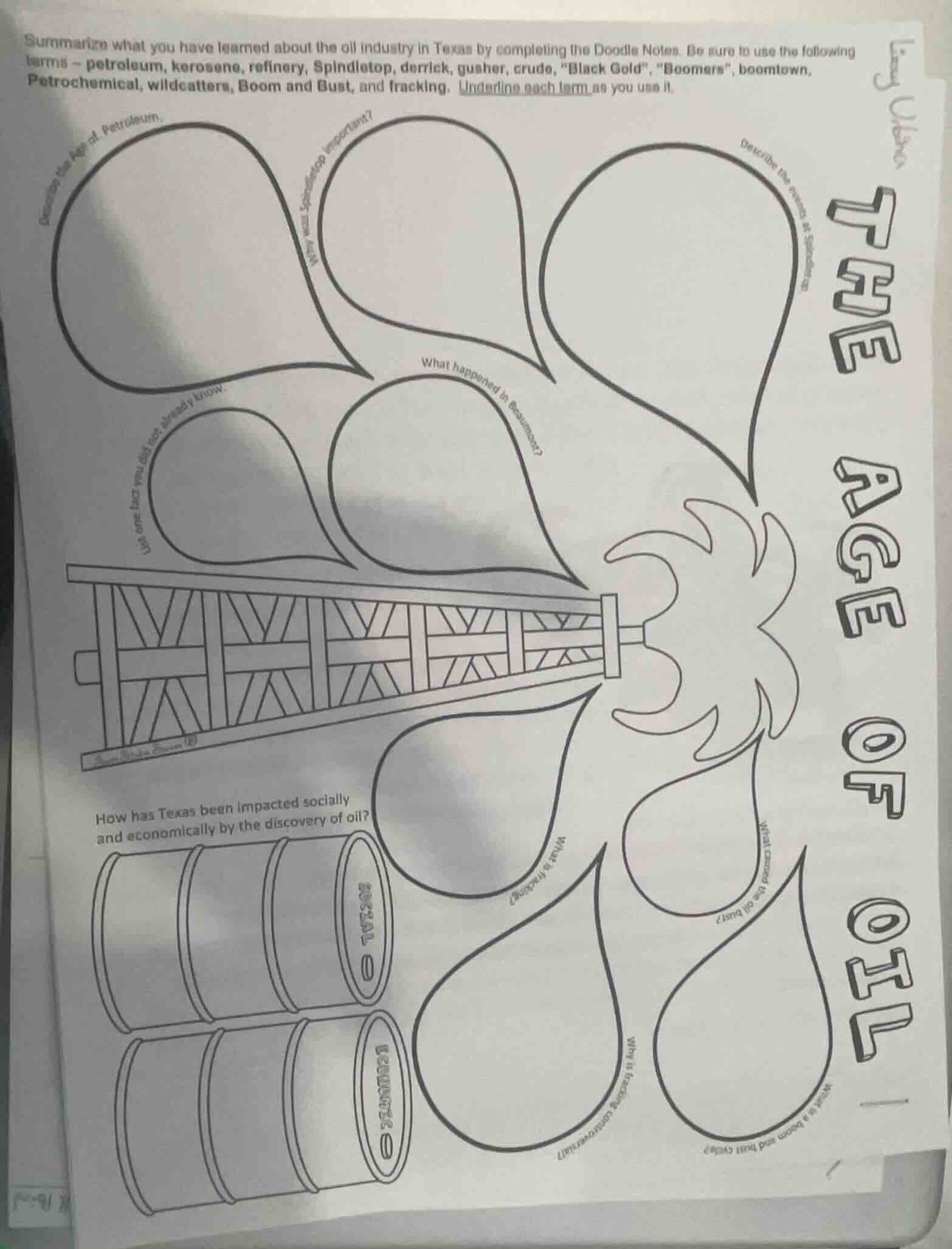
summarize what you have learned about the oil industry in texas by completing the doodle notes. be sure to use the following terms ~ petroleum, kerosene, refinery, spindletop, derrick, gusher, crude, \black gold\, \boomers\, boomtown, petrochemical, wildcatters, boom and bust, and fracking. underline each term as you use it.
describe the age of petroleum.
why was spindletop important?
describe the events at spindletop
list one fact you did not already know.
what happened in beaumont?
how has texas been impacted socially and economically by the discovery of oil?
what is fracking?
what caused the oil bust?
why is fracking controversial?
what is good and bad about fracking?
the age of oil
To summarize the Texas oil industry: The Age of Petroleum began with the discovery of "Black Gold" (crude oil) at Spindletop, where a gusher from a derrick transformed Beaumont into a boomtown. Wildcatters and "Boomers" flocked, with refineries processing crude into petroleum products like kerosene and petrochemicals. Fracking later expanded production, but the industry saw Boom and Bust cycles. Socially, boomtowns grew rapidly; economically, oil boosted Texas, though busts caused downturns. Each term (petroleum, kerosene, refinery, Spindletop, derrick, gusher, crude, "Black Gold", "Boomers", boomtown, Petrochemical, wildcatters, Boom and Bust, fracking) is underlined as used.

Snap & solve any problem in the app
Get step-by-step solutions on Sovi AI
Photo-based solutions with guided steps
Explore more problems and detailed explanations
Describe the Age of Petroleum:
The Age of Petroleum in Texas started with the discovery of crude oil (nicknamed "Black Gold") at Spindletop, where a massive gusher erupted from a derrick. This sparked a rush of wildcatters and "Boomers" to drill for oil, turning towns like Beaumont into boomtowns. Refineries processed crude into products like kerosene and petrochemicals, while later fracking expanded production. The industry experienced "Boom and Bust" cycles, with periods of rapid growth (boom) followed by economic downturns (bust).
Why was Spindletop important?
Spindletop was critical because its gusher proved Texas had vast petroleum reserves, launching the state’s oil industry. It attracted investors, refineries, and workers, creating boomtowns and establishing Texas as a global oil leader.
Describe the events at Spindletop:
In 1901, a derrick at Spindletop struck a gusher of crude oil ("Black Gold"), shooting oil hundreds of feet into the air. This unexpected, massive flow (a gusher) made Spindletop the most productive well in the world at the time, triggering an oil rush.
What happened in Beaumont?
Beaumont transformed from a small town into a boomtown after Spindletop’s gusher. Thousands of "Boomers" (oil-seeking settlers) and wildcatters flooded in, building refineries to process crude oil. The town’s population and economy exploded, though it later faced challenges during "Boom and Bust" cycles.
List one fact you did not already know:
Before researching, I did not know that Spindletop’s gusher initially produced over 100,000 barrels of crude oil per day, or that fracking (hydraulic fracturing) would later revolutionize Texas’s oil production decades after Spindletop.
How has Texas been impacted socially by the discovery of oil?
Socially, the oil industry created boomtowns (like Beaumont) with rapid population growth, attracting diverse workers (including "Boomers" and wildcatters). However, boomtowns often faced overcrowding and social upheaval, while "Boom and Bust" cycles led to job losses and economic uncertainty during busts.
How has Texas been impacted economically by the discovery of oil?
Economically, oil turned Texas into a powerhouse. Petroleum production, refining (into kerosene, petrochemicals, etc.), and later fracking drove wealth, funded infrastructure, and created jobs. Yet, "Boom and Bust" cycles meant downturns (busts) caused business failures and budget crises for the state.
What is fracking?
Fracking (hydraulic fracturing) is a modern drilling technique where pressurized fluid is injected into rock to release trapped crude oil or natural gas. It revived Texas’s oil industry by accessing previously unreachable reserves, though it also sparked debates over environmental impacts.
What caused the oil bust?
Oil busts occurred during "Boom and Bust" cycles, often triggered by overproduction (leading to falling oil prices), global economic downturns (reducing demand for petroleum products), or geopolitical events (e.g., oil embargoes). These factors caused refineries to cut production, wildcatters to go bankrupt, and boomtowns to decline.
Why is fracking controversial?
Fracking is controversial due to environmental concerns: it can contaminate groundwater, trigger small earthquakes, and release methane (a greenhouse gas). Socially, it sparks debates over land use, property rights, and health risks, even as it boosts oil production and economic growth.
What is good and bad about fracking?
- Good: Fracking increases crude oil production, creates jobs, lowers energy costs, and strengthens Texas’s economy.
- Bad: It risks groundwater pollution, causes seismic activity, and contributes to climate change (via methane emissions), while also fueling "Boom and Bust" volatility.