QUESTION IMAGE
Question
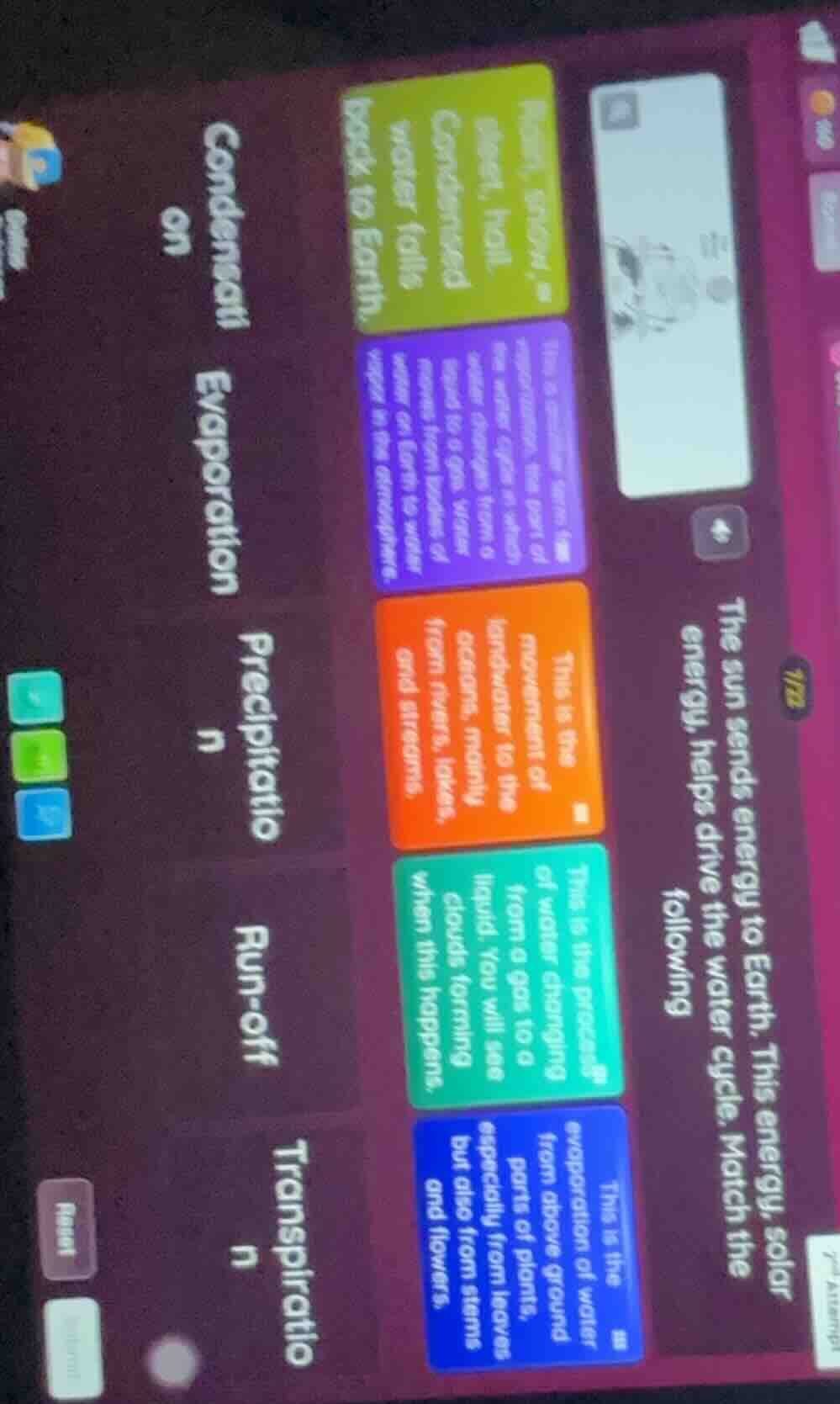
the sun sends energy to earth. this energy, solar energy, helps drive the water cycle. match the following
1/22
this is the evaporation of water from above ground parts of plants, especially from leaves but also from stems and flowers.
this is the process of water changing from a gas to a liquid. you will see clouds forming when this happens.
this is the movement of landwater to the oceans, mainly from rivers, lakes, and streams.
this is a circular term for evaporation, the part of the water cycle in which water changes from a liquid to a gas. water moves from bodies of water on earth to water vapor in the atmosphere.
rain, snow, sleet, hail. condensed water falls back to earth.
condensation
evaporation
precipitation
run-off
transpiration
Match each water cycle term to its definition by identifying the core process described:
- Condensation: Defined as water changing from gas to liquid, forming clouds.
- Evaporation: The specific term for water changing from liquid to gas, moving to the atmosphere.
- Precipitation: Refers to condensed water falling back to Earth as rain, snow, sleet, hail.
- Run-off: The movement of landwater to oceans, rivers, lakes, streams.
- Transpiration: Evaporation of water from plant parts (leaves, stems, flowers).

Snap & solve any problem in the app
Get step-by-step solutions on Sovi AI
Photo-based solutions with guided steps
Explore more problems and detailed explanations
- Condensation: This is the process of water changing from a gas to a liquid. You will see clouds forming when this happens.
- Evaporation: This is a specific term for evaporation, the part of the water cycle in which water changes from a liquid to a gas. Water moves from bodies of water on Earth to water vapor in the atmosphere.
- Precipitation: Rain, snow, sleet, hail. Condensed water falls back to Earth.
- Run-off: This is the movement of landwater to the oceans, mainly from rivers, lakes, and streams.
- Transpiration: This is the evaporation of water from above ground parts of plants, especially from leaves but also from stems and flowers.