QUESTION IMAGE
Question
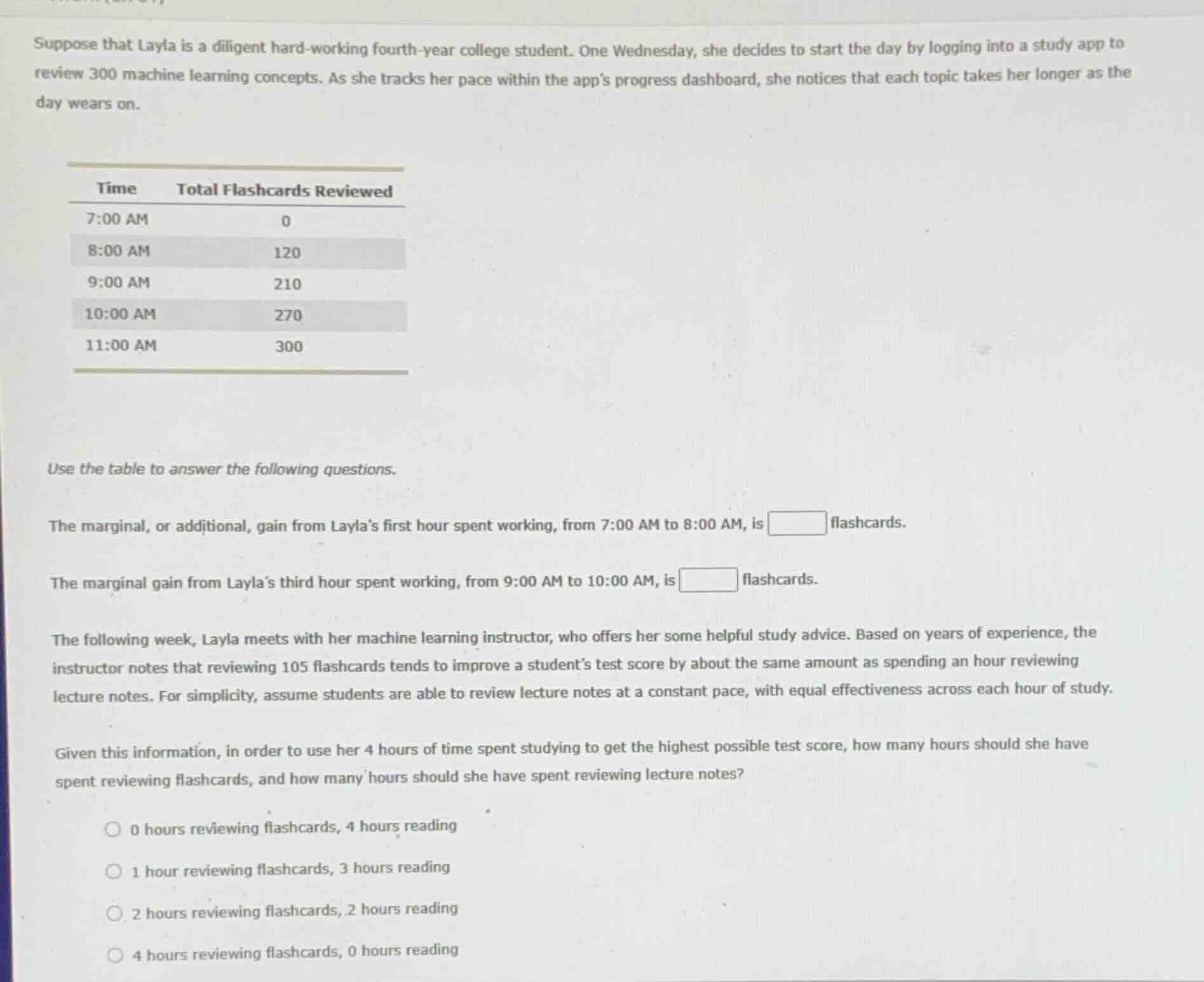
suppose that layla is a diligent hard - working fourth - year college student. one wednesday, she decides to start the day by logging into a study app to review 300 machine learning concepts. as she tracks her pace within the app’s progress dashboard, she notices that each topic takes her longer as the day wears on.
| time | total flashcards reviewed |
|---|---|
| 8:00 am | 120 |
| 9:00 am | 210 |
| 10:00 am | 270 |
| 11:00 am | 300 |
use the table to answer the following questions.
the marginal, or additional, gain from layla’s first hour spent working, from 7:00 am to 8:00 am, is \boxed{} flashcards.
the marginal gain from layla’s third hour spent working, from 9:00 am to 10:00 am, is \boxed{} flashcards.
the following week, layla meets with her machine learning instructor, who offers her some helpful study advice. based on years of experience, the instructor notes that reviewing 105 flashcards tends to improve a student’s test score by about the same amount as spending an hour reviewing lecture notes. for simplicity, assume students are able to review lecture notes at a constant pace, with equal effectiveness across each hour of study.
given this information, in order to use her 4 hours of time spent studying to get the highest possible test score, how many hours should she have spent reviewing flashcards, and how many hours should she have spent reviewing lecture notes?
\\(\bigcirc\\) 0 hours reviewing flashcards, 4 hours reading
\\(\bigcirc\\) 1 hour reviewing flashcards, 3 hours reading
\\(\bigcirc\\) 2 hours reviewing flashcards, 2 hours reading
\\(\bigcirc\\) 4 hours reviewing flashcards, 0 hours reading
First Question: Marginal Gain from 7:00 AM to 8:00 AM
Step1: Recall Marginal Gain Formula
Marginal gain is the change in total flashcards reviewed. Formula: $ \text{Marginal Gain} = \text{Total at end} - \text{Total at start} $
Step2: Apply Formula for 7 - 8 AM
At 7:00 AM, total is 0. At 8:00 AM, total is 120. So, $ 120 - 0 = 120 $
Step1: Use Marginal Gain Formula
Again, $ \text{Marginal Gain} = \text{Total at end} - \text{Total at start} $
Step2: Apply for 9 - 10 AM
At 9:00 AM, total is 210. At 10:00 AM, total is 270. So, $ 270 - 210 = 60 $
Step1: Calculate Marginal Gains per Hour for Flashcards
- 1st hour (7 - 8 AM): 120 flashcards (as before)
- 2nd hour (8 - 9 AM): $ 210 - 120 = 90 $ flashcards
- 3rd hour (9 - 10 AM): 60 flashcards (as before)
- 4th hour (10 - 11 AM): $ 300 - 270 = 30 $ flashcards
Step2: Compare with Lecture Notes Effectiveness
Lecture notes: 105 flashcards per hour (constant). We need to choose hours where flashcard marginal gain ≥ 105 (to be better than lecture notes)
- 1st hour: 120 ≥ 105 → better to do flashcards
- 2nd hour: 90 < 105 → better to do lecture notes
- 3rd hour: 60 < 105 → better to do lecture notes
- 4th hour: 30 < 105 → better to do lecture notes
So, do 1 hour of flashcards (1st hour, gain 120) and 3 hours of lecture notes (each hour gives 105, total 3×105=315; while 2nd - 4th hours of flashcards give 90+60+30=180 < 315)

Snap & solve any problem in the app
Get step-by-step solutions on Sovi AI
Photo-based solutions with guided steps
Explore more problems and detailed explanations
120