QUESTION IMAGE
Question
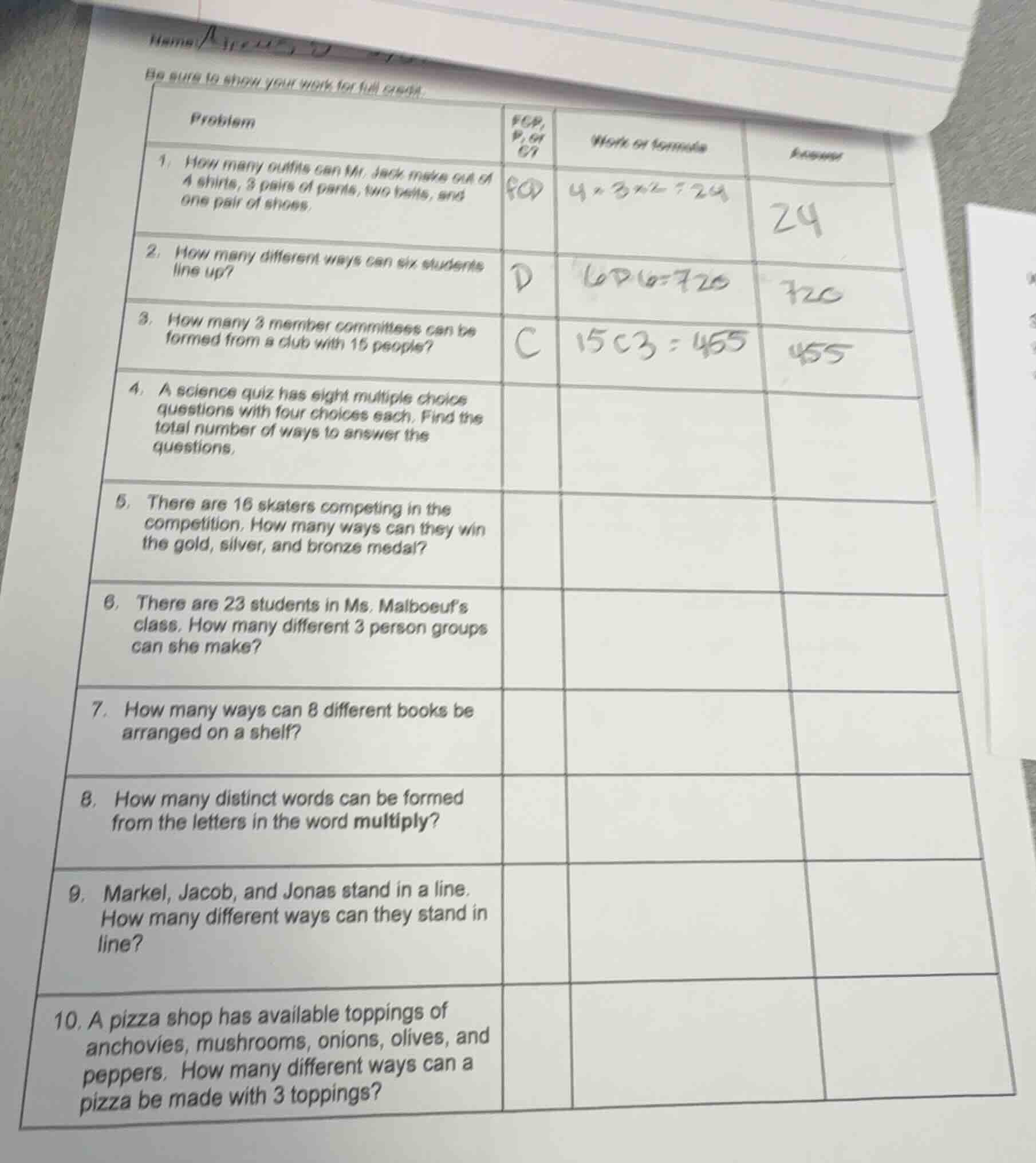
be sure to show your work for full credit.
- how many outfits can mr. jack make out of 4 shirts, 3 pairs of pants, two belts, and one pair of shoes.
- how many different ways can six students line up?
- how many 3 member committees can be formed from a club with 15 people?
- a science quiz has eight multiple choice questions with four choices each. find the total number of ways to answer the questions.
- there are 16 skaters competing in the competition. how many ways can they win the gold, silver, and bronze medal?
- there are 23 students in ms. malboeuf’s class. how many different 3 person groups can she make?
- how many ways can 8 different books be arranged on a shelf?
- how many distinct words can be formed from the letters in the word multiply?
- markel, jacob, and jonas stand in a line. how many different ways can they stand in line?
- a pizza shop has available toppings of anchovies, mushrooms, onions, olives, and peppers. how many different ways can a pizza be made with 3 toppings?
Problem 4
Step1: Identify the principle
Each multiple - choice question has 4 choices, and there are 8 such questions. We use the Fundamental Counting Principle (FCP), which states that if there are \(n_1\) ways to do the first task, \(n_2\) ways to do the second task, \(\cdots\), \(n_k\) ways to do the \(k\) - th task, then the total number of ways to do all \(k\) tasks together is \(n_1\times n_2\times\cdots\times n_k\). Here, for each of the 8 questions (tasks), there are 4 choices (ways to answer).
Step2: Apply the FCP
The number of ways to answer the 8 questions is \(4\times4\times\cdots\times4\) (8 times). Using the formula for exponents, \(a^n\) where \(a = 4\) and \(n=8\), we have \(4^8\).
Calculate \(4^8=4\times4\times4\times4\times4\times4\times4\times4 = 65536\).
Step1: Identify the permutation formula
We want to find the number of ways to award 3 distinct medals (gold, silver, bronze) to 16 skaters. The number of permutations of \(n\) objects taken \(r\) at a time is given by the formula \(P(n,r)=\frac{n!}{(n - r)!}\), where \(n = 16\) (total number of skaters) and \(r=3\) (number of medals).
Step2: Calculate the permutation
\(P(16,3)=\frac{16!}{(16 - 3)!}=\frac{16!}{13!}\)
Since \(n!=n\times(n - 1)\times\cdots\times1\), we can write \(16! = 16\times15\times14\times13!\)
So, \(\frac{16\times15\times14\times13!}{13!}=16\times15\times14 = 3360\)
Step1: Identify the combination formula
We want to form 3 - person groups from 23 students. The number of combinations of \(n\) objects taken \(r\) at a time is given by the formula \(C(n,r)=\frac{n!}{r!(n - r)!}\), where \(n = 23\) and \(r = 3\).
Step2: Calculate the combination
\(C(23,3)=\frac{23!}{3!(23 - 3)!}=\frac{23!}{3!×20!}\)
Since \(23! = 23\times22\times21\times20!\), we have \(\frac{23\times22\times21\times20!}{3\times2\times1\times20!}\)
Simplify the expression: \(\frac{23\times22\times21}{6}=\frac{23\times11\times21}{3}=23\times11\times7 = 1771\)

Snap & solve any problem in the app
Get step-by-step solutions on Sovi AI
Photo-based solutions with guided steps
Explore more problems and detailed explanations
65536