QUESTION IMAGE
Question
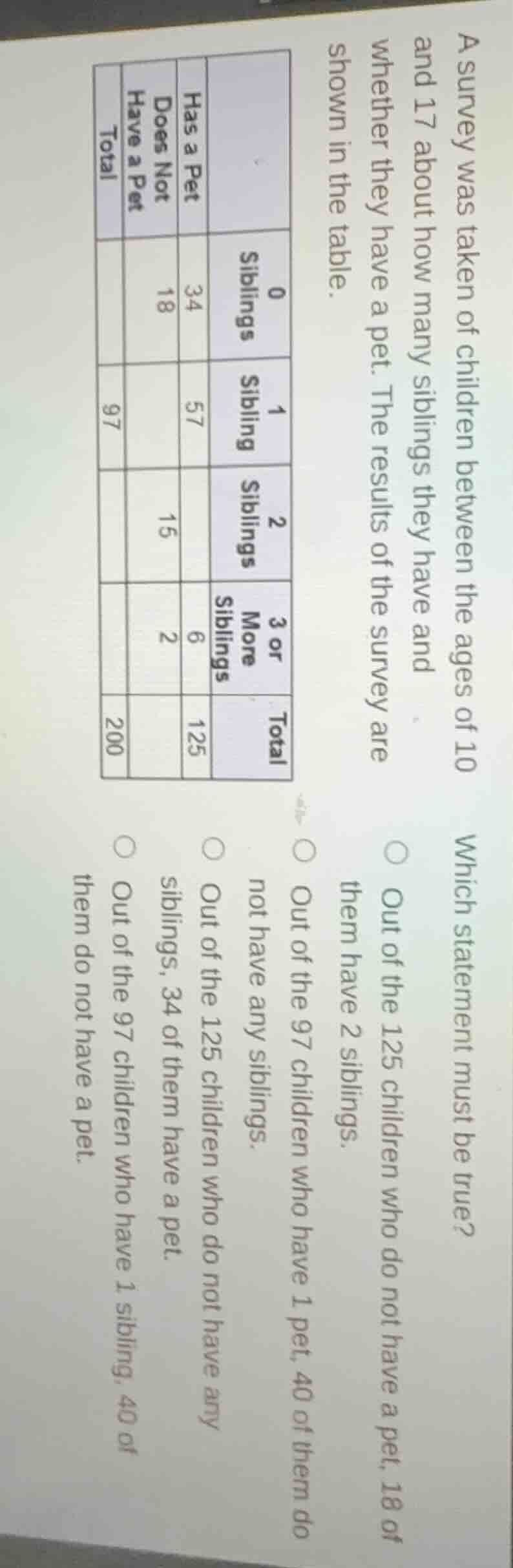
a survey was taken of children between the ages of 10 and 17 about how many siblings they have and whether they have a pet. the results of the survey are shown in the table.
| 0 siblings | 1 sibling | 2 siblings | 3 or more siblings | total | |
|---|---|---|---|---|---|
| does not have a pet | 18 | 15 | 2 | ||
| total | 97 | 200 |
which statement must be true?
- out of the 125 children who do not have a pet, 18 of them have 2 siblings.
- out of the 97 children who have 1 pet, 40 of them do not have any siblings.
- out of the 125 children who do not have any siblings, 34 of them have a pet.
- out of the 97 children who have 1 sibling, 40 of them do not have a pet.
To solve this, we analyze each option using the table data:
Step 1: Analyze Option 1
Total children with a pet: 125. Children with 2 siblings and a pet: Let's find "Does Not Have a Pet" total: \( 200 - 125 = 75 \). For "2 Siblings - Does Not Have a Pet" is 15, so "2 Siblings - Has a Pet" = Total for 2 Siblings (let's calculate: Total children = 200. Total for 0 siblings: \( 34 + 18 = 52 \); 1 sibling: 97; 3 or more: \( 6 + 2 = 8 \). So 2 siblings total: \( 200 - 52 - 97 - 8 = 43 \). Thus, "2 Siblings - Has a Pet" = \( 43 - 15 = 28 \). So 18 (no pet) ≠ 28 (has pet) for 2 siblings. Incorrect.
Step 2: Analyze Option 2
Children with 1 pet: 97 (total with 1 sibling). "Does Not Have Siblings" (0 siblings) has 18 (no pet) and 34 (has pet), so total 0 siblings: \( 34 + 18 = 52 \). Total children: 200. So children with siblings (1, 2, 3+) = \( 200 - 52 = 148 \). But 97 (1 sibling) + 43 (2 siblings) + 8 (3 or more) = \( 97 + 43 + 8 = 148 \), correct. Now, "1 sibling - no pet" = \( 97 - 57 = 40 \). So 40 out of 97 (1 sibling, has pet) do not have siblings? No, 0 siblings total is 52, not 97. Wait, recheck: "1 sibling" row: has pet = 57, total = 97. So no pet = \( 97 - 57 = 40 \). But "no siblings" (0 siblings) is a separate category. Wait, the option says "Out of the 97 children who have 1 pet, 40 of them do not have any siblings." But 0 siblings has 34 (has pet) and 18 (no pet) → total 52. So 97 (1 sibling) can’t have 40 with 0 siblings. Incorrect.
Step 3: Analyze Option 3
Children with no pets: \( 200 - 125 = 75 \). "No siblings" (0 siblings) no pet: 18; "2 siblings" no pet: 15; "3 or more" no pet: 2. So total no pet with siblings (1, 2, 3+) = \( 75 - 18 = 57 \). "1 sibling" no pet: \( 97 - 57 = 40 \); "2 siblings" no pet: 15; "3 or more" no pet: 2. So no pet with siblings: \( 40 + 15 + 2 = 57 \), correct. Now, "no pets, no siblings" (0 siblings) is 18, "no pets, 2 siblings" is 15, "no pets, 3 or more" is 2. So total no pets with siblings: \( 40 + 15 + 2 = 57 \). Now, "no pets, no siblings" (0 siblings) is 18, so no pets with siblings: \( 75 - 18 = 57 \). But the option says "Out of the 125 children who do not have any siblings..." Wait, 125 is total with pets. No, 125 is "Has a Pet" total. Wait, re-express: "Out of the 125 children who do not have any siblings, 34 of them have a pet." Wait, 0 siblings: has pet = 34, total 0 siblings = \( 34 + 18 = 52 \). So 34 out of 52 (0 siblings) have a pet, not 125. Incorrect.
Step 4: Analyze Option 4
"1 sibling" row: total = 97, has pet = 57. So no pet = \( 97 - 57 = 40 \). Thus, out of 97 children with 1 sibling (has pet), 40 do not have a pet. Correct.

Snap & solve any problem in the app
Get step-by-step solutions on Sovi AI
Photo-based solutions with guided steps
Explore more problems and detailed explanations
The correct statement is "Out of the 97 children who have 1 sibling, 40 of them do not have a pet." (The last option, as per the image’s options.)