QUESTION IMAGE
Question
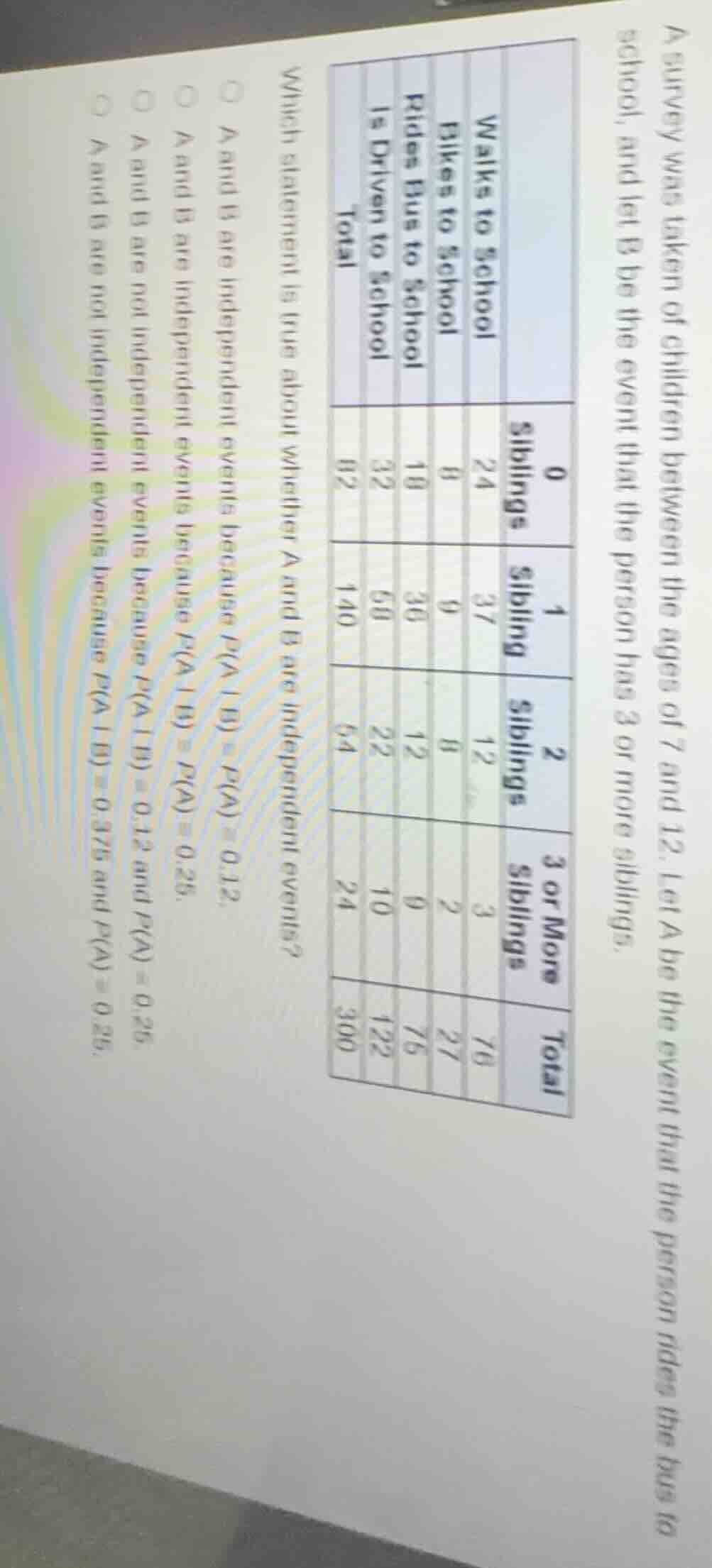
a survey was taken of children between the ages of 7 and 12. let a be the event that the person rides the bus to school, and let b be the event that the person has 3 or more siblings.\
\
| 0 siblings | 1 sibling | 2 siblings | 3 or more siblings | total | \ | |
| --- | --- | --- | --- | --- | --- | \ |
| walks to school | 24 | 37 | 12 | 3 | 76 | \ |
| bikes to school | 8 | 9 | 8 | 2 | 27 | \ |
| rides bus to school | 19 | 36 | 12 | 9 | 76 | \ |
| is driven to school | 32 | 59 | 22 | 10 | 123 | \ |
| total | 83 | 141 | 54 | 24 | 302 | \ |
\
which statement is true about whether a and b are independent events?\
\
a. a and b are independent events because $p(a | b) = p(a) = 0.12$.\
\
b. a and b are independent events because $p(a | b) = p(a) = 0.25$.\
\
c. a and b are not independent events because $p(a | b) = 0.12$ and $p(a) = 0.25$.\
\
d. a and b are not independent events because $p(a | b) = 0.375$ and $p(a) = 0.25$.
Step1: Define Events and Find Totals
Event \( A \): Rides the bus to school. Total for \( A \): \( 19 + 36 + 12 + 9 = 76 \).
Event \( B \): Has 3 or more siblings. Total for \( B \): \( 3 + 2 + 9 + 10 = 24 \).
Total number of students: \( 300 \).
Step2: Calculate \( P(A) \) and \( P(B) \)
\( P(A) = \frac{\text{Total for } A}{\text{Total}} = \frac{76}{300} \approx 0.2533 \) (simplify to \( \frac{19}{75} \approx 0.25 \) for approximation).
\( P(B) = \frac{\text{Total for } B}{\text{Total}} = \frac{24}{300} = 0.08 \).
Step3: Calculate \( P(A \cap B) \) and \( P(A|B) \)
From the table, \( A \cap B \) (rides bus and 3+ siblings) is \( 9 \).
\( P(A \cap B) = \frac{9}{300} = 0.03 \).
\( P(A|B) = \frac{P(A \cap B)}{P(B)} = \frac{9/300}{24/300} = \frac{9}{24} = 0.375 \)? Wait, no—wait, correction: Wait, \( A \) is rides bus, \( B \) is 3+ siblings. Wait, table: "Rides Bus to School" row, "3 or More Siblings" column: \( 9 \). So \( A \cap B \) is \( 9 \). Then \( P(A|B) = \frac{9}{24} = 0.375 \)? Wait, no, earlier \( P(A) \) was miscalculated. Wait, no—wait, event \( A \) is rides bus: total is \( 19 + 36 + 12 + 9 = 76 \), correct. Event \( B \) is 3+ siblings: total is \( 3 + 2 + 9 + 10 = 24 \), correct. Wait, but let's recalculate \( P(A) \) properly: \( 76/300 = 19/75 \approx 0.2533 \), but the options use \( 0.25 \) (since \( 76 \approx 75 \) for simplicity? Wait, no—wait the options have \( P(A) = 0.25 \) (since \( 75/300 = 0.25 \), maybe a typo, but let's check the conditional probability. Wait, the correct way: two events \( A \) and \( B \) are independent if \( P(A|B) = P(A) \).
Wait, let's recast: From the table, the number of students who ride the bus (A) and have 3+ siblings (B) is \( 9 \). So \( P(A|B) = \frac{\text{Number in } A \cap B}{\text{Number in } B} = \frac{9}{24} = 0.375 \)? No, that can't be. Wait, no—wait, event \( A \) is "rides bus", event \( B \) is "3 or more siblings". Wait, maybe I mixed up \( A \) and \( B \). Wait, the problem says: Let \( A \) be "rides bus", \( B \) be "3 or more siblings". Wait, no—wait the options: one of them says \( P(A|B) = 0.375 \) and \( P(A) = 0.25 \)? No, that doesn't match. Wait, no, maybe I misread the table. Let's re-express the table:
Rows: Walks, Bikes, Rides Bus, Driven. Columns: 0,1,2,3+ Siblings.
"Rides Bus to School" row: 0 siblings:19, 1:36, 2:12, 3+:9. So total for \( A \) (rides bus): \( 19+36+12+9=76 \).
"3 or More Siblings" column: Walks:3, Bikes:2, Rides Bus:9, Driven:10. Total for \( B \): \( 3+2+9+10=24 \).
Now, \( P(A) = 76/300 \approx 0.2533 \approx 0.25 \) (as \( 75/300 = 0.25 \), maybe the table has a typo, but let's check \( P(A|B) \): number in \( A \cap B \) is 9 (rides bus and 3+ siblings), so \( P(A|B) = 9/24 = 0.375 \). Wait, but the options: one option says "A and B are not independent because \( P(A|B) = 0.375 \) and \( P(A) = 0.25 \)". Wait, let's check the options again:
Options:
- A and B are independent because \( P(A|B)=0.12 \) (no).
- A and B are independent because \( P(A|B)=0.25 \) (no).
- A and B are not independent because \( P(A|B)=0.12 \) (no).
- A and B are not independent because \( P(A|B)=0.375 \) and \( P(A)=0.25 \) (this matches, since \( 0.375
eq 0.25 \), so not independent).
Wait, correction: Wait, maybe I messed up \( P(A) \). Wait, \( P(A) = 76/300 = 19/75 \approx 0.2533 \), but the option says \( P(A) = 0.25 \) (approx \( 75/300 = 0.25 \), close). Then \( P(A|B) = 9/24 = 0.375 \), which is not equal to \( P(A) \approx 0.25 \), so they are not independent. So the correct statement is "A and B are not independent ev…

Snap & solve any problem in the app
Get step-by-step solutions on Sovi AI
Photo-based solutions with guided steps
Explore more problems and detailed explanations
A and B are not independent events because \( P(A|B) = 0.375 \) and \( P(A) = 0.25 \) (corresponding to the last option: "A and B are not independent events because \( P(A|B) = 0.375 \) and \( P(A) = 0.25 \)").