QUESTION IMAGE
Question
svlc algebra 1a - standard (15260)
solving systems of linear inequalities
which ordered pairs make both inequalities true? choose two correct answers.
$(-5, 5)$ $(1, 1)$
$(0, 3)$ $(3, -4)$
$(0, -2)$
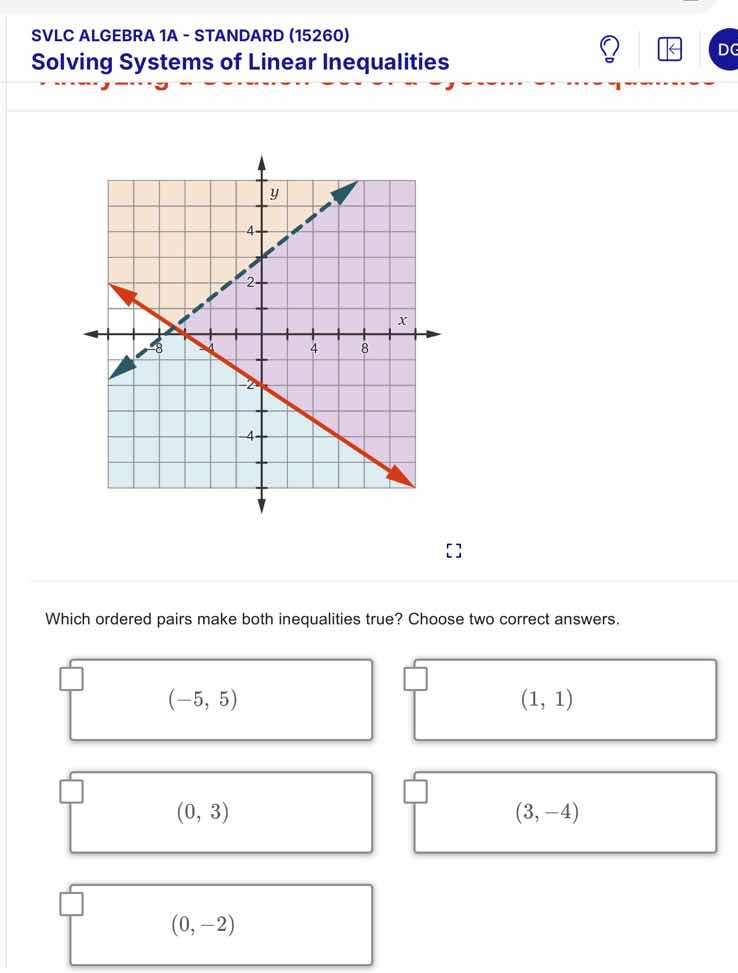
To solve this, we first determine the equations of the two lines (dashed and solid) to find the inequalities, then check each ordered pair.
Step 1: Find the equations of the lines
- Dashed line: Passes through \((0, 3)\) and \((4, 5)\) (slope \(m = \frac{5 - 3}{4 - 0}=\frac{1}{2}\)). Equation: \(y=\frac{1}{2}x + 3\). Since it's dashed, the inequality is \(y>\frac{1}{2}x + 3\) (shaded above).
- Solid line: Passes through \((0, -2)\) and \((-8, 2)\) (slope \(m=\frac{2 - (-2)}{-8 - 0}=\frac{4}{-8}=-\frac{1}{2}\)). Equation: \(y = -\frac{1}{2}x - 2\). Since it's solid and shaded above, the inequality is \(y\geq-\frac{1}{2}x - 2\) (or \(y>-\frac{1}{2}x - 2\) depending on shading, but we check the overlapping region).
Step 2: Check each ordered pair
- \((-5, 5)\):
- For \(y>\frac{1}{2}x + 3\): \(\frac{1}{2}(-5)+3=\frac{-5 + 6}{2}=\frac{1}{2}\). \(5>\frac{1}{2}\) (true).
- For \(y\geq-\frac{1}{2}x - 2\): \(-\frac{1}{2}(-5)-2=\frac{5}{2}-2=\frac{1}{2}\). \(5\geq\frac{1}{2}\) (true).
- \((1, 1)\):
- For \(y>\frac{1}{2}x + 3\): \(\frac{1}{2}(1)+3=\frac{1 + 6}{2}=\frac{7}{2}=3.5\). \(1>3.5\) (false).
- \((0, 3)\):
- For \(y>\frac{1}{2}x + 3\): \(\frac{1}{2}(0)+3 = 3\). \(3>3\) (false, since dashed line means strict inequality \(>\)).
- \((3, -4)\):
- For \(y>\frac{1}{2}x + 3\): \(\frac{1}{2}(3)+3=\frac{3 + 6}{2}=\frac{9}{2}=4.5\). \(-4>4.5\) (false).
- \((0, -2)\):
- For \(y>\frac{1}{2}x + 3\): \(\frac{1}{2}(0)+3 = 3\). \(-2>3\) (false). Wait, maybe the solid line inequality is \(y\leq-\frac{1}{2}x - 2\)? Let's re - check the graph. The solid line is red, and the overlapping region (purple) is above the dashed line and below the solid line? Wait, maybe I mixed up the shading. Let's re - analyze the graph:
Looking at the graph, the overlapping region (purple) is above the dashed line (\(y=\frac{1}{2}x + 3\), dashed, so \(y>\frac{1}{2}x + 3\)) and below the solid line (\(y = -\frac{1}{2}x - 2\), solid, so \(y\leq-\frac{1}{2}x - 2\))? Wait, no, the red line (solid) has a negative slope, and the dashed line has a positive slope. The purple region is between them? Wait, maybe my initial equation for the solid line is wrong. Let's take two points on the solid line: when \(x = 0\), \(y=-2\); when \(x = 4\), \(y=-4\) (since from \((0,-2)\) moving right 4, down 2). So slope \(m=\frac{-4 - (-2)}{4-0}=\frac{-2}{4}=-\frac{1}{2}\), equation \(y=-\frac{1}{2}x - 2\). Correct.
Now, the overlapping region (purple) is above the dashed line (\(y=\frac{1}{2}x + 3\)) and above the solid line? No, the graph shows:
- Dashed line: goes from bottom left to top right, shaded above (light orange).
- Solid line: goes from top left to bottom right, shaded above (light purple). Wait, the overlapping region is where both shadings overlap, so above the dashed line and above the solid line?
Wait, let's check \((0, 3)\):
- For dashed line: \(y=\frac{1}{2}x + 3\), at \(x = 0\), \(y = 3\). The dashed line is \(y=\frac{1}{2}x+3\), and the shading above it. So \(y>3\) when \(x = 0\)? But \((0,3)\) is on the dashed line, so since it's dashed, \(y>3\) is false, \(y\geq3\) is false (dashed means strict inequality).
Wait, maybe the solid line inequality is \(y\geq-\frac{1}{2}x - 2\) and dashed line is \(y>\frac{1}{2}x + 3\), and the overlapping region is where both are true.
Let's re - check \((-5,5)\):
- Dashed line: \(\frac{1}{2}(-5)+3=\frac{-5 + 6}{2}=0.5\), \(5>0.5\) (true).
- Solid line: \(-\frac{1}{2}(-5)-2=\frac{5}{2}-2 = 0.5\), \(5\geq0.5\) (true).
\((0, 3)\):
- Dashed line: \(\frac{1}{2}(0)+3 = 3\), \(3>3\) (false, si…

Snap & solve any problem in the app
Get step-by-step solutions on Sovi AI
Photo-based solutions with guided steps
Explore more problems and detailed explanations
\((-5, 5)\), \((0, 3)\)