QUESTION IMAGE
Question
swyk week 22 standards to study and know
be able to do the following for wednesdays
swyk
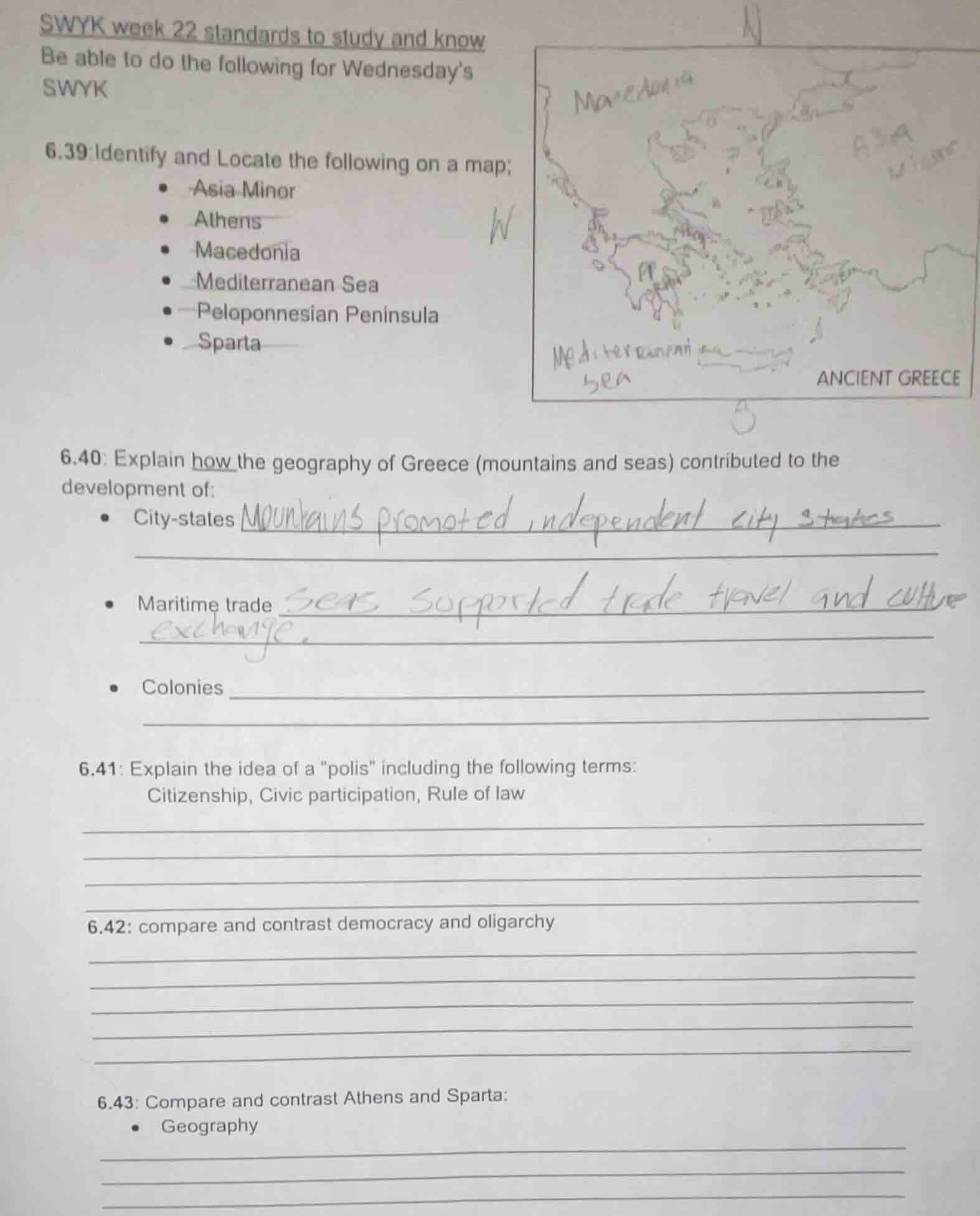
6.39:identify and locate the following on a map;
- asia minor
- athens
- macedonia
- mediterranean sea
- peloponnesian peninsula
- sparta
6.40: explain how the geography of greece (mountains and seas) contributed to the
development of:
- city-states
- maritime trade
- colonies
6.41: explain the idea of a \polis\ including the following terms:
citizenship, civic participation, rule of law
6.42: compare and contrast democracy and oligarchy
6.43: compare and contrast athens and sparta:
- geography
ancient greece
For 6.39 Map Locations:
- Asia Minor: The peninsula (modern Turkey) east of the Aegean Sea, adjacent to Greece's eastern coast.
- Athens: A city-state in eastern central Greece, near the Aegean Sea.
- Macedonia: A region in northern Greece, north of the main Greek city-states.
- Mediterranean Sea: The large sea south of the Greek mainland and Peloponnesian Peninsula.
- Peloponnesian Peninsula: The large peninsula forming the southern part of Greece, connected to the mainland by a narrow isthmus.
- Sparta: A city-state located in the southern part of the Peloponnesian Peninsula.
For 6.40:
- Colonies: Greece's mountainous terrain limited farmland, and the accessible seas allowed Greeks to sail to distant regions (like Italy, North Africa, and the Black Sea) to establish colonies for more resources and living space.
For 6.41:
A polis was an ancient Greek city-state, a self-governing community. Citizenship was restricted to free native-born men, granting them rights to participate in governance. Civic participation meant citizens took part in assemblies, voted, and held public office to shape the polis's policies. Rule of law meant all citizens (including leaders) were subject to the same set of written laws, ensuring consistent governance.
For 6.42:
- Similarity: Both were forms of governance in Greek city-states, with power held by a subset of the population (excluding enslaved people, women, and non-citizens).
- Difference: Democracy gave political power to all eligible citizens (free native-born men) who could vote and participate in decision-making (exemplified by Athens). Oligarchy concentrated power in a small, elite group of wealthy or influential people (exemplified by Sparta's ruling council of elders).
For 6.43 (Geography):
- Athens: Located in central eastern Greece, near the Aegean Sea, with access to a natural harbor (Piraeus) that supported trade and naval activity; its terrain included hills (like the Acropolis) but more arable land than Sparta.
- Sparta: Located in the southern Peloponnesian Peninsula, in a closed, fertile valley (the Eurotas Valley) surrounded by mountains, which isolated it from other city-states and focused its economy on agriculture rather than trade.

Snap & solve any problem in the app
Get step-by-step solutions on Sovi AI
Photo-based solutions with guided steps
Explore more problems and detailed explanations
6.39 Map Locations:
- Asia Minor: Eastern peninsula adjacent to Greece's Aegean coast
- Athens: Eastern central Greece, near Aegean Sea
- Macedonia: Northern region of Greece
- Mediterranean Sea: Large sea south of Greek mainland
- Peloponnesian Peninsula: Southern Greek peninsula
- Sparta: Southern Peloponnesian Peninsula
6.40:
- Colonies: Scarce farmland from mountains + accessible seas drove Greeks to establish colonies abroad for resources and space.
6.41:
A polis was a self-governing Greek city-state:
- Citizenship: Reserved for free native-born men, granting governance rights
- Civic participation: Citizens voted, joined assemblies, and held office to guide the polis
- Rule of law: All citizens, including leaders, followed uniform written laws
6.42:
- Similarity: Both excluded non-citizens from formal power
- Difference: Democracy gave power to all eligible citizens; Oligarchy concentrated power in a small elite group
6.43 (Geography):
- Athens: Coastal, with a harbor, hills, and moderate arable land
- Sparta: Landlocked valley, mountain-surrounded, focused on agriculture