QUESTION IMAGE
Question
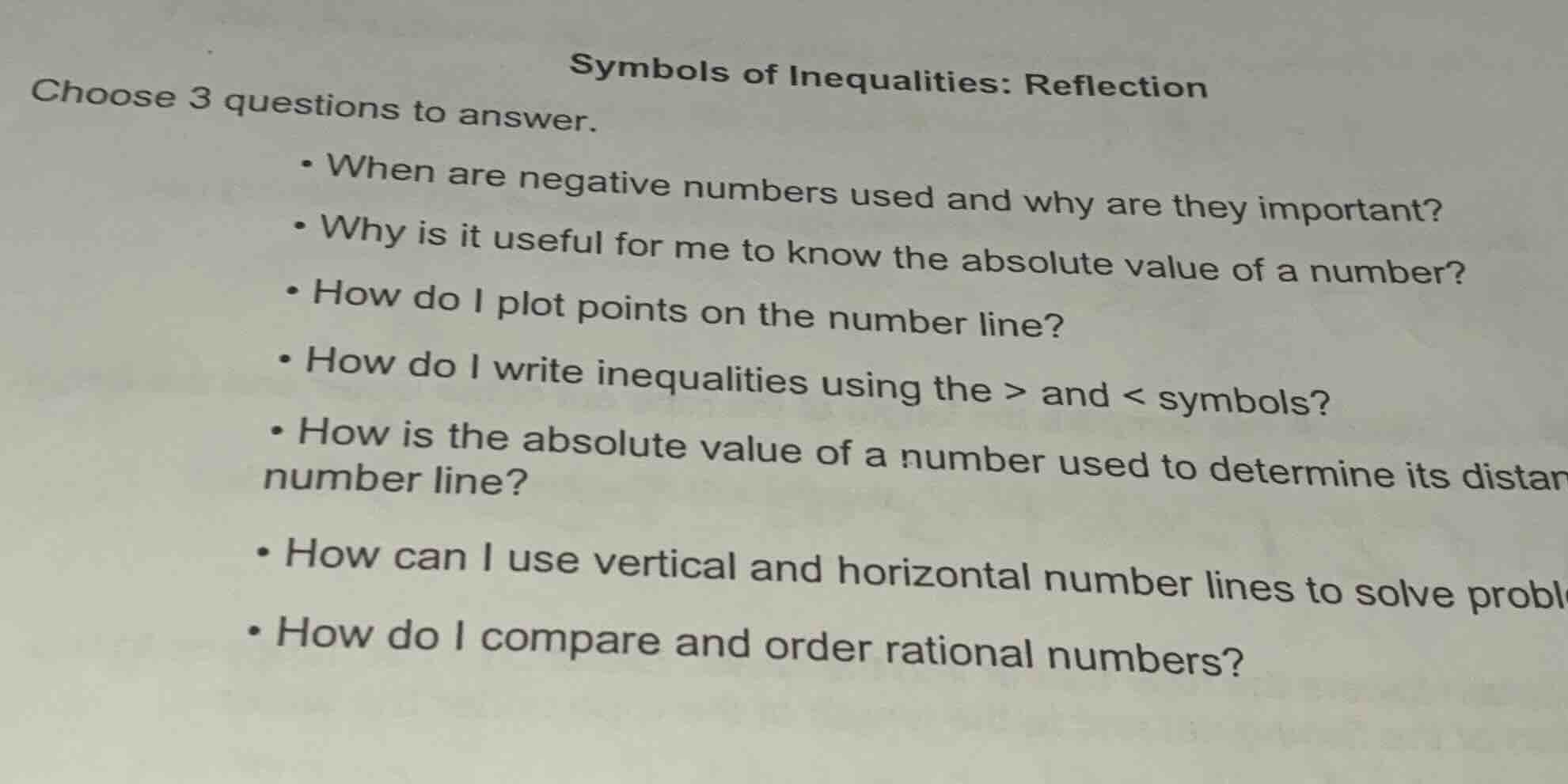
symbols of inequalities: reflection
choose 3 questions to answer.
- when are negative numbers used and why are they important?
- why is it useful for me to know the absolute value of a number?
- how do i plot points on the number line?
- how do i write inequalities using the > and < symbols?
- how is the absolute value of a number used to determine its distan
number line?
- how can i use vertical and horizontal number lines to solve probl
- how do i compare and order rational numbers?

Snap & solve any problem in the app
Get step-by-step solutions on Sovi AI
Photo-based solutions with guided steps
Explore more problems and detailed explanations
ing 3 Selected Questions:
1. When are negative numbers used and why are they important?
Negative numbers represent values less than zero. They are used in:
- Finance: To show debt (e.g., a bank account with -$50 means $50 owed).
- Temperature: Below freezing (e.g., -10°C).
- Elevation: Below sea level (e.g., -200 ft).
Importance: They extend the number system to model real-world contexts (loss, deficit, direction) and enable operations like subtraction (e.g., 5 - 8 = -3).
2. Why is it useful to know the absolute value of a number?
The absolute value \( |x| \) is a number’s distance from zero (always non-negative). Use cases:
- Distance: The distance between \( -3 \) and \( 5 \) is \( |-3 - 5| = 8 \).
- Magnitude: In science, speed (a scalar) is the absolute value of velocity (a vector, e.g., \( |-20 \, \text{m/s}| = 20 \, \text{m/s} \) for speed).
- Problem-solving: Comparing sizes of numbers regardless of sign (e.g., \( |-10| > |5| \)).
3. How do I plot points on the number line?
- Identify the number: For a positive number (e.g., 3), move 3 units right of zero. For a negative number (e.g., -2), move 2 units left of zero. For zero, mark the origin.
- Label the point: Draw a dot at the correct position and label it (e.g., “3” or “-2”).
- Scale: Ensure the number line has equal intervals (e.g., each tick mark represents 1 unit) for accuracy.