QUESTION IMAGE
Question
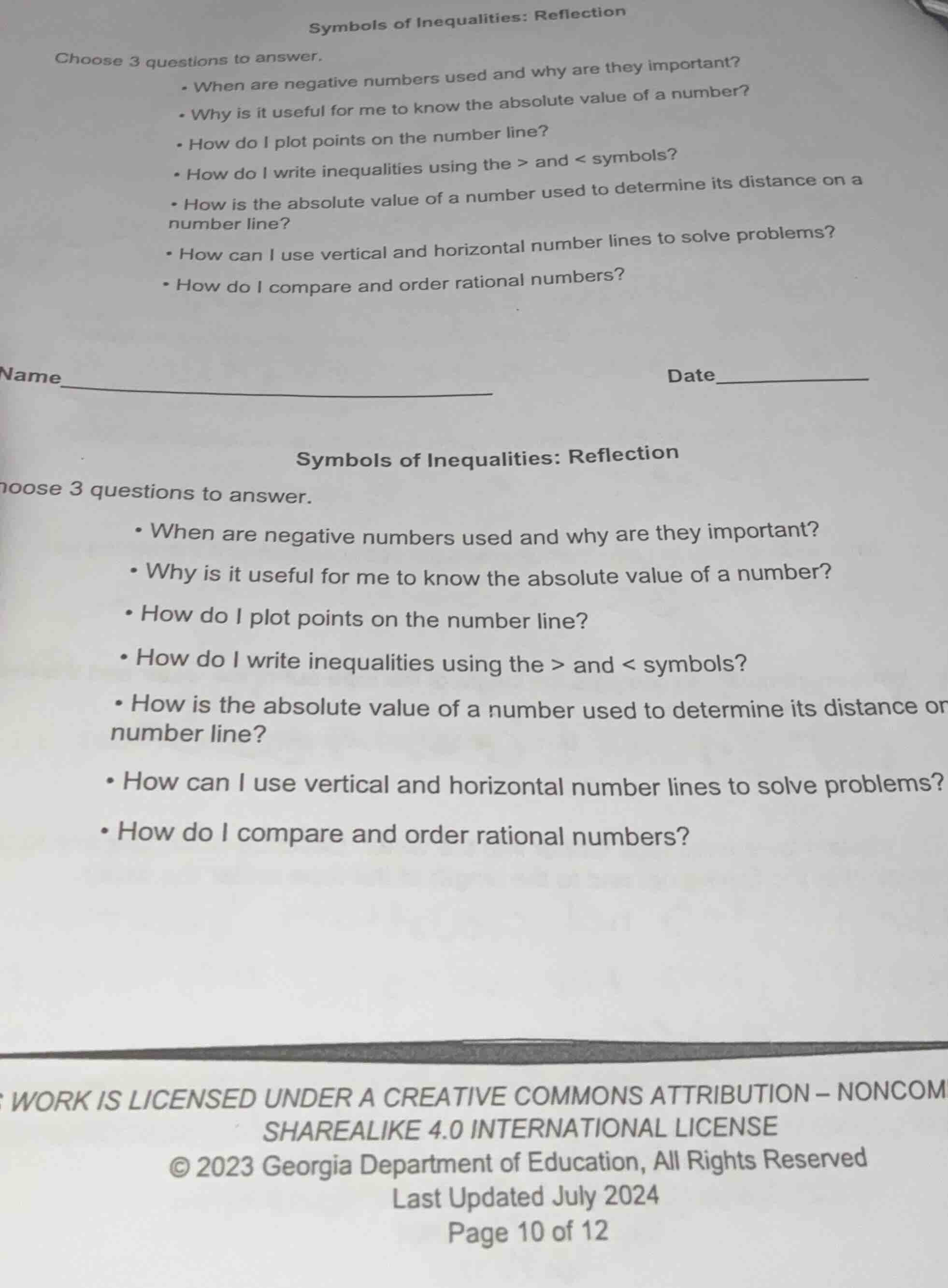
symbols of inequalities: reflection
choose 3 questions to answer.
- when are negative numbers used and why are they important?
- why is it useful for me to know the absolute value of a number?
- how do i plot points on the number line?
- how do i write inequalities using the > and < symbols?
- how is the absolute value of a number used to determine its distance on a number line?
- how can i use vertical and horizontal number lines to solve problems?
- how do i compare and order rational numbers?
name____________________________ date____________
symbols of inequalities: reflection
choose 3 questions to answer.
- when are negative numbers used and why are they important?
- why is it useful for me to know the absolute value of a number?
- how do i plot points on the number line?
- how do i write inequalities using the > and < symbols?
- how is the absolute value of a number used to determine its distance on a number line?
- how can i use vertical and horizontal number lines to solve problems?
- how do i compare and order rational numbers?
this work is licensed under a creative commons attribution - noncommercial - sharealike 4.0 international license
© 2023 georgia department of education, all rights reserved
last updated july 2024
page 10 of 12
To answer these reflection questions, we'll address three of them with brief explanations:
1. When are negative numbers used and why are they important?
Negative numbers represent values less than zero (e.g., debt, temperature below zero, elevation below sea level). They are important for quantifying losses, deficits, or directions (e.g., negative in finance means owed money; in science, they model opposite forces or temperatures).
2. Why is it useful to know the absolute value of a number?
Absolute value ($|x|$) measures a number’s distance from zero (always non - negative). It’s useful for:
- Comparing magnitudes (e.g., $|-5| = 5$, so -5 and 5 are equally far from 0).
- Solving real - world problems (e.g., distance can’t be negative, so $| - 3|$ miles = 3 miles).
- Simplifying equations (e.g., $|x| = 3$ has solutions $x = 3$ or $x=-3$).
3. How do I plot points on the number line?
- Identify the number: For a number like $2$, $-1$, or $\frac{1}{2}$, understand its value.
- Locate zero: Zero is the origin of the number line.
- Determine direction: Positive numbers go to the right of zero; negative numbers go to the left.
- Mark the point: For integers, place a dot on the tick mark corresponding to the number. For fractions/decimals, estimate the position between integers (e.g., $\frac{1}{2}$ is halfway between 0 and 1; $-1.5$ is halfway between -1 and -2).
(Note: You can choose any three questions from the list and adapt explanations based on the selected questions.)

Snap & solve any problem in the app
Get step-by-step solutions on Sovi AI
Photo-based solutions with guided steps
Explore more problems and detailed explanations
To answer these reflection questions, we'll address three of them with brief explanations:
1. When are negative numbers used and why are they important?
Negative numbers represent values less than zero (e.g., debt, temperature below zero, elevation below sea level). They are important for quantifying losses, deficits, or directions (e.g., negative in finance means owed money; in science, they model opposite forces or temperatures).
2. Why is it useful to know the absolute value of a number?
Absolute value ($|x|$) measures a number’s distance from zero (always non - negative). It’s useful for:
- Comparing magnitudes (e.g., $|-5| = 5$, so -5 and 5 are equally far from 0).
- Solving real - world problems (e.g., distance can’t be negative, so $| - 3|$ miles = 3 miles).
- Simplifying equations (e.g., $|x| = 3$ has solutions $x = 3$ or $x=-3$).
3. How do I plot points on the number line?
- Identify the number: For a number like $2$, $-1$, or $\frac{1}{2}$, understand its value.
- Locate zero: Zero is the origin of the number line.
- Determine direction: Positive numbers go to the right of zero; negative numbers go to the left.
- Mark the point: For integers, place a dot on the tick mark corresponding to the number. For fractions/decimals, estimate the position between integers (e.g., $\frac{1}{2}$ is halfway between 0 and 1; $-1.5$ is halfway between -1 and -2).
(Note: You can choose any three questions from the list and adapt explanations based on the selected questions.)