QUESTION IMAGE
Question
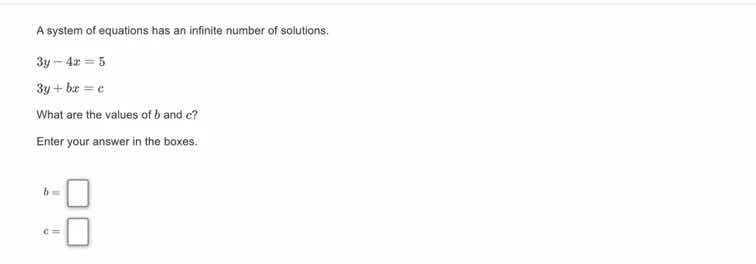
a system of equations has an infinite number of solutions.
$3y - 4x = 5$
$3y + bx = c$
what are the values of $b$ and $c$
enter your answer in the boxes.
$b = \square$
$c = \square$
Step1: Recall condition for infinite solutions
For a system of linear equations \(a_1x + b_1y = c_1\) and \(a_2x + b_2y = c_2\) to have infinite solutions, the ratios must satisfy \(\frac{a_1}{a_2}=\frac{b_1}{b_2}=\frac{c_1}{c_2}\). First, rewrite the given equations in standard form (\(Ax + By = C\)):
- First equation: \(-4x + 3y = 5\)
- Second equation: \(bx + 3y = c\)
Step2: Compare coefficients for \(x\)
For the \(x\)-coefficients, we have \(\frac{-4}{b}=\frac{3}{3}\) (since the \(y\)-coefficients are both 3, so their ratio is 1). Solving \(\frac{-4}{b}=1\) gives \(b=-4\).
Step3: Compare constants for infinite solutions
Now, using the constant term ratio, \(\frac{5}{c}=\frac{3}{3}=1\) (since we already have \(b = - 4\) to match the \(x\)-coefficient ratio, and the \(y\)-coefficient ratio is 1). Solving \(\frac{5}{c}=1\) gives \(c = 5\).

Snap & solve any problem in the app
Get step-by-step solutions on Sovi AI
Photo-based solutions with guided steps
Explore more problems and detailed explanations
\(b=\boxed{-4}\)
\(c=\boxed{5}\)