QUESTION IMAGE
Question
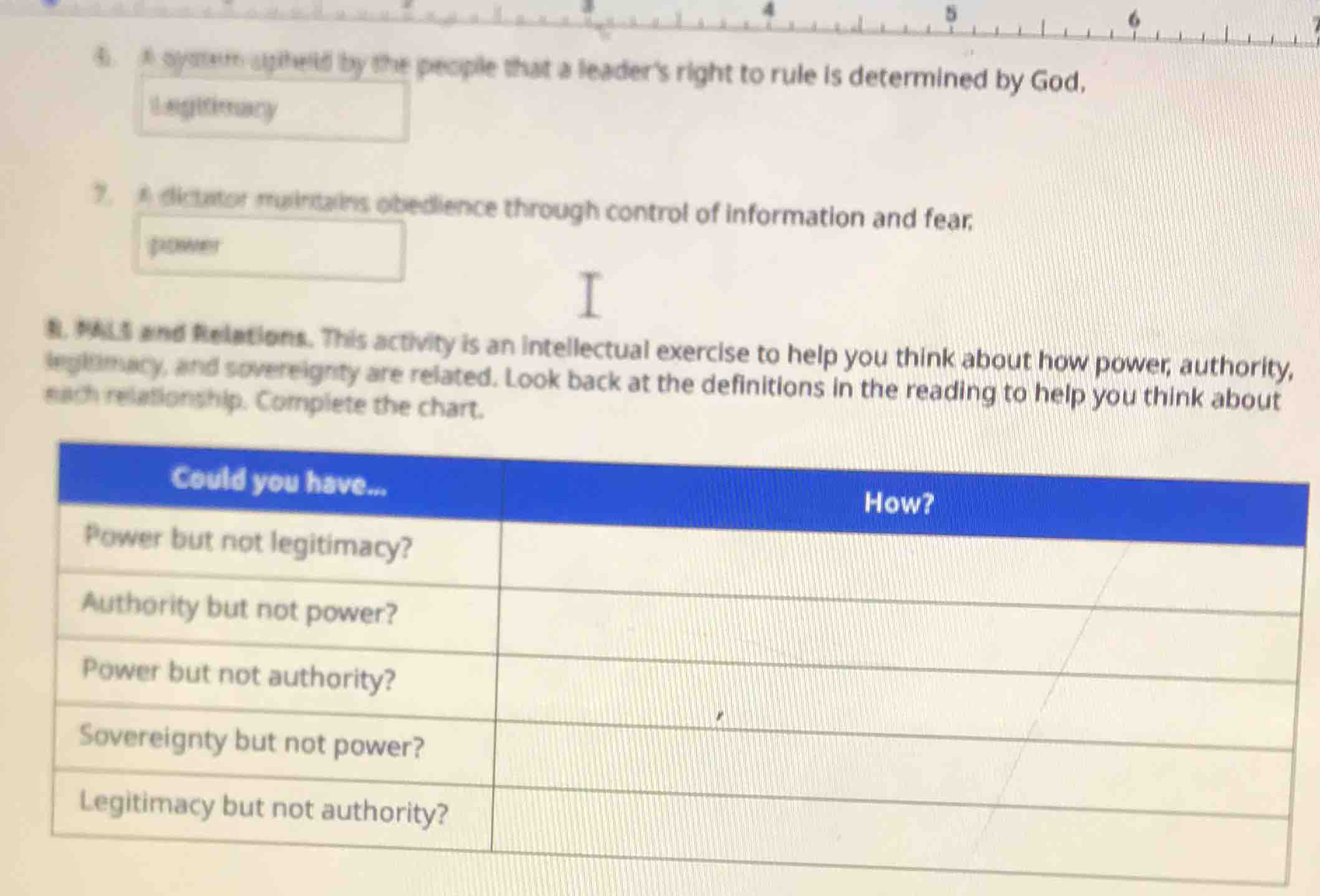
- a system upheld by the people that a leaders right to rule is determined by god.legitimacy7. a dictator maintains obedience through control of information and fear.power8. pals and relations. this activity is an intellectual exercise to help you think about how power, authority, legitimacy, and sovereignty are related. look back at the definitions in the reading to help you think about each relationship. complete the chart.could you have...how?power but not legitimacy?authority but not power?power but not authority?sovereignty but not power?legitimacy but not authority?
Brief Explanations
First, address the matching questions, then complete the chart using core political definitions:
- For question 6: The system where a leader's right to rule is divinely ordained is the divine right of kings, a form of traditional legitimacy.
- For question 7: A dictator using fear/information control relies on coercive power.
- For the chart:
- Power without legitimacy: Coercive rule lacks public acceptance.
- Authority without power: A figure has formal right but no enforcement.
- Power without authority: Coercion lacks formal institutional backing.
- Sovereignty without power: A state has legal status but no enforcement capacity.
- Legitimacy without authority: Public support exists but no formal governing role.

Snap & solve any problem in the app
Get step-by-step solutions on Sovi AI
Photo-based solutions with guided steps
Explore more problems and detailed explanations
Matching Questions:
- Divine Right of Kings (Legitimacy category)
- Coercive Power
Completed Chart:
| Could you have... | How? |
|---|---|
| Authority but not power? | Yes: A ceremonial monarch (e.g., the British Monarch) has formal legal authority but no real executive power to enforce decisions. |
| Power but not authority? | Yes: A rebel militia controls territory through force, but has no formal legal or institutional right to rule. |
| Sovereignty but not power? | Yes: A small, occupied nation has legal sovereign status under international law, but cannot exercise control over its territory or policies. |
| Legitimacy but not authority? | Yes: A widely respected community leader has public support and moral legitimacy, but holds no formal government position or legal authority to make binding rules. |