QUESTION IMAGE
Question
table
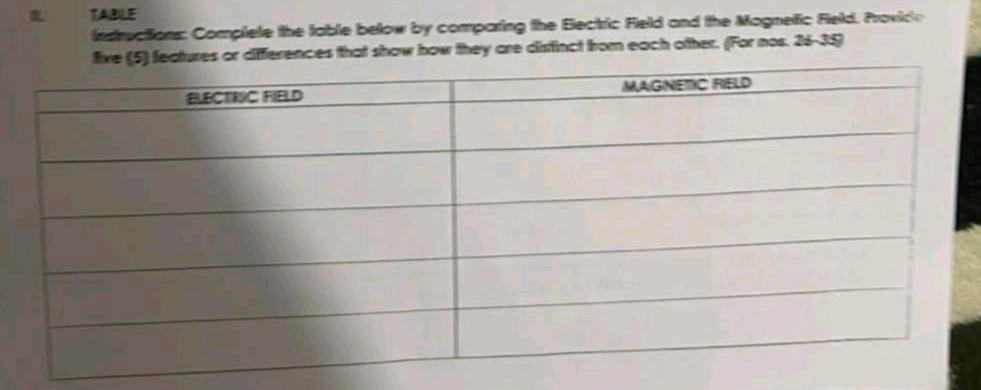
instructions: complete the table below by comparing the electric field and the magnetic field. provide five (5) features or differences that show how they are distinct from each other. (for nos. 26 - 30)
| electric field | magnetic field |
|---|---|
To complete the table comparing Electric Field and Magnetic Field, we identify five key differences:
| ELECTRIC FIELD | MAGNETIC FIELD |
|---|---|
| 2. Field lines start from positive charges and end at negative charges (or extend to infinity). | 2. Field lines are closed loops (no isolated magnetic monopoles; they form continuous loops from north to south pole inside and outside a magnet). |
| 3. Exerts a force on electric charges (both stationary and moving) given by $\vec{F} = q\vec{E}$. | 3. Exerts a force only on moving electric charges (or current-carrying conductors) given by $\vec{F} = q\vec{v} \times \vec{B}$ (Lorentz force law for charges; for currents, $\vec{F} = I\vec{l} \times \vec{B}$). |
| 4. Can do work on a charged particle (since the force is along the field direction for positive charges, allowing transfer of energy). | 4. Does no work on a charged particle (the magnetic force is always perpendicular to the velocity of the charge, so $W = \vec{F} \cdot \vec{d} = 0$). |
| 5. The electric field is conservative (the work done in moving a charge around a closed path is zero, and the curl of the electric field is related to the rate of change of magnetic flux, $
abla \times \vec{E} = -\frac{\partial \vec{B}}{\partial t}$ from Faraday’s law). | 5. The magnetic field is non - conservative (the work done in moving a charge around a closed path in a magnetic field is not zero in the context of energy transfer, and the divergence of the magnetic field is zero, $
abla \cdot \vec{B} = 0$ (Gauss’s law for magnetism)). |
These five features highlight the fundamental distinctions between electric and magnetic fields in terms of their sources, field line patterns, force interactions, work - doing capabilities, and field properties.

Snap & solve any problem in the app
Get step-by-step solutions on Sovi AI
Photo-based solutions with guided steps
Explore more problems and detailed explanations
To complete the table comparing Electric Field and Magnetic Field, we identify five key differences:
| ELECTRIC FIELD | MAGNETIC FIELD |
|---|---|
| 2. Field lines start from positive charges and end at negative charges (or extend to infinity). | 2. Field lines are closed loops (no isolated magnetic monopoles; they form continuous loops from north to south pole inside and outside a magnet). |
| 3. Exerts a force on electric charges (both stationary and moving) given by $\vec{F} = q\vec{E}$. | 3. Exerts a force only on moving electric charges (or current-carrying conductors) given by $\vec{F} = q\vec{v} \times \vec{B}$ (Lorentz force law for charges; for currents, $\vec{F} = I\vec{l} \times \vec{B}$). |
| 4. Can do work on a charged particle (since the force is along the field direction for positive charges, allowing transfer of energy). | 4. Does no work on a charged particle (the magnetic force is always perpendicular to the velocity of the charge, so $W = \vec{F} \cdot \vec{d} = 0$). |
| 5. The electric field is conservative (the work done in moving a charge around a closed path is zero, and the curl of the electric field is related to the rate of change of magnetic flux, $
abla \times \vec{E} = -\frac{\partial \vec{B}}{\partial t}$ from Faraday’s law). | 5. The magnetic field is non - conservative (the work done in moving a charge around a closed path in a magnetic field is not zero in the context of energy transfer, and the divergence of the magnetic field is zero, $
abla \cdot \vec{B} = 0$ (Gauss’s law for magnetism)). |
These five features highlight the fundamental distinctions between electric and magnetic fields in terms of their sources, field line patterns, force interactions, work - doing capabilities, and field properties.