QUESTION IMAGE
Question
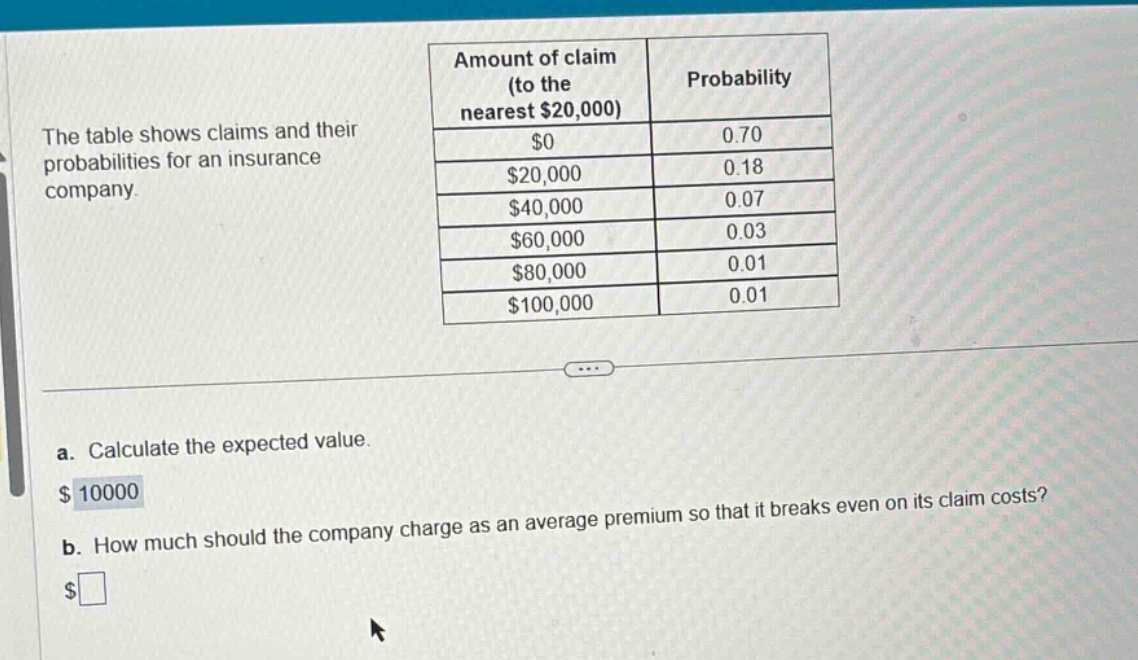
the table shows claims and their probabilities for an insurance company.
| amount of claim (to the nearest $20,000) | probability |
|---|---|
| $20,000 | 0.18 |
| $40,000 | 0.07 |
| $60,000 | 0.03 |
| $80,000 | 0.01 |
| $100,000 | 0.01 |
a. calculate the expected value.
$10000
b. how much should the company charge as an average premium so that it breaks even on its claim costs?
$\square
Part a: Calculate the Expected Value
Step1: Recall the formula for expected value
The expected value \( E(X) \) of a discrete random variable is given by \( E(X)=\sum_{i} x_i P(x_i) \), where \( x_i \) is the value of the random variable and \( P(x_i) \) is the corresponding probability.
Step2: Multiply each claim amount by its probability
- For \( x = 0 \), \( P(x)=0.70 \): \( 0\times0.70 = 0 \)
- For \( x = 20000 \), \( P(x)=0.18 \): \( 20000\times0.18 = 3600 \)
- For \( x = 40000 \), \( P(x)=0.07 \): \( 40000\times0.07 = 2800 \)
- For \( x = 60000 \), \( P(x)=0.03 \): \( 60000\times0.03 = 1800 \)
- For \( x = 80000 \), \( P(x)=0.01 \): \( 80000\times0.01 = 800 \)
- For \( x = 100000 \), \( P(x)=0.01 \): \( 100000\times0.01 = 1000 \)
Step3: Sum up all the products
\( E(X)=0 + 3600+2800 + 1800+800 + 1000 \)
\( E(X)=3600 + 2800=6400 \); \( 6400+1800 = 8200 \); \( 8200+800 = 9000 \); \( 9000+1000 = 10000 \)
Step1: Understand break - even in insurance
To break even on claim costs, the average premium the company charges should be equal to the expected value of the claim amounts. This is because the expected value represents the long - run average cost per claim for the insurance company.
Step2: Conclude the premium amount
Since the expected value of the claim (from part a) is \( \$10000 \), the company should charge an average premium equal to this expected value to break even.

Snap & solve any problem in the app
Get step-by-step solutions on Sovi AI
Photo-based solutions with guided steps
Explore more problems and detailed explanations
(for part a):
\( \$10000 \)