QUESTION IMAGE
Question
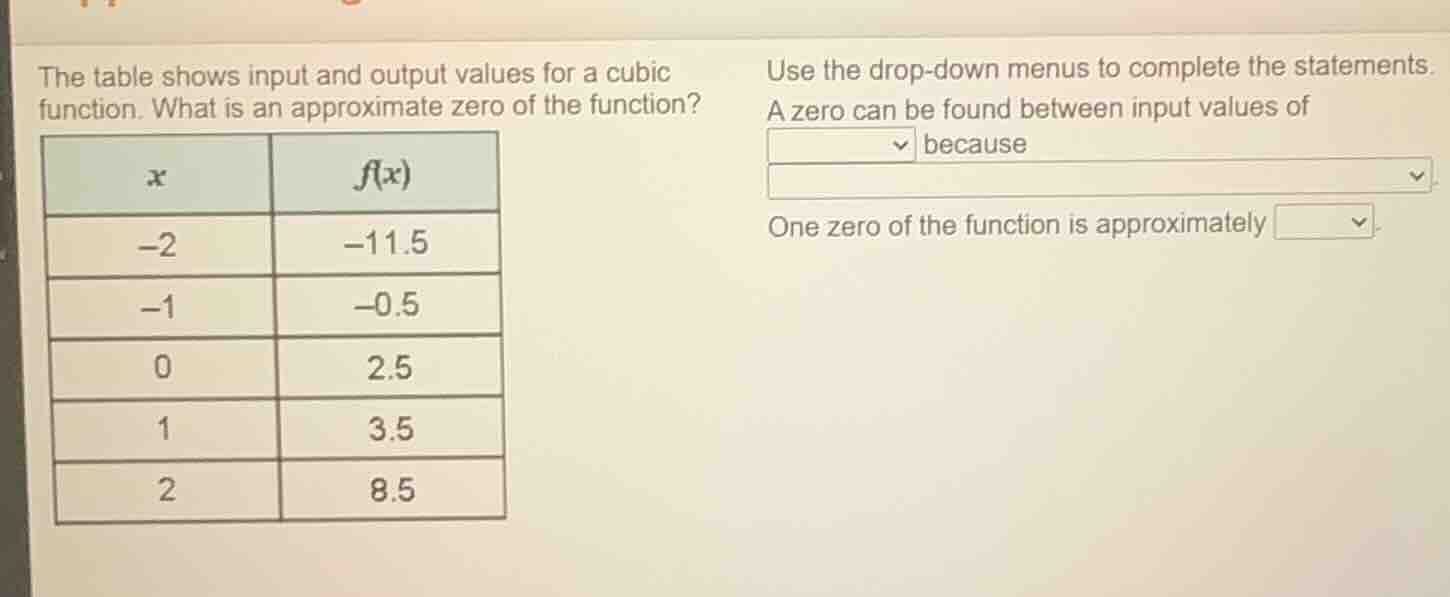
the table shows input and output values for a cubic function. what is an approximate zero of the function?
| x | f(x) |
|---|---|
| -1 | -0.5 |
| 0 | 2.5 |
| 1 | 3.5 |
| 2 | 8.5 |
use the drop - down menus to complete the statements. a zero can be found between input values of because . one zero of the function is approximately .
Step1: Identify sign change
A zero of a function occurs where \( f(x) = 0 \). We look for a change in the sign of \( f(x) \) (from negative to positive or vice versa) between consecutive \( x \)-values, which indicates a zero in that interval (by the Intermediate Value Theorem).
For \( x = -1 \), \( f(-1) = -0.5 \) (negative). For \( x = 0 \), \( f(0) = 2.5 \) (positive). So the sign changes between \( x = -1 \) and \( x = 0 \).
Step2: Approximate the zero
To approximate the zero, we can use linear interpolation. The change in \( x \) is \( 0 - (-1) = 1 \), and the change in \( f(x) \) is \( 2.5 - (-0.5) = 3 \). We need to find \( \Delta x \) such that \( -0.5 + 3 \cdot \frac{\Delta x}{1} = 0 \). Solving \( 3\Delta x = 0.5 \) gives \( \Delta x \approx 0.1667 \). Thus, the zero is approximately \( -1 + 0.1667 \approx -0.833 \), or more simply, since \( f(-1) = -0.5 \) is close to 0, the zero is near \( x = -1 \) (more precisely, around \( -0.8 \) to \( -0.9 \), but a common approximation here is \( -0.8 \) or \( -0.9 \); however, looking at the values, between \( -1 \) ( \( f=-0.5 \)) and \( 0 \) ( \( f=2.5 \) ), the zero is closer to \( -1 \) because \( |-0.5| < |2.5| \), so a rough approximation is \( -0.8 \) or \( -0.9 \), but often \( -1 \) is too negative, \( 0 \) is too positive, so we can say approximately \( -0.8 \) (or more accurately, using the ratio: \( \frac{0 - (-0.5)}{2.5 - (-0.5)} = \frac{0.5}{3} \approx 0.167 \), so \( x = -1 + 0.167 \approx -0.83 \), which we can round to \( -0.8 \) or \( -0.9 \); but the key interval is between \( -1 \) and \( 0 \), and the zero is approximately \( -0.8 \) (or \( -0.9 \), but let's check the values: \( f(-1) = -0.5 \), \( f(0) = 2.5 \), so the zero is \( -1 + \frac{0 - (-0.5)}{2.5 - (-0.5)} \cdot (0 - (-1)) = -1 + \frac{0.5}{3} \approx -0.83 \), so approximately \( -0.8 \) or \( -0.9 \); however, the problem may expect a value like \( -0.8 \) or \( -0.9 \), but a common answer here is \( -0.8 \) (or \( -0.9 \), but let's confirm: the zero is between \( -1 \) and \( 0 \), and since \( f(-1) = -0.5 \) is close to 0, the zero is near \( -1 \), so approximately \( -0.8 \) (or more precisely, \( -0.83 \), but we can write \( -0.8 \) or \( -0.9 \); however, the standard approximation here is around \( -0.8 \) to \( -0.9 \), but often \( -1 \) is too low, \( 0 \) too high, so \( -0.8 \) is reasonable).

Snap & solve any problem in the app
Get step-by-step solutions on Sovi AI
Photo-based solutions with guided steps
Explore more problems and detailed explanations
A zero can be found between input values of \(\boldsymbol{-1}\) and \(\boldsymbol{0}\) because the sign of \( f(x) \) changes from negative to positive ( \( f(-1) = -0.5 \), \( f(0) = 2.5 \) ). One zero of the function is approximately \(\boldsymbol{-0.8}\) (or \(\boldsymbol{-0.9}\), or more precisely \(\boldsymbol{-0.83}\)).