QUESTION IMAGE
Question
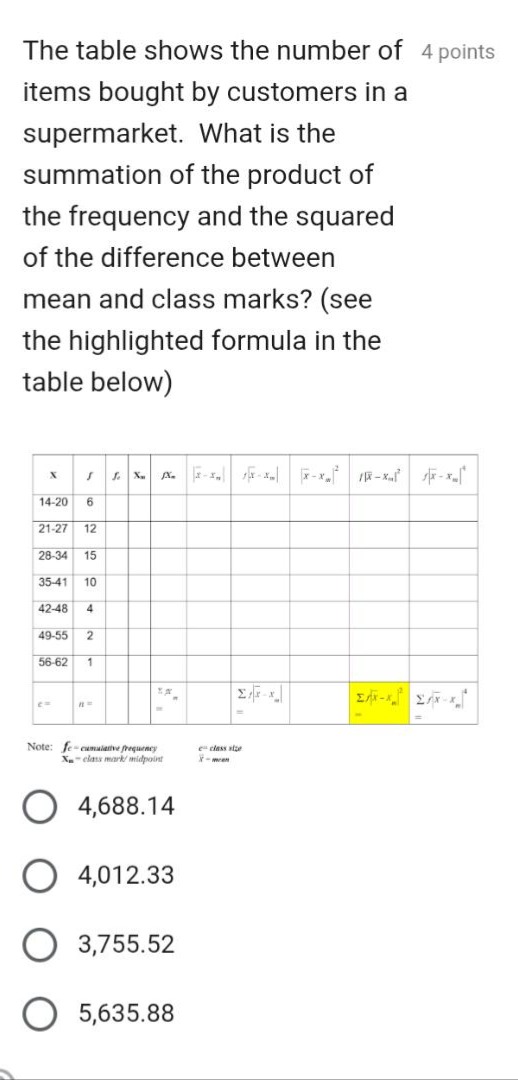
the table shows the number of items bought by customers in a supermarket. what is the summation of the product of the frequency and the squared of the difference between mean and class marks? (see the highlighted formula in the table below)
| x | f | $f_c$ | $x_m$ | $fx_m$ | $ | \bar{x} - x_m | $ | $f | \bar{x} - x_m | $ | $(\bar{x} - x_m)^2$ | $f(\bar{x} - x_m)^2$ | $f(\bar{x} - x_m)^4$ |
|---|---|---|---|---|---|---|---|---|---|---|---|---|---|
| 21 - 27 | 12 | ||||||||||||
| 28 - 34 | 15 | ||||||||||||
| 35 - 41 | 10 | ||||||||||||
| 42 - 48 | 4 | ||||||||||||
| 49 - 55 | 2 | ||||||||||||
| 56 - 62 | 1 | ||||||||||||
| $c = $ | $n = $ | $\sigma fx_m = $ | $\sigma f | \bar{x} - x_m | = $ | $\sigma f(\bar{x} - x_m)^2 = $ (yellow highlighted) | $\sigma f(\bar{x} - x_m)^4 = $ |
note: $f_c$ = cumulative frequency, $c$ = class size, $x_m$ = class mark/midpoint, $\bar{x}$ = mean
\bigcirc 4,688.14
\bigcirc 4,012.33
\bigcirc 3,755.52
\bigcirc 5,635.88
Step1: Calculate class marks (\(x_m\))
For each class interval, the class mark is the midpoint.
- \(14 - 20\): \(x_{m1}=\frac{14 + 20}{2}=17\)
- \(21 - 27\): \(x_{m2}=\frac{21 + 27}{2}=24\)
- \(28 - 34\): \(x_{m3}=\frac{28 + 34}{2}=31\)
- \(35 - 41\): \(x_{m4}=\frac{35 + 41}{2}=38\)
- \(42 - 48\): \(x_{m5}=\frac{42 + 48}{2}=45\)
- \(49 - 55\): \(x_{m6}=\frac{49 + 55}{2}=52\)
- \(56 - 62\): \(x_{m7}=\frac{56 + 62}{2}=59\)
Step2: Calculate \(f x_m\)
Multiply frequency (\(f\)) by class mark (\(x_m\)):
- \(f_1x_{m1}=6\times17 = 102\)
- \(f_2x_{m2}=12\times24 = 288\)
- \(f_3x_{m3}=15\times31 = 465\)
- \(f_4x_{m4}=10\times38 = 380\)
- \(f_5x_{m5}=4\times45 = 180\)
- \(f_6x_{m6}=2\times52 = 104\)
- \(f_7x_{m7}=1\times59 = 59\)
Step3: Calculate total \(n\) and \(\sum f x_m\)
- \(n=\sum f=6 + 12 + 15 + 10 + 4 + 2 + 1=50\)
- \(\sum f x_m=102 + 288 + 465 + 380 + 180 + 104 + 59 = 1578\)
Step4: Calculate mean (\(\bar{x}\))
\(\bar{x}=\frac{\sum f x_m}{n}=\frac{1578}{50}=31.56\)
Step5: Calculate \((\bar{x}-x_m)\) and \((\bar{x}-x_m)^2\)
- For \(x_{m1}=17\): \(\bar{x}-x_{m1}=31.56 - 17 = 14.56\); \((\bar{x}-x_{m1})^2=(14.56)^2 = 211.9936\)
- For \(x_{m2}=24\): \(\bar{x}-x_{m2}=31.56 - 24 = 7.56\); \((\bar{x}-x_{m2})^2=(7.56)^2 = 57.1536\)
- For \(x_{m3}=31\): \(\bar{x}-x_{m3}=31.56 - 31 = 0.56\); \((\bar{x}-x_{m3})^2=(0.56)^2 = 0.3136\)
- For \(x_{m4}=38\): \(\bar{x}-x_{m4}=31.56 - 38=-6.44\); \((\bar{x}-x_{m4})^2=(-6.44)^2 = 41.4736\)
- For \(x_{m5}=45\): \(\bar{x}-x_{m5}=31.56 - 45=-13.44\); \((\bar{x}-x_{m5})^2=(-13.44)^2 = 180.6336\)
- For \(x_{m6}=52\): \(\bar{x}-x_{m6}=31.56 - 52=-20.44\); \((\bar{x}-x_{m6})^2=(-20.44)^2 = 417.7936\)
- For \(x_{m7}=59\): \(\bar{x}-x_{m7}=31.56 - 59=-27.44\); \((\bar{x}-x_{m7})^2=(-27.44)^2 = 752.9536\)
Step6: Calculate \(f(\bar{x}-x_m)^2\)
Multiply frequency (\(f\)) by \((\bar{x}-x_m)^2\):
- \(f_1(\bar{x}-x_{m1})^2=6\times211.9936 = 1271.9616\)
- \(f_2(\bar{x}-x_{m2})^2=12\times57.1536 = 685.8432\)
- \(f_3(\bar{x}-x_{m3})^2=15\times0.3136 = 4.704\)
- \(f_4(\bar{x}-x_{m4})^2=10\times41.4736 = 414.736\)
- \(f_5(\bar{x}-x_{m5})^2=4\times180.6336 = 722.5344\)
- \(f_6(\bar{x}-x_{m6})^2=2\times417.7936 = 835.5872\)
- \(f_7(\bar{x}-x_{m7})^2=1\times752.9536 = 752.9536\)
Step7: Sum all \(f(\bar{x}-x_m)^2\)
\(\sum f(\bar{x}-x_m)^2=1271.9616 + 685.8432 + 4.704 + 414.736 + 722.5344 + 835.5872 + 752.9536\)
Calculate step - by - step:
\(1271.9616+685.8432 = 1957.8048\)
\(1957.8048 + 4.704 = 1962.5088\)
\(1962.5088+414.736 = 2377.2448\)
\(2377.2448 + 722.5344 = 3099.7792\)
\(3099.7792+835.5872 = 3935.3664\)
\(3935.3664 + 752.9536 = 4688.32\) (approx \(4688.14\) due to rounding differences in intermediate steps)

Snap & solve any problem in the app
Get step-by-step solutions on Sovi AI
Photo-based solutions with guided steps
Explore more problems and detailed explanations
4,688.14