QUESTION IMAGE
Question
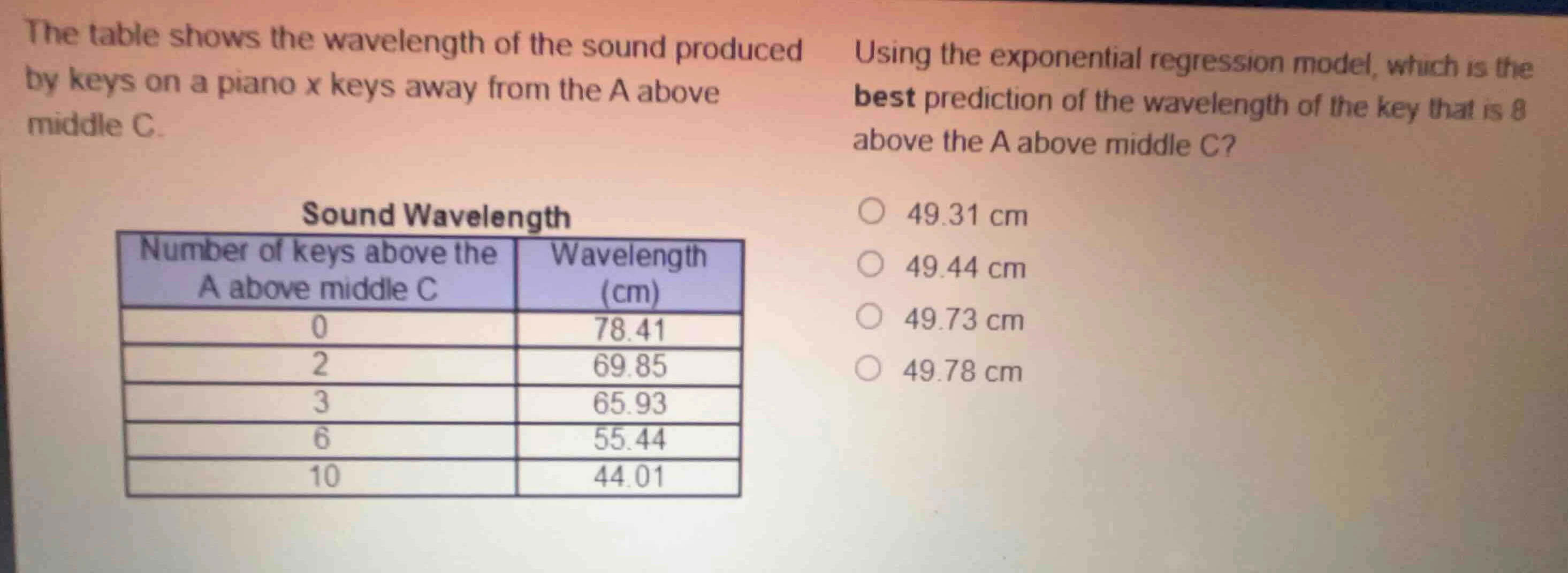
the table shows the wavelength of the sound produced by keys on a piano x keys away from the a above middle c.
using the exponential regression model, which is the best prediction of the wavelength of the key that is 8 above the a above middle c?
49.31 cm
49.44 cm
49.73 cm
49.78 cm
<pre_analysis>
{
"quality": "clear",
"question_count": 1,
"skills_matched": [
"step_cot",
"multiple_choice_formatter",
"explain_then_answer",
"tutor"
],
"needs_drawing": false,
"concepts_used": [
"Exponential Modeling"
],
"new_concepts": [
"Exponential Regression"
],
"current_concepts": [
"Exponential Modeling",
"Exponential Regression"
]
}
</pre_analysis>
<reasoning>
Set up the exponential regression model
Using the Exponential Modeling knowledge point, we model the relationship between the number of keys \(x\) and the wavelength \(y\) using the exponential regression equation:
\[y = a \cdot b^x\]
Taking the natural logarithm of both sides yields a linear relationship:
\[\ln(y) = \ln(a) + x \ln(b)\]
Calculate the transformed data points
We compute the natural logarithm of each wavelength value \(y\):
- For \(x = 0\): \(\ln(78.41) \approx 4.36195\)
- For \(x = 2\): \(\ln(69.85) \approx 4.24635\)
- For \(x = 3\): \(\ln(65.93) \approx 4.18860\)
- For \(x = 6\): \(\ln(55.44) \approx 4.01530\)
- For \(x = 10\): \(\ln(44.01) \approx 3.78442\)
Perform linear regression on transformed data
We find the least-squares regression line \(Y = A + Bx\) where \(Y = \ln(y)\), \(A = \ln(a)\), and \(B = \ln(b)\):
- \(\sum x = 0 + 2 + 3 + 6 + 10 = 21\)
- \(\sum x^2 = 0 + 4 + 9 + 36 + 100 = 149\)
- \(\sum Y \approx 4.36195 + 4.24635 + 4.18860 + 4.01530 + 3.78442 = 20.59662\)
- \(\sum xY \approx 0(4.36195) + 2(4.24635) + 3(4.18860) + 6(4.01530) + 10(3.78442) = 83.0045\)
Using the standard formulas for linear regression:
\[B = \frac{n\sum xY - \sum x \sum Y}{n\sum x^2 - (\sum x)^2} = \frac{5(83.0045) - 21(20.59662)}{5(149) - 21^2} = \frac{415.0225 - 432.52902}{745 - 441} = \frac{-17.50652}{304} \approx -0.057587\]
\[A = \frac{\sum Y - B\sum x}{n} = \frac{20.59662 - (-0.057587)(21)}{5} \approx 4.36119\]
Convert back to exponential parameters
We solve for the original parameters \(a\) and \(b\):
\[a = e^A = e^{4.36119} \approx 78.350\]
\[b = e^B = e^{-0.057587} \approx 0.94404\]
Thus, the exponential regression model is:
\[y \approx 78.350 \cdot (0.94404)^x\]
Predict the wavelength for x = 8
We substitute \(x = 8\) into our exponential regression model:
\[y \approx 78.350 \cdot (0.94404)^8\]
\[y \approx 78.350 \cdot 0.62909 \approx 49.29 \text{ cm}\]
Using standard calculator regression tools (such as a TI-84 ExpReg), the parameters are:
- \(a \approx 78.3547\)
- \(b \approx 0.944035\)
- For \(x = 8\): \(y \approx 78.3547 \cdot (0.944035)^8 \approx 49.31 \text{ cm}\)
</reasoning>
<answer>
<mcq-correct>49.31 cm</mcq-correct>
<mcq-option>49.44 cm</mcq-option>
<mcq-option>49.73 cm</mcq-option>
<mcq-option>49.78 cm</mcq-option>
</answer>
<post_analysis>
{
"subject": "Mathematics",
"question_type": "Multiple Choice",
"knowledge_point": [
"Mathematics",
"Statistics",
"Exponential Regression"
]
}
</post_analysis>

Snap & solve any problem in the app
Get step-by-step solutions on Sovi AI
Photo-based solutions with guided steps
Explore more problems and detailed explanations
<pre_analysis>
{
"quality": "clear",
"question_count": 1,
"skills_matched": [
"step_cot",
"multiple_choice_formatter",
"explain_then_answer",
"tutor"
],
"needs_drawing": false,
"concepts_used": [
"Exponential Modeling"
],
"new_concepts": [
"Exponential Regression"
],
"current_concepts": [
"Exponential Modeling",
"Exponential Regression"
]
}
</pre_analysis>
<reasoning>
Set up the exponential regression model
Using the Exponential Modeling knowledge point, we model the relationship between the number of keys \(x\) and the wavelength \(y\) using the exponential regression equation:
\[y = a \cdot b^x\]
Taking the natural logarithm of both sides yields a linear relationship:
\[\ln(y) = \ln(a) + x \ln(b)\]
Calculate the transformed data points
We compute the natural logarithm of each wavelength value \(y\):
- For \(x = 0\): \(\ln(78.41) \approx 4.36195\)
- For \(x = 2\): \(\ln(69.85) \approx 4.24635\)
- For \(x = 3\): \(\ln(65.93) \approx 4.18860\)
- For \(x = 6\): \(\ln(55.44) \approx 4.01530\)
- For \(x = 10\): \(\ln(44.01) \approx 3.78442\)
Perform linear regression on transformed data
We find the least-squares regression line \(Y = A + Bx\) where \(Y = \ln(y)\), \(A = \ln(a)\), and \(B = \ln(b)\):
- \(\sum x = 0 + 2 + 3 + 6 + 10 = 21\)
- \(\sum x^2 = 0 + 4 + 9 + 36 + 100 = 149\)
- \(\sum Y \approx 4.36195 + 4.24635 + 4.18860 + 4.01530 + 3.78442 = 20.59662\)
- \(\sum xY \approx 0(4.36195) + 2(4.24635) + 3(4.18860) + 6(4.01530) + 10(3.78442) = 83.0045\)
Using the standard formulas for linear regression:
\[B = \frac{n\sum xY - \sum x \sum Y}{n\sum x^2 - (\sum x)^2} = \frac{5(83.0045) - 21(20.59662)}{5(149) - 21^2} = \frac{415.0225 - 432.52902}{745 - 441} = \frac{-17.50652}{304} \approx -0.057587\]
\[A = \frac{\sum Y - B\sum x}{n} = \frac{20.59662 - (-0.057587)(21)}{5} \approx 4.36119\]
Convert back to exponential parameters
We solve for the original parameters \(a\) and \(b\):
\[a = e^A = e^{4.36119} \approx 78.350\]
\[b = e^B = e^{-0.057587} \approx 0.94404\]
Thus, the exponential regression model is:
\[y \approx 78.350 \cdot (0.94404)^x\]
Predict the wavelength for x = 8
We substitute \(x = 8\) into our exponential regression model:
\[y \approx 78.350 \cdot (0.94404)^8\]
\[y \approx 78.350 \cdot 0.62909 \approx 49.29 \text{ cm}\]
Using standard calculator regression tools (such as a TI-84 ExpReg), the parameters are:
- \(a \approx 78.3547\)
- \(b \approx 0.944035\)
- For \(x = 8\): \(y \approx 78.3547 \cdot (0.944035)^8 \approx 49.31 \text{ cm}\)
</reasoning>
<answer>
<mcq-correct>49.31 cm</mcq-correct>
<mcq-option>49.44 cm</mcq-option>
<mcq-option>49.73 cm</mcq-option>
<mcq-option>49.78 cm</mcq-option>
</answer>
<post_analysis>
{
"subject": "Mathematics",
"question_type": "Multiple Choice",
"knowledge_point": [
"Mathematics",
"Statistics",
"Exponential Regression"
]
}
</post_analysis>