QUESTION IMAGE
Question
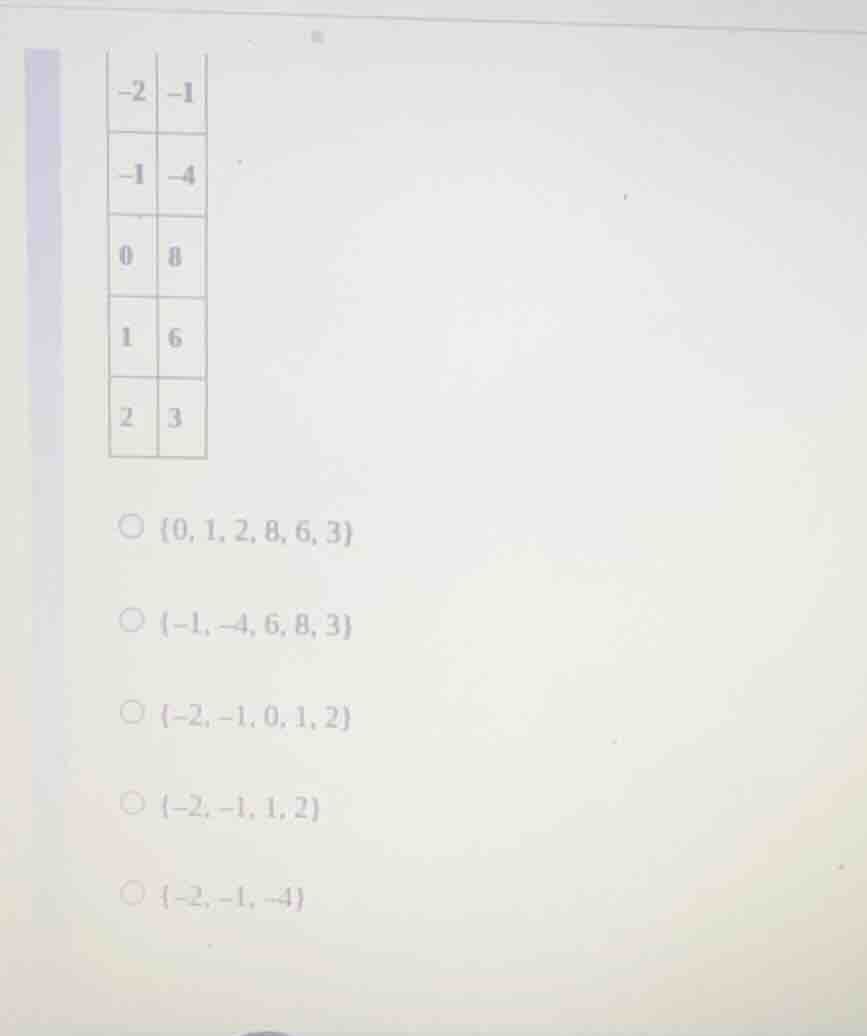
the table has two columns. the first column has values -2, -1, 0, 1, 2; the second column has values -1, -4, 8, 6, 3. the multiple - choice options are: \\(\\{0, 1, 2, 8, 6, 3\\}\\), \\(\\{-1, -4, 6, 8, 3\\}\\), \\(\\{-2, -1, 0, 1, 2\\}\\), \\(\\{-2, -1, 1, 2\\}\\), \\(\\{-2, -1, -4\\}\\)
Step1: Identify the domain (first column)
The table has two columns. The first column contains the values: -2, -1, 0, 1, 2. These represent the input or domain values of a relation (like a function's x - values).
Step2: Match with options
We check each option:
- Option 1: {0, 1, 2, 8, 6, 3} – these are mostly from the second column (range), not the first.
- Option 2: {-1, -4, 6, 8, 3} – these are from the second column (range).
- Option 3: {-2, -1, 0, 1, 2} – these are exactly the values in the first column (domain).
- Option 4: {-2, -1, 1, 2} – missing 0 from the first column.
- Option 5: {-2, -1, -4} – -4 is from the second column, and 0,1,2 are missing from the first column.

Snap & solve any problem in the app
Get step-by-step solutions on Sovi AI
Photo-based solutions with guided steps
Explore more problems and detailed explanations
C. {-2, -1, 0, 1, 2} (assuming the third option is labeled C; if the original options had labels like A, B, C, D, E with the third being C, then the answer is C. {-2, -1, 0, 1, 2})