QUESTION IMAGE
Question
take notes
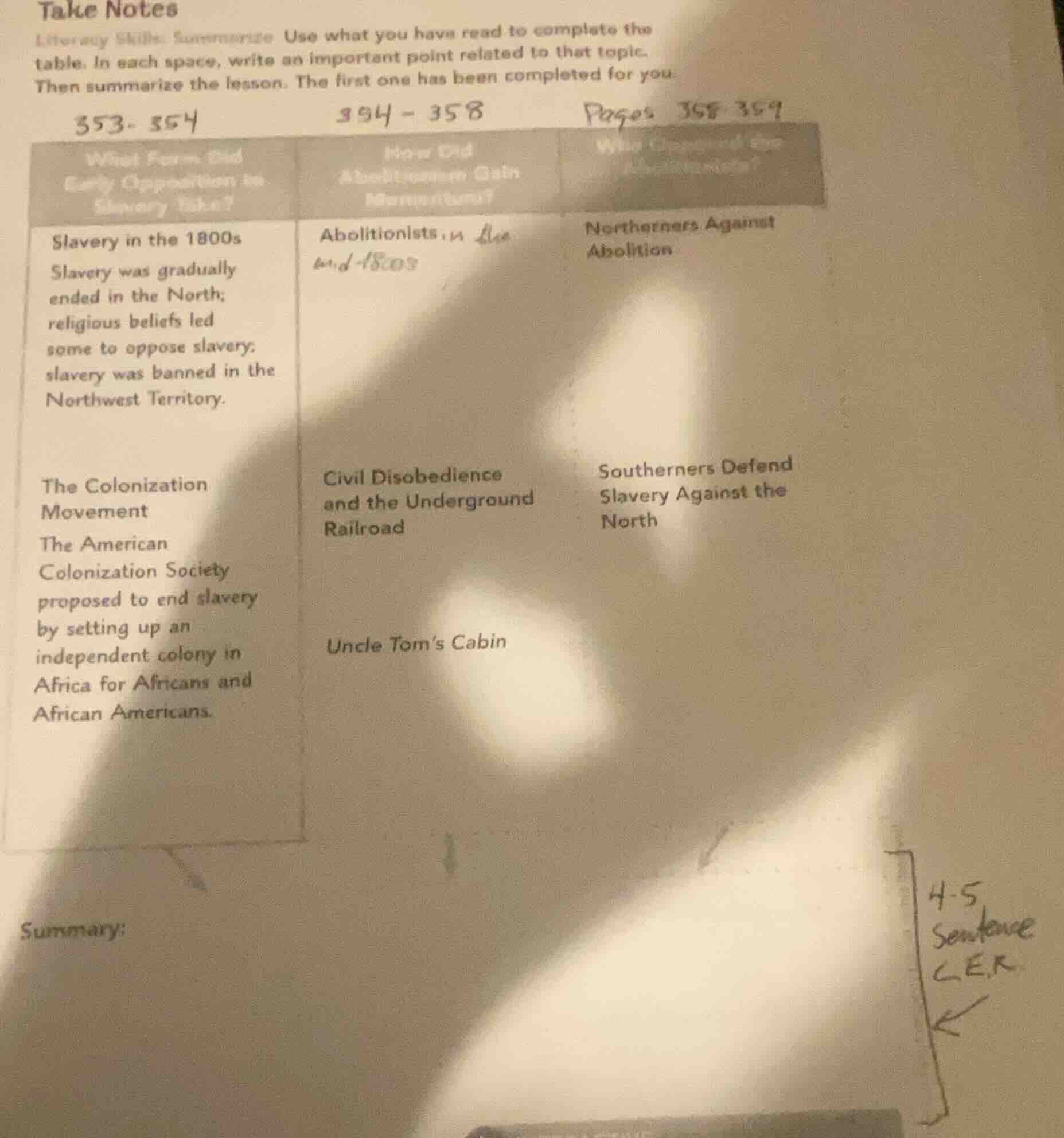
literacy skills: summarize use what you have read to complete the
table. in each space, write an important point related to that topic.
then summarize the lesson. the first one has been completed for you.
353- 354
354 - 358
pages 358-359
what form did
early opposition to
slavery take?
how did
abolitionism gain
momentum?
what opposed the
abolitionists?
slavery in the 1800s
slavery was gradually
ended in the north;
religious beliefs led
some to oppose slavery;
slavery was banned in the
northwest territory.
abolitionists in the
and 1800s
northerners against
abolition
the colonization
movement
the american
colonization society
proposed to end slavery
by setting up an
independent colony in
africa for africans and
african americans.
civil disobedience
and the underground
railroad
southerners defend
slavery against the
north
uncle toms cabin
summary:
4-5
sentence
c.e.r.
Completed the table with key historical points from U.S. abolitionist history, then wrote a concise 4-5 sentence summary.

Snap & solve any problem in the app
Get step-by-step solutions on Sovi AI
Photo-based solutions with guided steps
Explore more problems and detailed explanations
Completed Table:
| What Form Did Early Opposition to Slavery Take? | How Did Abolitionism Gain Momentum? | What Opposed the Abolitionists? |
|---|---|---|
| The Colonization Movement<br>The American Colonization Society proposed to end slavery by setting up an independent colony in Africa for Africans and African Americans. | Civil Disobedience and the Underground Railroad<br>Enslaved people and allies used secret networks (Underground Railroad) to escape to freedom; acts of civil disobedience challenged slave laws. | Southerners Defend Slavery Against the North<br>Southern leaders argued slavery was vital to their agrarian economy, claimed enslaved people were "better off" under slavery, and passed laws restricting anti-slavery speech. |
| Uncle Tom’s Cabin<br>Harriet Beecher Stowe’s 1852 novel humanized enslaved people, spreading anti-slavery sentiment across the North and angering the South. |
Summary:
In the early 1800s, opposition to slavery in the U.S. emerged gradually in the North, where slavery was phased out and banned in the Northwest Territory, and through the Colonization Movement, which proposed relocating Black people to Africa. Abolitionism gained major momentum in the 1830s with radical activists like William Lloyd Garrison, the secret escape network of the Underground Railroad, and the wildly influential novel Uncle Tom’s Cabin, which turned many Northerners against slavery. However, the movement faced fierce pushback: many Northerners opposed abolition over economic fears and a desire to avoid sectional conflict, while Southern leaders defended slavery as essential to their economy and a "positive good" for enslaved people. This growing divide between pro- and anti-slavery factions deepened tensions between the North and South, laying critical groundwork for the U.S. Civil War.