QUESTION IMAGE
Question
take quiz
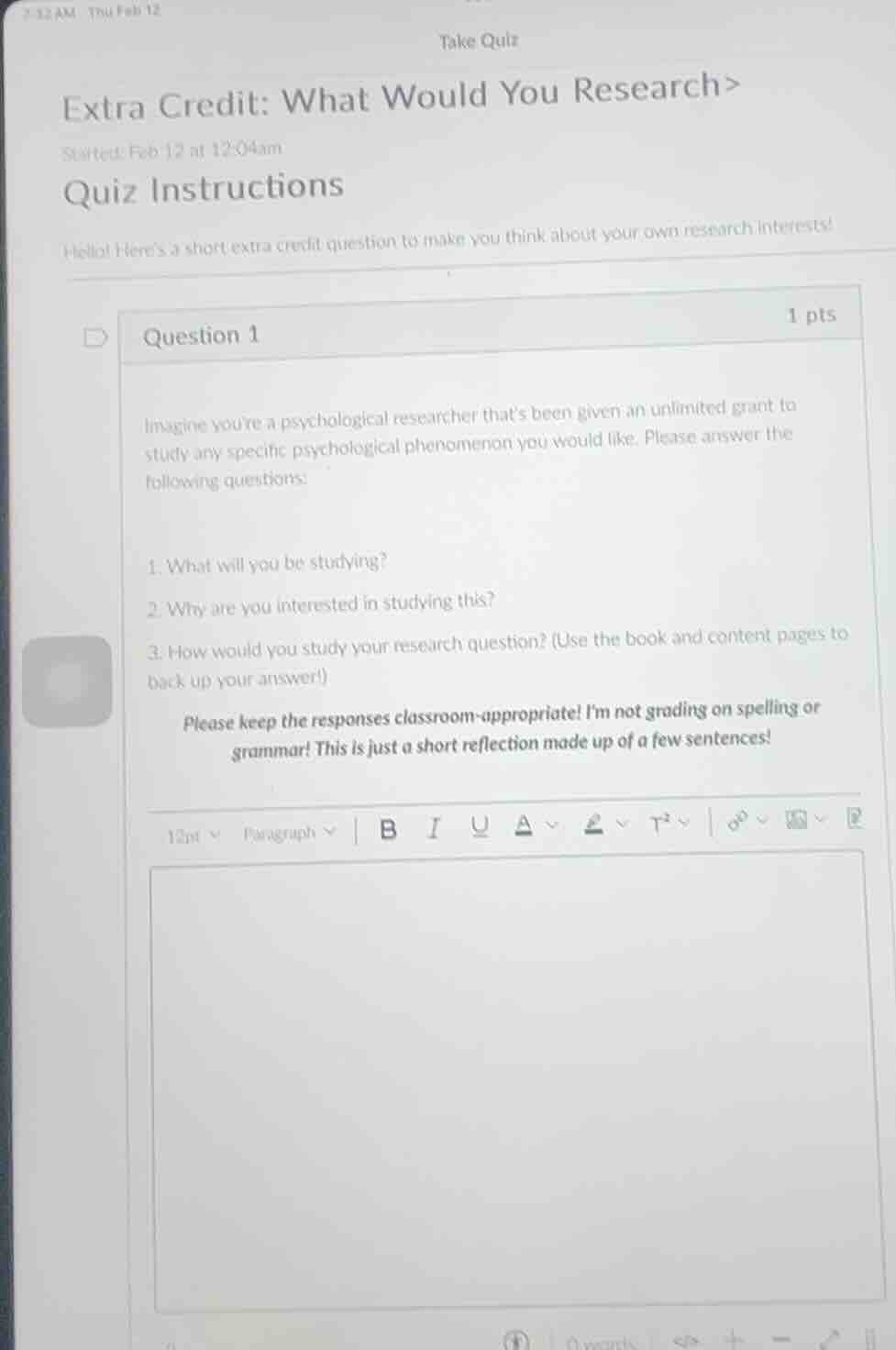
extra credit: what would you research>
started: feb 12 at 12:04am
quiz instructions
hello! heres a short extra credit question to make you think about your own research interests!
question 1 1 pts
imagine youre a psychological researcher thats been given an unlimited grant to study any specific psychological phenomenon you would like. please answer the following questions:
- what will you be studying?
- why are you interested in studying this?
- how would you study your research question? (use the book and content pages to back up your answer!)
please keep the responses classroom-appropriate! im not grading on spelling or grammar! this is just a short reflection made up of a few sentences!
Brief Explanations
- For the research topic, I selected the psychological phenomenon of "the impact of micro-interactions on long-term romantic relationship satisfaction" as it is a relatable, understudied area with real-world implications.
- The interest stems from observing that small, daily interactions are often overlooked in relationship advice, yet anecdotal evidence suggests they shape long-term connection; this research could fill a gap in applied relationship psychology.
- The study would use a mixed-methods approach: first, a longitudinal correlational study (following 200 romantic couples over 2 years, having them log daily micro-interactions and weekly relationship satisfaction scores, aligned with research methods for longitudinal data in psychology textbooks) to identify correlations. Then, a randomized controlled trial where half the couples are taught a micro-interaction skill set, to test causal links, with post-intervention satisfaction surveys to measure impact.

Snap & solve any problem in the app
Get step-by-step solutions on Sovi AI
Photo-based solutions with guided steps
Explore more problems and detailed explanations
- I will be studying the impact of daily positive micro-interactions (like small compliments, active listening moments, or shared inside jokes) on long-term romantic relationship satisfaction.
- I am interested in this because popular relationship advice often focuses on big gestures, but small, consistent daily interactions form the foundation of most long-term partnerships, and there is limited research on their specific, long-term causal impact on satisfaction.
- I would use a mixed-methods approach: First, a longitudinal study following 200 romantic couples over 2 years, having them complete daily digital journals to log micro-interactions and weekly validated relationship satisfaction scales (as recommended in psychological research methodology content for tracking long-term behavioral and attitudinal data). Second, a randomized controlled trial where 100 of the couples receive a 4-week workshop on intentional positive micro-interactions, while the other 100 do not; I would compare satisfaction scores pre- and post-intervention, as well as at the 2-year mark, to test if intentional micro-interactions lead to higher long-term satisfaction.