QUESTION IMAGE
Question
- target i
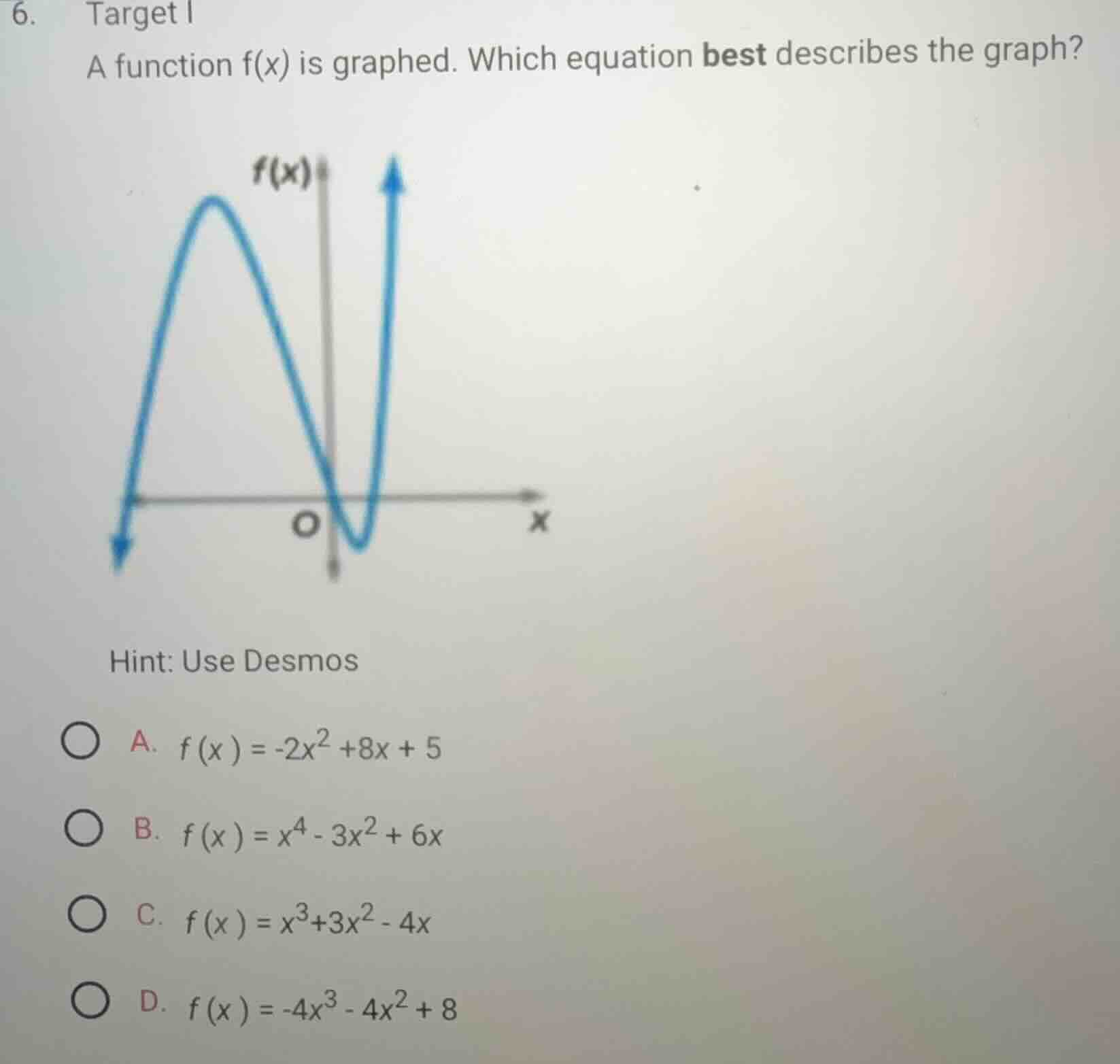
a function f(x) is graphed. which equation best describes the graph?
hint: use desmos
a. $f(x) = -2x^2 + 8x + 5$
b. $f(x) = x^4 - 3x^2 + 6x$
c. $f(x) = x^3 + 3x^2 - 4x$
d. $f(x) = -4x^3 - 4x^2 + 8$
Step1: Analyze the degree and end - behavior
The graph of the function has a left - end behavior (as \(x
ightarrow-\infty\)) of going down (since the left end of the curve is pointing down) and a right - end behavior (as \(x
ightarrow+\infty\)) of going up.
- For a quadratic function (degree 2) like option A: \(f(x)=- 2x^{2}+8x + 5\), the general form of a quadratic function is \(y = ax^{2}+bx + c\). The end - behavior of a quadratic function (\(a
eq0\)) is determined by the coefficient of \(x^{2}\). If \(a\lt0\), as \(x
ightarrow\pm\infty\), \(y
ightarrow-\infty\). So the end - behavior of option A does not match the given graph.
- For a quartic function (degree 4) like option B: \(f(x)=x^{4}-3x^{2}+6x\), the leading term is \(x^{4}\) with a positive coefficient. For a quartic function \(y = ax^{4}+bx^{3}+cx^{2}+dx + e\) (\(a
eq0\)), when \(a>0\), as \(x
ightarrow\pm\infty\), \(y
ightarrow+\infty\). So the end - behavior of option B (both ends go up) does not match the given graph.
- For a cubic function (degree 3) like option C: \(f(x)=x^{3}+3x^{2}-4x\), the leading term is \(x^{3}\) with a positive coefficient. For a cubic function \(y=ax^{3}+bx^{2}+cx + d\) (\(a
eq0\)), when \(a > 0\), as \(x
ightarrow+\infty\), \(y
ightarrow+\infty\) and as \(x
ightarrow-\infty\), \(y
ightarrow-\infty\). This matches the end - behavior of the given graph (left end down, right end up).
- For a cubic function (degree 3) like option D: \(f(x)=-4x^{3}-4x^{2}+8\), the leading term is \(-4x^{3}\) with a negative coefficient. For a cubic function with \(a<0\), as \(x
ightarrow+\infty\), \(y
ightarrow-\infty\) and as \(x
ightarrow-\infty\), \(y
ightarrow+\infty\). This end - behavior (left end up, right end down) does not match the given graph.
Step2: Confirm with the shape
We can also factor option C: \(f(x)=x^{3}+3x^{2}-4x=x(x^{2}+3x - 4)=x(x + 4)(x - 1)\). The roots of the function are \(x = 0\), \(x=-4\), and \(x = 1\). The graph of a cubic function with a positive leading coefficient will have a shape that crosses the x - axis at its roots and has the end - behavior we analyzed. The given graph has a similar shape to a cubic function with a positive leading coefficient, crossing the x - axis at multiple points and having the correct end - behavior.

Snap & solve any problem in the app
Get step-by-step solutions on Sovi AI
Photo-based solutions with guided steps
Explore more problems and detailed explanations
C. \(f(x)=x^{3}+3x^{2}-4x\)