QUESTION IMAGE
Question
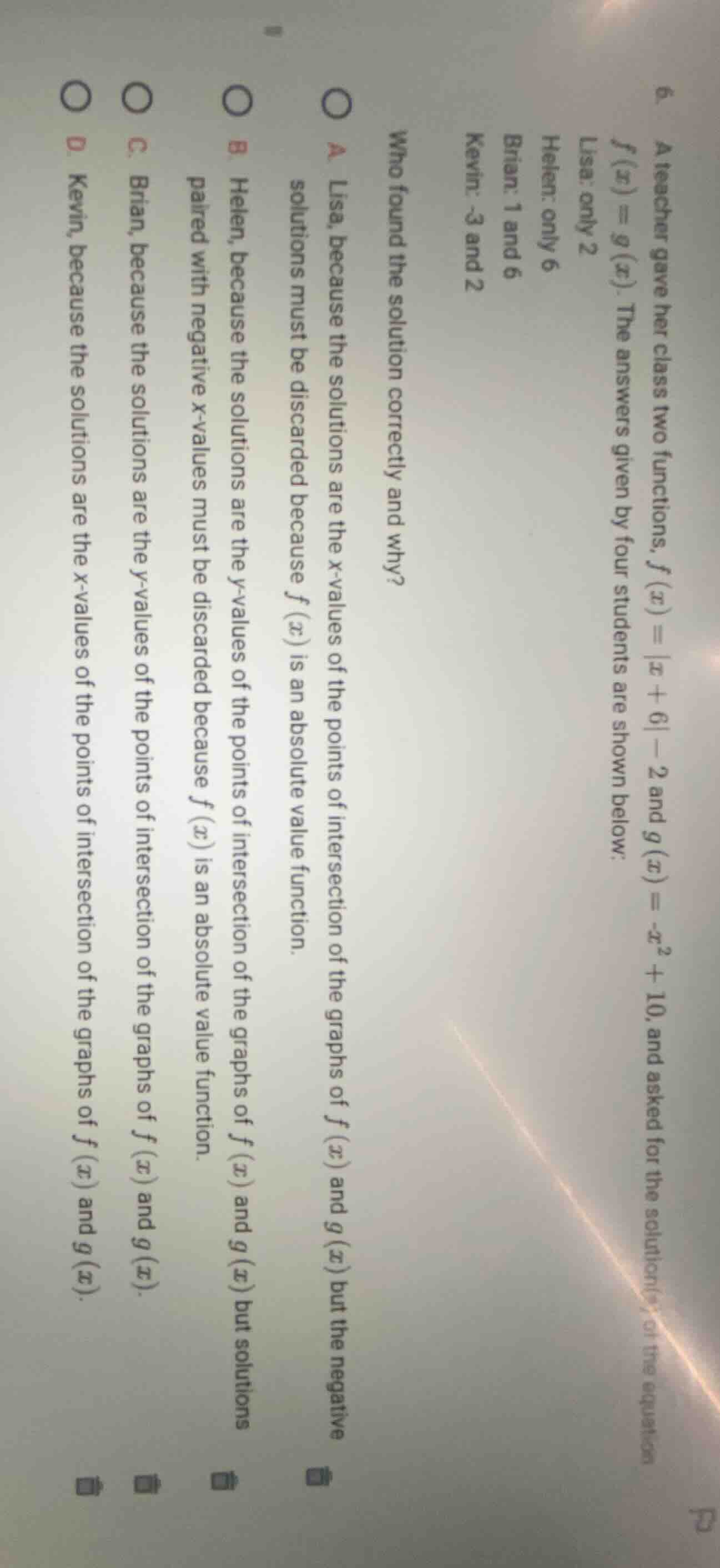
- a teacher gave her class two functions, $f(x)=|x + 6|-2$ and $g(x)=-x^2 + 10$, and asked for the solution(s) of the equation $f(x)=g(x)$. the answers given by four students are shown below:
lisa: only 2
helen: only 6
brian: 1 and 6
kevin: -3 and 2
who found the solution correctly and why?
a lisa, because the solutions are the x-values of the points of intersection of the graphs of $f(x)$ and $g(x)$ but the negative solutions must be discarded because $f(x)$ is an absolute value function.
b helen, because the solutions are the y-values of the points of intersection of the graphs of $f(x)$ and $g(x)$ but solutions paired with negative x-values must be discarded because $f(x)$ is an absolute value function.
c brian, because the solutions are the y-values of the points of intersection of the graphs of $f(x)$ and $g(x)$.
d kevin, because the solutions are the x-values of the points of intersection of the graphs of $f(x)$ and $g(x)$.
Step 1: Set up the equation
To find the solutions of \( f(x) = g(x) \), we set \( |x + 6| - 2 = -x^2 + 10 \). Rearranging gives \( |x + 6| = -x^2 + 12 \).
Step 2: Solve the absolute - value equation
Case 1: When \( x+6\geq0 \) (i.e., \( x\geq - 6 \)), the equation becomes \( x + 6=-x^2 + 12 \), or \( x^2+x - 6 = 0 \). Factoring, we get \( (x + 3)(x - 2)=0 \). So \( x=-3 \) or \( x = 2 \). Both \( x=-3\) and \( x = 2 \) satisfy \( x\geq - 6 \).
Case 2: When \( x + 6<0 \) (i.e., \( x<-6 \)), the equation becomes \( -(x + 6)=-x^2 + 12 \), or \( -x - 6=-x^2 + 12 \), or \( x^2-x - 18 = 0 \). Using the quadratic formula \( x=\frac{1\pm\sqrt{1+72}}{2}=\frac{1\pm\sqrt{73}}{2} \). \( \frac{1+\sqrt{73}}{2}\approx\frac{1 + 8.544}{2}\approx4.772 \) (does not satisfy \( x < - 6 \)), \( \frac{1-\sqrt{73}}{2}\approx\frac{1-8.544}{2}\approx - 3.772 \) (does not satisfy \( x < - 6 \)).
The solutions of \( f(x)=g(x) \) are the \( x \) - values of the points of intersection of the graphs of \( f(x) \) and \( g(x) \). The solutions are \( x=-3 \) and \( x = 2 \), which is what Kevin found.
Step 3: Analyze each student's answer
- Lisa: Lisa's answer of only 2 is wrong because \( x=-3 \) is also a solution.
- Helen: Helen's answer of only 6 is wrong as 6 is not a solution.
- Brian: Brian's answer of 1 and 6 is wrong. The solutions are \( x=-3 \) and \( x = 2 \), not 1 and 6. Brian also has a wrong reasoning as the solutions are \( x \) - values, not \( y \) - values.
- Kevin: Kevin's answer of - 3 and 2 is correct. The solutions of \( f(x)=g(x) \) are the \( x \) - values of the points of intersection of the graphs of \( f(x) \) and \( g(x) \).

Snap & solve any problem in the app
Get step-by-step solutions on Sovi AI
Photo-based solutions with guided steps
Explore more problems and detailed explanations
D. Kevin, because the solutions are the x - values of the points of intersection of the graphs of \( f(x) \) and \( g(x) \)