QUESTION IMAGE
Question
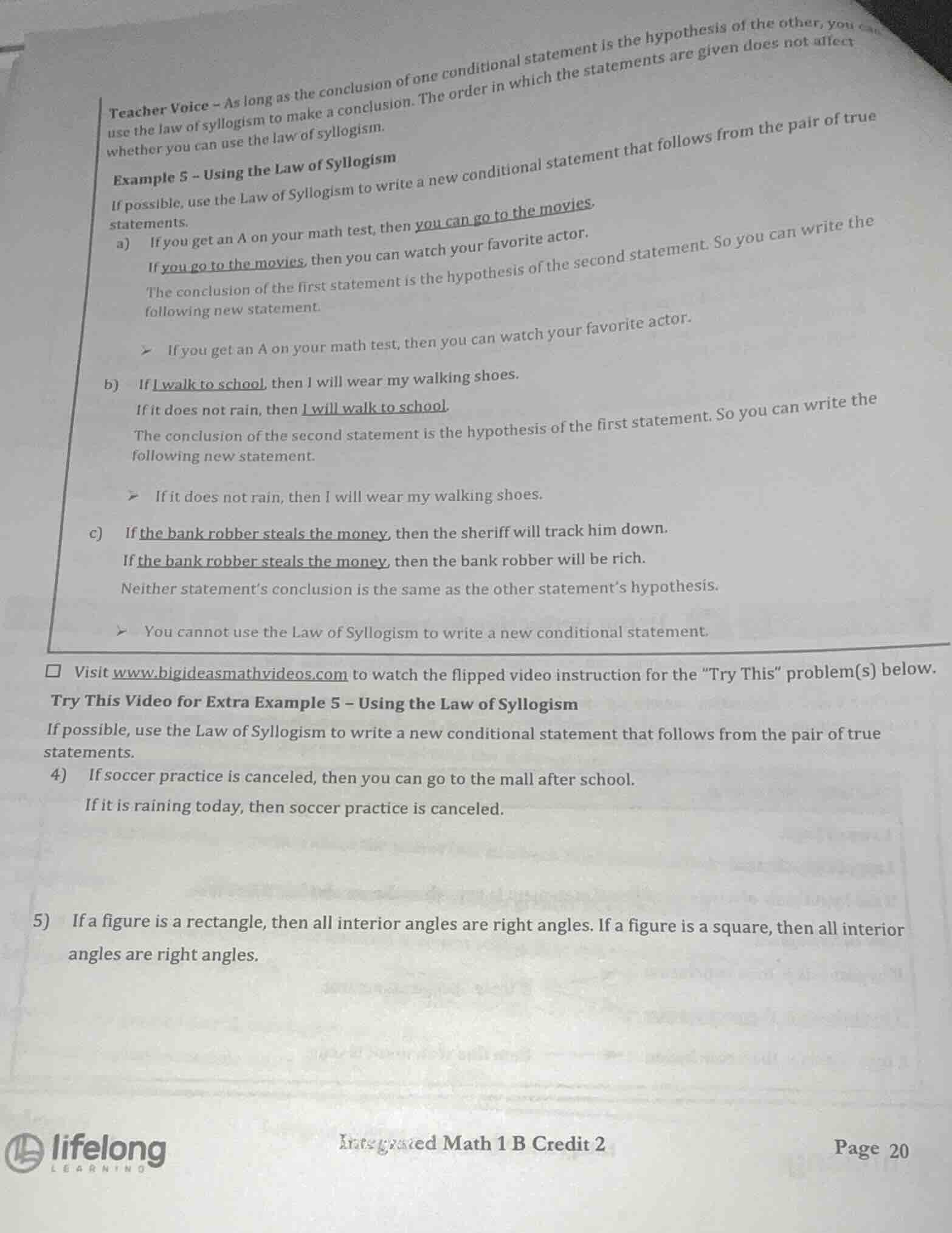
teacher voice - as long as the conclusion of one conditional statement is the hypothesis of the other, you can use the law of syllogism to make a conclusion. the order in which the statements are given does not affect whether you can use the law of syllogism. example 5 - using the law of syllogism if possible, use the law of syllogism to write a new conditional statement that follows from the pair of true statements. a) if you get an a on your math test, then you can go to the movies. if you go to the movies, then you can watch your favorite actor. the conclusion of the first statement is the hypothesis of the second statement. so you can write the following new statement. if you get an a on your math test, then you can watch your favorite actor. b) if i walk to school, then i will wear my walking shoes. if it does not rain, then i will walk to school. the conclusion of the second statement is the hypothesis of the first statement. so you can write the following new statement. if it does not rain, then i will wear my walking shoes. c) if the bank robber steals the money, then the sheriff will track him down. if the bank robber steals the money, then the bank robber will be rich. neither statement’s conclusion is the same as the other statement’s hypothesis. you cannot use the law of syllogism to write a new conditional statement. visit www.bigideasmathvideos.com to watch the flipped video instruction for the \try this\ problem(s) below. try this video for extra example 5 - using the law of syllogism if possible, use the law of syllogism to write a new conditional statement that follows from the pair of true statements. 4) if soccer practice is canceled, then you can go to the mall after school. if it is raining today, then soccer practice is canceled. 5) if a figure is a rectangle, then all interior angles are right angles. if a figure is a square, then all interior angles are right angles.
Step1: Analyze problem 4 statements
Let Statement 1: If it is raining today, then soccer practice is canceled. (Conclusion: soccer practice is canceled)
Statement 2: If soccer practice is canceled, then you can go to the mall after school. (Hypothesis: soccer practice is canceled)
The conclusion of Statement 1 matches the hypothesis of Statement 2, so we can apply the Law of Syllogism.
Step2: Form new statement for problem 4
Combine the hypothesis of Statement 1 and conclusion of Statement 2:
If it is raining today, then you can go to the mall after school.
Step3: Analyze problem 5 statements
Let Statement 1: If a figure is a rectangle, then all interior angles are right angles. (Conclusion: all interior angles are right angles)
Statement 2: If a figure is a square, then all interior angles are right angles. (Hypothesis: a figure is a square)
Neither statement's conclusion matches the other's hypothesis, so Law of Syllogism does not apply.

Snap & solve any problem in the app
Get step-by-step solutions on Sovi AI
Photo-based solutions with guided steps
Explore more problems and detailed explanations
- If it is raining today, then you can go to the mall after school.
- You cannot use the Law of Syllogism to write a new conditional statement.