QUESTION IMAGE
Question
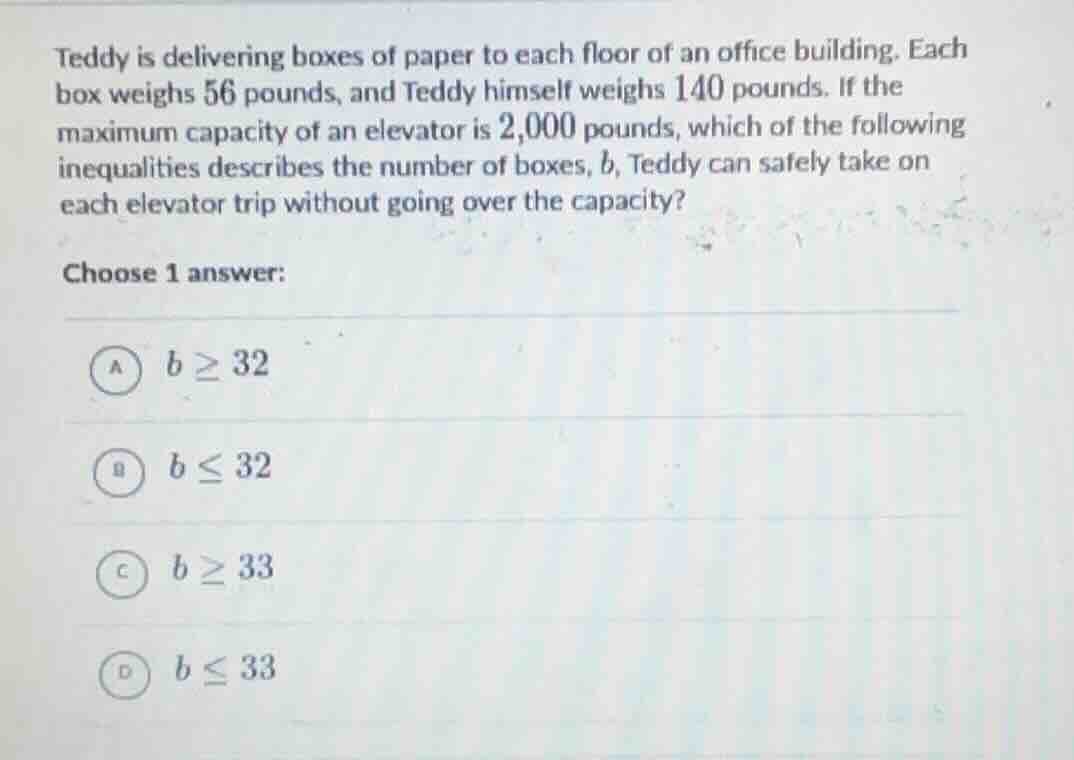
teddy is delivering boxes of paper to each floor of an office building. each box weighs 56 pounds, and teddy himself weighs 140 pounds. if the maximum capacity of an elevator is 2,000 pounds, which of the following inequalities describes the number of boxes, $b$, teddy can safely take on each elevator trip without going over the capacity?
choose 1 answer:
a $b \geq 32$
b $b \leq 32$
c $b \geq 33$
d $b \leq 33$
Step1: Set up total weight inequality
The total weight is Teddy's weight plus the weight of $b$ boxes, which must be ≤ 2000 pounds.
$140 + 56b \leq 2000$
Step2: Isolate the term with $b$
Subtract 140 from both sides.
$56b \leq 2000 - 140$
$56b \leq 1860$
Step3: Solve for $b$
Divide both sides by 56.
$b \leq \frac{1860}{56}$
$b \leq 33.214...$
Since $b$ must be an integer (whole boxes), the maximum number of boxes is 32 (as 33 boxes would exceed capacity: $140 + 56*33 = 140 + 1848 = 1988$? Wait correction: $56*33=1848$, $1848+140=1988 ≤2000$. Wait recalculate $\frac{1860}{56}=33.214$, so $b≤33.214$, so integer $b≤33$. Wait no: $56*33=1848$, $1848+140=1988 ≤2000$. $56*34=1904$, $1904+140=2044>2000$. So $b≤33$ is allowed? Wait no, original calculation: 2000-140=1860. 1860/56=33.214, so $b≤33.214$, so whole number boxes $b≤33$. Wait but let's check: 33 boxes: 5633=1848, 1848+140=1988 ≤2000. 34 boxes: 5634=1904, 1904+140=2044>2000. So correct inequality is $b≤33$? Wait no, wait 1860 divided by 56: 56*33=1848, 1860-1848=12, so yes 33.214. So $b≤33$ is correct.
Wait my mistake earlier, 33 boxes are under capacity. So step 3: $b ≤ 33.214$, so since $b$ is integer, $b ≤33$.

Snap & solve any problem in the app
Get step-by-step solutions on Sovi AI
Photo-based solutions with guided steps
Explore more problems and detailed explanations
D. $b \leq 33$