QUESTION IMAGE
Question
television/internet video news broadcasts: pay attention to who uploaded the video (was it an individual, organization, or news source) and does the source provide the origin, date, and key information (who, what, when, where, why, and how).
accuracy: who is the author or creator of the source? can the accuracy of the information being presented be verified using another source? can you verify the author’s credentials (i.e., learn more about who they are, who they write for, their background)?
objectivity: is the source used for public service or educational use or is it really an advertisement for products related to the topic? are there links provided where you can locate additional information.
read through the research guide: assessing sources document and note the additional information provided for each characteristic. once you have read this document, review the checklist: evaluating sources document which provides areas to check to determine whether a source is credible or non-credible.
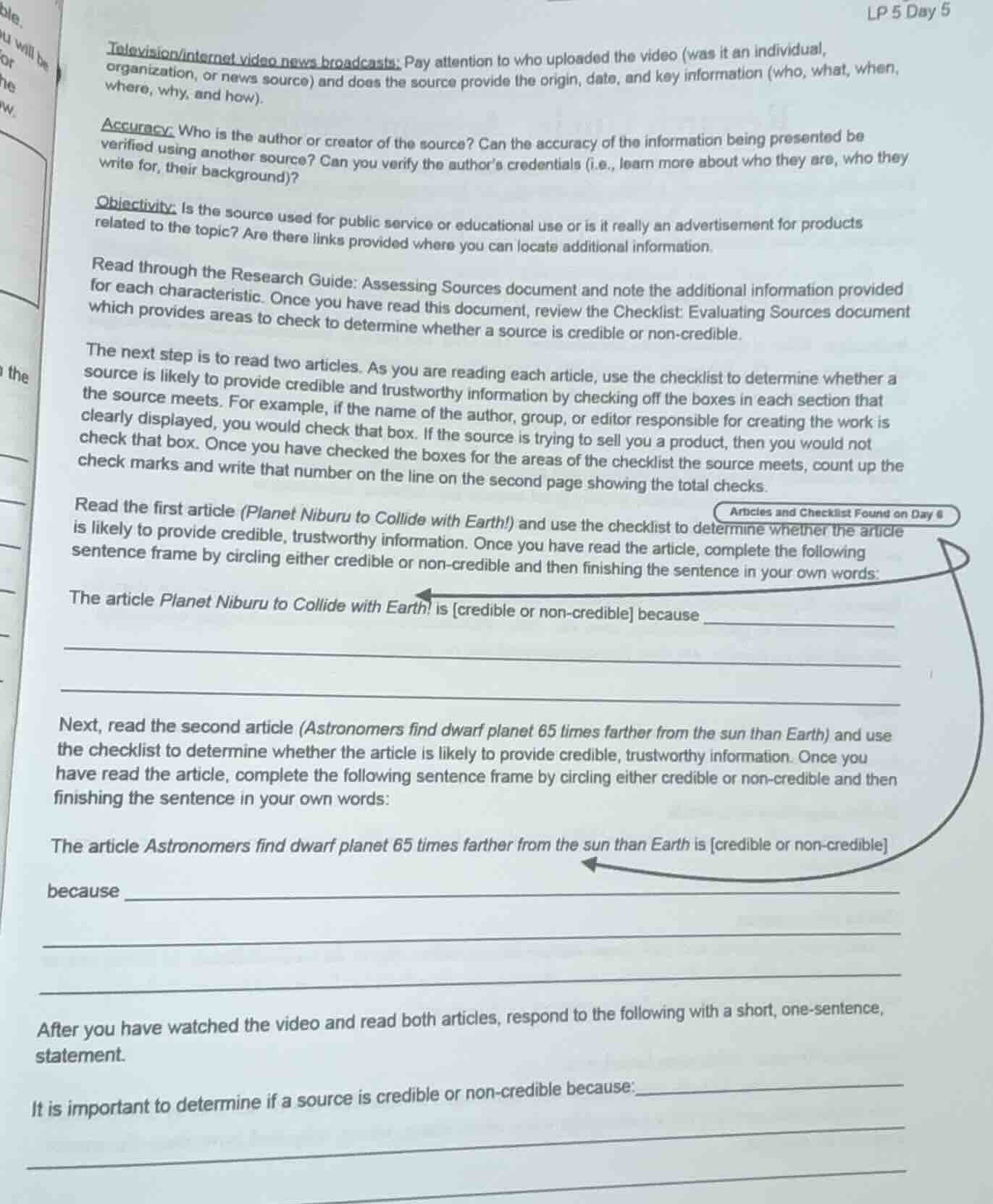
the next step is to read two articles. as you are reading each article, use the checklist to determine whether a source is likely to provide credible and trustworthy information by checking off the boxes in each section that the source meets. for example, if the name of the author, group, or editor responsible for creating the work is clearly displayed, you would check that box. if the source is trying to sell you a product, then you would not check that box. once you have checked the boxes for the areas of the checklist the source meets, count up the check marks and write that number on the line on the second page showing the total checks.
read the first article (planet niburu to collide with earth!) and use the checklist to determine whether the article is likely to provide credible, trustworthy information. once you have read the article, complete the following sentence frame by circling either credible or non-credible and then finishing the sentence in your own words:
the article planet niburu to collide with earth! is credible or non-credible because
next, read the second article (astronomers find dwarf planet 65 times farther from the sun than earth) and use the checklist to determine whether the article is likely to provide credible, trustworthy information. once you have read the article, complete the following sentence frame by circling either credible or non-credible and then finishing the sentence in your own words:
the article astronomers find dwarf planet 65 times farther from the sun than earth is credible or non-credible because
after you have watched the video and read both articles, respond to the following with a short, one-sentence, statement.
it is important to determine if a source is credible or non-credible because:
To answer these questions, we analyze each article and the importance of source credibility:
1. Article: Planet Niburu to Collide with Earth
Claims about "Planet Niburu colliding with Earth" are unproven by scientific consensus. Such articles often lack verifiable authors, credible origins, or peer - reviewed support, and promote misinformation (e.g., Niburu is a pseudoscientific concept).
Astronomical discoveries (like finding a dwarf planet) are typically reported by credible sources (e.g., news outlets covering science, or scientific journals). These articles cite astronomers (experts), use verifiable data (e.g., distance measurements), and align with scientific research methods.
Credible sources ensure accurate information for learning, decision - making, and avoiding misinformation (e.g., in research, news, or education). Non - credible sources spread falsehoods that can mislead, harm, or undermine trust in information.

Snap & solve any problem in the app
Get step-by-step solutions on Sovi AI
Photo-based solutions with guided steps
Explore more problems and detailed explanations
The article Planet Niburu to Collide with Earth is non - credible because it promotes a pseudoscientific claim (Niburu - Earth collision) with no valid scientific evidence, unclear author credentials, and cannot be verified by legitimate scientific sources.