QUESTION IMAGE
Question
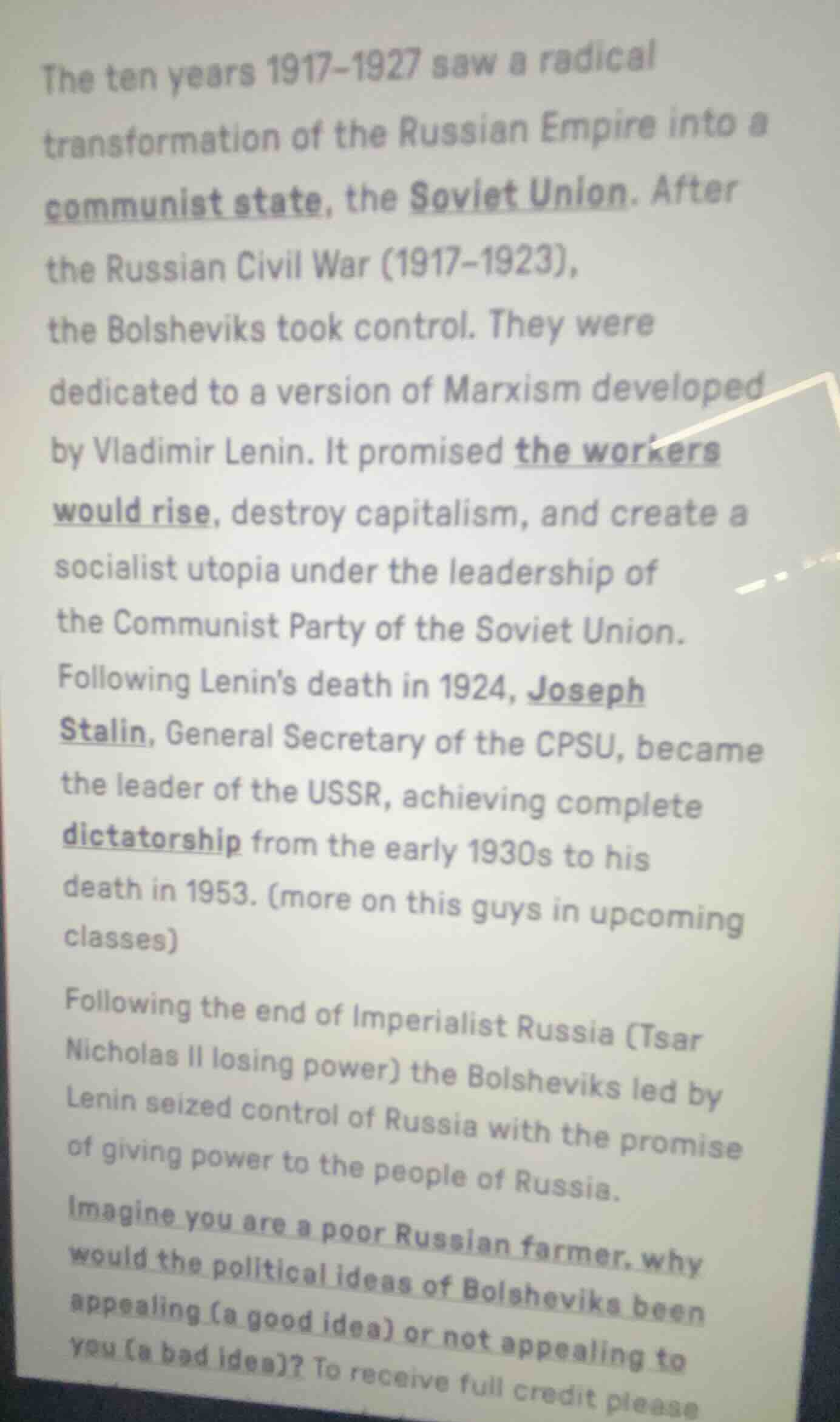
the ten years 1917-1927 saw a radical transformation of the russian empire into a communist state, the soviet union. after the russian civil war (1917-1923), the bolsheviks took control. they were dedicated to a version of marxism developed by vladimir lenin. it promised the workers would rise, destroy capitalism, and create a socialist utopia under the leadership of the communist party of the soviet union. following lenins death in 1924, joseph stalin, general secretary of the cpsu, became the leader of the ussr, achieving complete dictatorship from the early 1930s to his death in 1953. (more on this guys in upcoming classes) following the end of imperialist russia (tsar nicholas ii losing power) the bolsheviks led by lenin seized control of russia with the promise of giving power to the people of russia. imagine you are a poor russian farmer, why would the political ideas of bolsheviks been appealing (a good idea) or not appealing to you (a bad idea)? to receive full credit please
As a poor Russian farmer, the Bolsheviks' ideas would be highly appealing for key reasons:
- The Bolsheviks promised land redistribution, which would give landless or struggling farmers access to the farmland they needed to sustain themselves, a critical change from the Tsarist system where land was concentrated in the hands of wealthy nobles.
- Their Marxist framework focused on empowering the working and peasant classes, framing them as the core of the new society, which would make a poor farmer feel their needs and labor were valued.
- They opposed the capitalist and aristocratic systems that had kept farmers in cycles of poverty and exploitation under the Russian Empire.

Snap & solve any problem in the app
Get step-by-step solutions on Sovi AI
Photo-based solutions with guided steps
Explore more problems and detailed explanations
As a poor Russian farmer, the Bolsheviks' political ideas would be strongly appealing:
- They promised land redistribution, granting access to land (a vital resource I lacked under Tsarist rule, where land was held by wealthy nobles).
- Their ideology centered on empowering working/peasant classes, positioning people like me as the foundation of the new society, rather than being exploited by the elite.
- They aimed to dismantle the capitalist and aristocratic systems that kept me in cycles of poverty and powerlessness.