QUESTION IMAGE
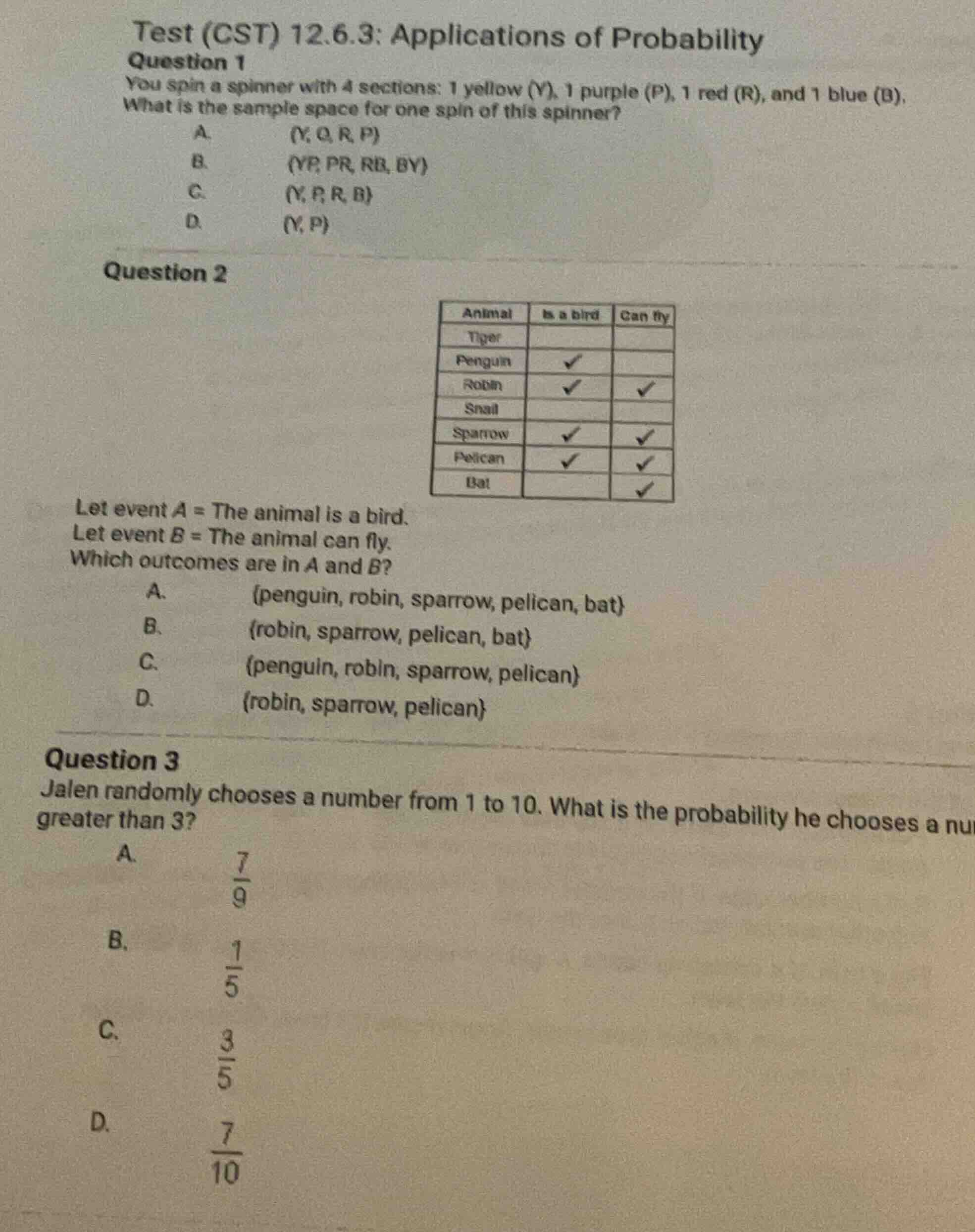
Question
test (cst) 12.6.3: applications of probability
question 1
you spin a spinner with 4 sections: 1 yellow (y), 1 purple (p), 1 red (r), and 1 blue (b).
what is the sample space for one spin of this spinner?
a. {y, q, r, p}
b. {yp, pr, rb, by}
c. {y, p, r, b}
d. {y, p}
question 2
| animal | is a bird | can fly |
|---|---|---|
| penguin | ✓ | |
| robin | ✓ | ✓ |
| snail | ||
| sparrow | ✓ | ✓ |
| pelican | ✓ | ✓ |
| bat | ✓ |
let event a = the animal is a bird.
let event b = the animal can fly.
which outcomes are in a and b?
a. {penguin, robin, sparrow, pelican, bat}
b. {robin, sparrow, pelican, bat}
c. {penguin, robin, sparrow, pelican}
d. {robin, sparrow, pelican}
question 3
jalen randomly chooses a number from 1 to 10. what is the probability he chooses a number greater than 3?
a. $\frac{7}{9}$
b. $\frac{1}{5}$
c. $\frac{3}{5}$
d. $\frac{7}{10}$
Question 1
Step1: Define sample space
The sample space is all single possible outcomes of one spin, which are the 4 sections: yellow (Y), purple (P), red (R), blue (B).
Step2: Match to options
The set of these outcomes is $\{Y, P, R, B\}$.
Question 2
Step1: Identify event A ∩ B
Event A (bird) and B (can fly) means animals that are both birds and can fly.
Step2: Check table entries
From the table: Penguin is a bird but can't fly; Robin, Sparrow, Pelican are birds that can fly; Bat can fly but isn't a bird. So the outcomes are {robin, sparrow, pelican}.
Question 3
Step1: Count total outcomes
Total numbers from 1 to 10: $n(\text{total}) = 10$
Step2: Count favorable outcomes
Numbers greater than 3: 4,5,6,7,8,9,10. $n(\text{favorable}) = 7$
Step3: Calculate probability
Probability = $\frac{\text{Number of favorable outcomes}}{\text{Total number of outcomes}}$ = $\frac{7}{10}$

Snap & solve any problem in the app
Get step-by-step solutions on Sovi AI
Photo-based solutions with guided steps
Explore more problems and detailed explanations
- C. {Y, P, R, B}
- D. {robin, sparrow, pelican}
- D. $\frac{7}{10}$